


Change Management Models Adkar And Kotters 8 Step Organizational Change Management




Try Before you Buy Download Free Sample Product
 Impress Your
 Audience
 100%
100% Editable
 Save Hours
 of Time


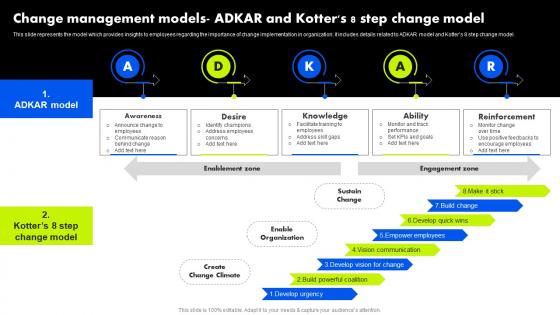
This slide represents the model which provides insights to employees regarding the importance of change implementation in organization. It includes details related to ADKAR model and Kotters 8 step change model.
People who downloaded this PowerPoint presentation also viewed the following :
Change Management Models Adkar And Kotters 8 Step Organizational Change Management with all 6 slides:
Use our Change Management Models Adkar And Kotters 8 Step Organizational Change Management to effectively help you save your valuable time. They are readymade to fit into any presentation structure.





FAQs for Change Management Models Adkar And Kotters 8 Step
**INPUT**: What are the key stages of an effective change management process? **OUTPUT**: Effective change management processes include preparation and planning, stakeholder engagement, implementation with communication, monitoring progress, and reinforcement of new behaviors. These stages work together by building organizational readiness, minimizing resistance, and ensuring sustainable adoption, with many companies finding that structured approaches deliver faster transitions, reduced costs, and ultimately stronger competitive positioning in increasingly dynamic business environments. **Word count: 58 words**
Organizations identify structural change needs through performance gap analysis, employee feedback surveys, competitive benchmarking, customer satisfaction metrics, and financial indicator reviews. These assessment methods reveal inefficiencies, communication breakdowns, and market misalignments, with many companies finding that regular organizational health audits enable proactive restructuring, ultimately delivering improved operational efficiency and competitive positioning.
Leadership serves as the primary catalyst for successful change management by setting clear vision, securing stakeholder buy-in, allocating necessary resources, and maintaining consistent communication throughout transformation processes. Effective leaders in organizations like healthcare systems and financial institutions create psychological safety, model adaptive behaviors, and address resistance proactively, ultimately delivering higher employee engagement and sustainable organizational transformation.
Communication strategies enhance change management by establishing transparent channels, providing regular updates, addressing employee concerns, and creating feedback loops for two-way dialogue. These approaches streamline transitions by building trust, reducing resistance, and ensuring alignment across all organizational levels, with many companies finding that consistent, clear messaging ultimately delivers faster adoption rates and stronger employee buy-in during transformational initiatives.
Common resistance factors include fear of job security, comfort with existing processes, lack of understanding about change benefits, inadequate training resources, and poor communication from leadership. These concerns can be addressed by providing transparent communication about change rationale, comprehensive training programs, involving employees in planning processes, and demonstrating quick wins, with many organizations finding that early employee engagement significantly reduces resistance while accelerating successful implementation.
Organizational culture significantly influences change management success by shaping employee attitudes, resistance levels, and adoption patterns throughout transformation initiatives. Organizations with collaborative cultures typically experience smoother transitions, while rigid hierarchies may face greater resistance, ultimately requiring tailored communication strategies, leadership alignment, and cultural adaptation to deliver sustainable change outcomes.
Effective change management tools include Kotter's 8-Step Process, ADKAR framework, Lean Change Management, Prosci methodology, and stakeholder mapping platforms. These frameworks streamline organizational transitions by enhancing communication, measuring adoption rates, and addressing resistance systematically, with many companies finding that structured approaches deliver faster implementation timelines and higher employee engagement rates.
Employee feedback can be integrated through regular surveys, focus groups, town halls, suggestion boxes, and one-on-one meetings throughout each change phase. These mechanisms enable organizations to identify resistance early, adjust implementation strategies, and maintain employee engagement, with many companies finding that continuous feedback loops reduce change fatigue while accelerating adoption timelines.
Key metrics for evaluating change initiatives include adoption rates, employee engagement scores, productivity measures, customer satisfaction indices, and financial performance indicators like ROI and cost savings. These metrics enable organizations to track progress across multiple dimensions, with many companies finding that combining leading indicators like training completion rates with lagging indicators such as revenue impact provides comprehensive visibility into transformation success and competitive advantage.
Change management strategies vary significantly across industries based on regulatory requirements, organizational culture, stakeholder complexity, and operational constraints. Healthcare organizations prioritize patient safety and compliance protocols, while technology companies emphasize agility and rapid iteration, and manufacturing focuses on operational continuity and workforce adaptation, with many organizations finding that industry-specific approaches deliver faster adoption and measurable business outcomes.
Technology significantly enhances change management practices by automating communication workflows, providing real-time analytics on adoption rates, and enabling virtual training platforms for distributed teams. Through digital dashboards and AI-powered feedback systems, organizations streamline stakeholder engagement, accelerate decision-making processes, and deliver more personalized change experiences, ultimately reducing implementation timelines while improving employee buy-in across diverse organizational structures.
Change management training improves employee adaptability by developing resilience skills, teaching flexible problem-solving approaches, and providing frameworks for navigating uncertainty effectively. Through structured learning programs, employees build confidence in handling transitions, enhance their communication during organizational shifts, and develop strategic thinking capabilities, ultimately delivering faster implementation of changes and stronger competitive positioning in increasingly dynamic business environments.
Stakeholder engagement serves as the foundation for successful change management by building buy-in, identifying potential resistance, gathering valuable insights, and ensuring clear communication throughout the transformation process. Through strategic stakeholder involvement, organizations streamline implementation timelines, minimize disruption, and enhance adoption rates, with many companies finding that early engagement ultimately delivers smoother transitions and sustainable organizational change.
Organizations sustain change by embedding new processes into daily operations, maintaining continuous communication, and providing ongoing training and support systems. Through regular monitoring, feedback loops, and recognition programs, companies reinforce behavioral shifts while addressing resistance, with many finding that leadership commitment and employee engagement ultimately deliver long-term transformation success.
Common change management pitfalls include inadequate communication, insufficient leadership support, resistance from employees, poor planning timelines, and lack of training resources. These challenges can be avoided by establishing clear communication channels, securing executive buy-in early, involving stakeholders in planning processes, and implementing comprehensive training programs, with many organizations finding that proactive engagement ultimately delivers smoother transitions and higher adoption rates.
-
Unique design & color.
-
The quality of the templates is as fine as it could get. It was a purchase well made!