

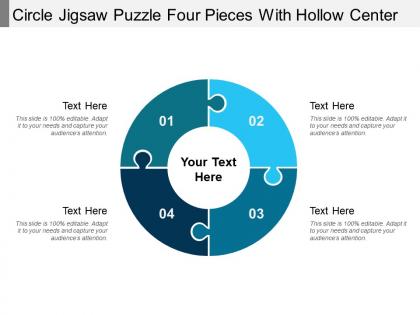
Circle jigsaw puzzle four pieces with hollow center




Try Before you Buy Download Free Sample Product
 Impress Your
 Audience
 100%
100% Editable
 Save Hours
 of Time


Appear gracious with our Circle Jigsaw Puzzle Four Pieces With Hollow Center. They help extend every courtesy.
People who downloaded this PowerPoint presentation also viewed the following :
Circle jigsaw puzzle four pieces with hollow center with all 5 slides:
Capture the imagination of your clients with our Circle Jigsaw Puzzle Four Pieces With Hollow Center. Include all the incentives they could expect.

FAQs for Circle jigsaw puzzle four pieces
Honestly, circle puzzles are so much harder than regular ones - no corners or edges to help you out! You're stuck figuring everything out by colors and patterns alone. The cool thing though is you can spin the whole puzzle around while working, which actually helps a lot. Way better angles that way. If you're doing it with friends, everyone can reach pieces easier too. They do look pretty sick on the wall when you're done, not gonna lie. I'd definitely start with 500 pieces first - trust me on this one. The 1000+ piece circles will destroy you otherwise!
Oh, circle puzzles are actually really good for kids! My nephew loves them. They're trickier than regular ones because there's no corners to start with, so kids have to get creative with how they approach it. Really builds up their problem-solving skills and hand-eye coordination too. Plus the curved pieces make them work those fine motor skills more. Honestly, watching kids figure out the pattern recognition is pretty cool. I'd start with like 24-48 pieces for little ones - any more and they'll get frustrated. You can always bump up the difficulty once they've got the hang of it.
Oh my god, try circle jigsaw puzzles! They're weirdly perfect for zoning out in the best way. You know how your brain just won't shut up sometimes? Well, when you're hunting for that one piece that fits, everything else kinda fades away. It's super repetitive but in a good way - almost like meditation without having to sit still and breathe funny. The circle shape hits different too, way more chill than regular square ones. I honestly don't know why but there's something about the curves that just works. Do like 20-30 minutes after work and you'll actually feel human again.
Honestly, it's all about working with the circle instead of against it. Mandala patterns are perfect - they radiate out naturally from the center. Celestial stuff and botanical designs flow really well too. Don't even bother with square artwork forced into a circle, it just looks weird and choppy. Symmetrical elements help your eye move around smoothly. Color gradients are amazing for this. The trick is finding images where cropping them into a circle actually makes the composition better, not worse. Like, you want the round format to enhance what you're looking at rather than just randomly chopping off edges.
Ugh yeah, circle puzzles are such a pain! Your brain expects corners and straight edges, but instead you're stuck hunting for these subtle curves that all look the same. No border pieces to start with either, which is honestly the worst part. I got completely stuck on one last month for like three weeks - so frustrating. What helped me was ignoring the edges completely and just focusing on distinctive colors or patterns instead. The pieces are all curved so they're super deceptive. Way harder than regular puzzles but weirdly satisfying once you get going.
Kids go crazy for cartoon characters and bright animals - anything colorful they can recognize. Nature scenes are huge with adults, especially flowers and landscapes. Oh, and mandalas! Seriously, everyone's obsessed with those intricate geometric ones right now. Seniors usually stick to classic stuff - vintage art, birds, seasonal themes with good contrast that won't strain their eyes. You definitely want to match complexity to skill level though. Beginners need simpler designs, while puzzle pros want something that'll actually challenge them. Just figure out who you're targeting first.
Oh they're actually perfect for so many classes! Geometry is obvious - kids can measure circumference and work with sectors using the actual pieces. History timelines work great as "time wheels" too. Science teachers love them for life cycles and planetary stuff. The curved pieces are weirdly satisfying to put together, honestly. For English, try story wheels where each piece is a plot element. Start small with 12-piece ones for younger kids. Definitely test it yourself first though - I learned that the hard way when half my class got stuck on the same tricky section!
Most circle puzzles are just cardboard with a picture glued on - totally fine for casual puzzling. Wood ones cost more but they're way sturdier if you plan on doing it multiple times or want to frame it. The fancy wooden pieces are usually laser-cut which makes them super precise. You'll also see some thick chipboard versions that feel nicer than regular cardboard but aren't as expensive as wood. Honestly? Unless you're really into puzzles, cardboard works great. Just check the piece thickness when you're shopping - thicker pieces are easier to handle and won't bend as much.
-
Easily Understandable slides.
-
Good research work and creative work done on every template.