

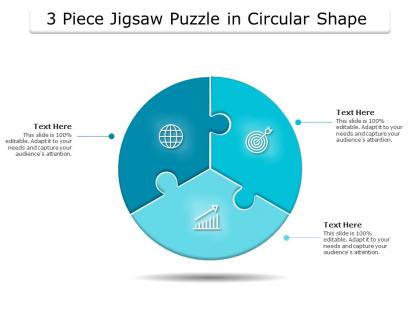
3 piece jigsaw puzzle in circular shape




Try Before you Buy Download Free Sample Product
 Impress Your
 Audience
 100%
100% Editable
 Save Hours
 of Time


Your team are really eager to hear you. Give them their due with our 3 Piece Jigsaw Puzzle In Circular Shape.
People who downloaded this PowerPoint presentation also viewed the following :
3 piece jigsaw puzzle in circular shape with all 2 slides:
Our 3 Piece Jigsaw Puzzle In Circular Shape are eager to please. They will help satisfy your strong desire for achievement.
FAQs for 3 piece jigsaw puzzle
Honestly, circular jigsaw puzzles are perfect for this stuff. Your audience can jump in anywhere - no weird hierarchy vibes like those flowchart things. Way more visually interesting too, let's be real. The shape itself screams "everything's connected" which is exactly what you want. Works amazing for cycles or processes where each piece matters equally. I used one last month and people actually stayed engaged instead of zoning out. You'll avoid that whole "follow steps 1-2-3" trap that makes presentations feel like instruction manuals. Definitely try it next time you're explaining interconnected systems.
Oh man, circular puzzles are perfect for this! They get people actually moving around the table and working together. I'd go with like 100-200 pieces - keeps it challenging but doable in 15-20 minutes. The curved pieces are weirdly addictive too, way better than regular puzzles. You can use them as icebreakers or turn it into a competition between teams. Honestly, there's something about the circular shape that just makes people naturally collaborate more. If you're feeling fancy, get one customized with your logo or theme. Works great as a metaphor for problem-solving too.
Oh man, circular puzzles are genius for kids! No corner pieces means they can't cheat with the usual shortcuts. Instead they're stuck figuring out colors and weird shapes - honestly makes my brain hurt sometimes. But that's the point! Kids get way better at sticking with hard stuff and really looking at details. Plus they start thinking about problems differently when there's no "right way" to begin. I'd definitely start small though, like 100 pieces max. Perfect for those moments when everyone's fried and needs a mental reset.
Oh that's actually a cool idea! Split everyone into small teams and have them race to finish identical circular puzzles. The round shape is weirdly perfect for this because there's no corners to start with - forces people to actually talk and strategize together. My old company did something similar at a retreat and it worked surprisingly well. Custom puzzles with your team photos or logo would be pretty neat too. Just don't go too easy or too brutal with the difficulty... nobody wants to sit there for three hours getting mad at puzzle pieces, you know?
You've got a few routes here. Illustrator or Inkscape give you total control over piece shapes, but you'll need some design chops. There's also specialized stuff like Puzzle Cutter or JigCut that basically do the work for you. Honestly? I've seen people hack together decent results using Canva or GIMP with circular templates - not pretty but it works. Just make sure whatever you pick handles vector paths so your cutting lines are crisp. I'd mess around with Inkscape first since it's free, then see if you need anything fancier.
Ugh, circular puzzles are such a pain but also weirdly fun? You can't do the usual trick of finding edges first since everything's curved. I always end up sorting by colors and patterns way more carefully than normal puzzles. The piece shapes are usually more random too. You'll probably find yourself starting with obvious stuff in the image - like faces or text - then working outward. It's backwards from regular puzzles but honestly once you get the hang of it, there's something satisfying about not having those corner pieces to rely on.
Circular puzzles work great for stuff that loops back on itself - like project cycles, seasonal trends, or how different departments feed into each other. The round shape just makes more sense than forcing everything into a straight line, you know? I'd probably sketch it out first though, just to make sure the flow actually works before you go all-in. You could map out customer touchpoints, show budget breakdowns as segments, or even visualize feedback loops. Honestly, anything where the pieces connect back to create the whole picture. It's a solid way to get people thinking differently about your data.
Honestly, kids around 8-12 get the most out of circular puzzles. Without those corner pieces to guide them, their brains really have to work differently - it's wild how much harder spatial reasoning becomes. I've watched high schoolers struggle with them too, which is pretty funny. The 5-14 range works well overall since they're still building those problem-solving skills. Younger kids especially benefit from the challenge. Though if I'm being real, anything under 8 might get too frustrated. Start with that middle elementary sweet spot - challenging enough to help but won't make them want to quit.
Oh dude, circular puzzles are perfect for this! Since there's no edges, nobody can claim the "easy" corner pieces and leave everyone else stuck. Your whole team has to actually talk to each other about colors and patterns instead of just working in silence on their own section. People end up walking around the table, throwing out ideas, and honestly? Everyone's input matters equally for once. I tried this at work last month and even our quietest team member was jumping in with suggestions. Way better than those standard rectangular ones where half the group gives up after ten minutes!
So I've seen a bunch of different approaches work really well. Your company timeline as a spiral looks cool - or maybe showcase products in a circle? Values work great too, like each puzzle piece is one of your core principles. Customer journey mapped out in a circle gets people thinking about the whole experience. Team photos in mandala style are huge for internal stuff. Oh, and if you're manufacturing, product assembly diagrams are perfect. Honestly though, my favorite is turning your office layout into a bird's-eye circular view. It's weirdly engaging and people actually connect with seeing their workspace like that.
Okay so circular puzzles are actually amazing for this! You can start anywhere instead of being stuck with that boring left-to-right thing. Visual people love the color patterns flowing around, and if you're more hands-on, you get to rotate pieces in every direction. No "wrong" starting spot either. The curved edges feel totally different too - way more interesting than regular straight pieces. I swear there's something satisfying about working in a circle instead of rows. Bottom line: multiple ways in always beats one rigid path, whether it's puzzles or whatever you're teaching.
So there's not really solid research on circular puzzles specifically - most studies just look at regular rectangular ones or general spatial stuff. The existing puzzle research does show they help with visual processing and working memory though. Circular format hasn't been tested as its own thing, which is kinda surprising honestly. Makes sense that the radial patterns might hit different brain pathways than just finding straight edges. I'd probably start with the broader puzzle cognition research if you're digging into this for school or whatever, then maybe try a small study testing circular ones yourself.
Circular jigsaw puzzles work great for webinar icebreakers! Screen-share a digital one and let people shout out where pieces go. Or split everyone into breakout rooms to tackle different sections. The round shape is actually perfect for this - nobody's stuck staring at boring edge pieces that get cut off. I've seen people make custom ones with their company logos which is pretty cool, though maybe overkill depending on your crowd. Keep puzzle time short though, like 5-10 minutes tops. You don't want people getting too into it and forgetting what your webinar's actually about.
Get everyone to step back and look at the whole puzzle first. Ask what jumps out at them - patterns, connections, whatever they see. The circular part is usually where the magic happens, though people totally miss it unless you nudge them there. I'd throw out questions like "What's this saying about how we work?" or "Where are things connected?" Let them figure it out before you start explaining stuff. Then tie it back to why you're all there in the first place. Oh, and give them a few minutes to write down something they'll actually do differently afterward.
Honestly, circular jigsaw puzzles are game-changers for presentations. Your audience can actually see how everything connects instead of staring at boring bullet points. The whole thing radiates from the center, so relationships between ideas just make sense visually. I love how you can reveal pieces one by one - keeps everyone watching instead of zoning out on their phones. Works amazing when you're showing how different teams or concepts tie into one main goal. Maybe I'm biased because I'm super visual, but seriously try it next time!
No Reviews