

Circular economy diagram presentation outline




Try Before you Buy Download Free Sample Product
 Impress Your
 Audience
 100%
100% Editable
 Save Hours
 of Time


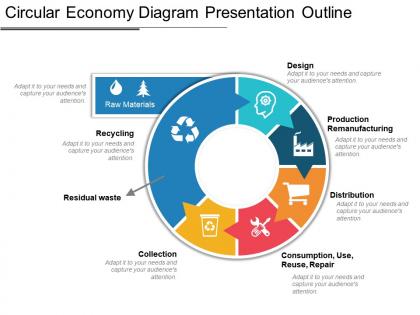
Easily depict how money flows in the economy using this Circular economy diagram presentation outline. Explain the process of exchange of money between your firm and the workers. Tell your audience how all the sectors including health, food, clothing, entertainment etc operate on the flow of money. With circular economy examples PPT diagram make the concept of economy clear and understandable. Show the interrelation between various sectors of economy effortlessly. Display the dependency of household, business, foreign and government sector with this circular economy business PPT template. Elaborate how money is added and removed in the business cycle. Make a comprehensive PowerPoint presentation of the complex concept effortlessly. Give your audience an idea of your current economic cycle. You can keep check of all the money transactions within your firm out any trouble. Circular diagrams depict how all the parts of the cycle are inter connected. Use this circular flow of income PPT chart to prepare an impressive and impactful PowerPoint presentation in less time. Gallop away with our Circular Economy Diagram Presentation Outline. Your growth will be really fast.
People who downloaded this PowerPoint presentation also viewed the following :
Circular economy diagram presentation outline with all 5 slides:
Figure out the inventory to have with our Circular Economy Diagram Presentation Outline. It helps analyze consumption.

FAQs for Circular economy
So circular economy breaks down into three big ideas: design stuff to eliminate waste, keep materials cycling around longer, and actually help nature regenerate. Pretty much flips our usual "take-make-toss" approach on its head. You're constantly looping materials back - repairing, refurbishing, recycling, making things modular so they don't just die. I mean, why wouldn't you want your waste becoming someone else's starting point? Creates these closed loops where nothing really gets thrown "away." Best place to start? Look at your processes and figure out where your waste goes - bet someone else could use it as raw material.
Honestly, just start with the stuff that'll save you money right away - like cutting down packaging materials or figuring out how to reuse your waste. Most companies try to do everything at once and crash and burn. Map out where you're literally throwing cash away first (trust me, there's probably more than you think). Once you've got some wins under your belt and people see the savings, then you can pitch the bigger stuff like service models or closed-loop systems. ROI is everything here - show results at each step or you'll lose everyone's attention fast.
Honestly, tech is what makes the whole circular economy thing actually doable at scale. AI helps optimize waste streams, IoT sensors track materials through their lifecycles, and blockchain keeps supply chains transparent. What's really cool though are the digital platforms connecting companies - so your waste becomes someone else's raw material. Advanced recycling can now handle crazy complex stuff that used to be impossible. The tracking alone is amazing for spotting where you've got real opportunities. I'd start by digitally mapping your current material flows first - that's usually where the biggest wins hide.
Honestly, start with stuff that hits their wallet - like buying refurbished phones or composting scraps instead of tossing them. People care way more when they see actual savings. Social media works better than boring reports (shocking, I know). Get influencers to show this stuff naturally, not some fake sponsored post. The trick is connecting the environmental wins to personal ones - cheaper costs, products that actually last, supporting brands they vibe with. Oh, and don't make it sound impossible. Keep examples simple and doable so they don't get overwhelmed.
Oh there's actually so much happening with this now! Patagonia does repairs and takes back old gear for recycling. H&M has those collection boxes in stores, and Eileen Fisher's Renew program is cool - they literally remake old clothes into new stuff. Rent the Runway is everywhere too, though I'm terrible at returning things on time lol. Designers are also upcycling waste materials into actual garments now. Start by seeing if brands you already buy from do repairs, or look for clothing swaps nearby.
Policies can totally make or break the whole circular economy thing. Some places have solid laws - like making companies responsible for their products after you toss them, or tax breaks for designing stuff that's actually reusable. But then you've got all these old regulations still pushing the wasteful linear model. Super frustrating. The EU's doing pretty well with their action plan, though other regions are way behind. Short sentences here. If you're dealing with this at work, definitely watch what's happening locally because those policies will determine which circular strategies you can actually pull off.
Honestly, the biggest win is just keeping stuff in the loop instead of that wasteful take-make-trash cycle we're stuck in. Mining and deforestation drop way down when you're not constantly extracting new materials. Waste practically disappears since everything gets reused or recycled back into the system. Energy use and emissions can drop by like 50% - which is pretty insane when you think about it. It's basically copying how nature works, where there's no real "waste." Oh, and start by checking where your supply chain currently tosses materials.
Honestly, start with just 3-4 metrics that actually matter to your business instead of drowning in data. Track your waste reduction percentages and material recovery rates - that's your environmental win. For the money side, look at cost savings and any new revenue from circular products. Customer engagement with your sustainability stuff is huge too, though that one's trickier to measure. Most companies I know went overboard at first trying to track everything. Way better to nail a few key numbers consistently. Pick what aligns with your goals and build from there.
Ugh, the money thing hits first - those upfront costs are brutal. Your team's gonna push back hard because they're stuck in that old take-make-waste mindset. Finding supply chain partners who actually get recycled materials? Good luck with that mess. Measuring real impact is honestly a nightmare - like which metrics even count? Oh and don't get me started on regulations changing every five miles across state lines. Makes scaling feel impossible sometimes. But seriously, just pick one product line to test first. Prove it actually makes money before you blow up the whole company trying to go circular everywhere at once.
Honestly, most companies still think "throw it away and buy new" which is completely backwards. Start by designing stuff that can actually be taken apart and reused later. Your recycling program probably sucks too - most do because sorting is terrible. Prevention beats everything though, so focus on better design first. Then reuse whatever you can before even thinking about recycling. Basically treat your "waste" like it's raw materials for something else. Pick one waste stream to test this with and track where everything goes. You'll spot opportunities pretty quick once you start paying attention.
Honestly, circular economy only works when everyone's actually working together. You can't have businesses trying to go green while governments are stuck with outdated policies - it just doesn't work. Communities need to be on board too, otherwise you're just spinning your wheels. Like, a company wanting to ditch plastic packaging? They'll need regulatory support AND people who actually care enough to buy the alternative. I've seen it work best when there's real local partnerships happening. Everyone needs something to gain from it, not just good PR points. The coordination is tricky but that's where the real impact happens.
Okay so basically these new materials are built to actually get reused or recycled instead of just ending up in landfills. Bio-based plastics, edible packaging - some pretty wild stuff out there. Companies are finally ditching that whole "make it cheap and disposable" approach which honestly took way too long. The smart move is designing things so you can easily take them apart later and recover the materials. Way better than trying to figure out what to do with waste after it's already a problem. I'd start by looking at what packaging you're using now and finding suppliers who are already testing this circular stuff out.
Don't treat sustainability like something you slap on at the end - build it into your design from the start. Pick materials that'll either last forever or break down easily later. Those fancy composite materials? They look amazing but become a recycling nightmare. Make everything modular so people can swap out broken pieces instead of ditching the whole thing. Skip permanent adhesives and use standard tools for assembly - honestly, this makes repairs so much easier too. Your design team basically needs to think like they're the ones dealing with the waste pile later.
Honestly, circular economy stuff is pretty promising for local jobs. Repair shops, refurb businesses, better waste management - that kind of work can't really be shipped overseas, which is refreshing. Your community gets cleaner air, less trash, and isn't as vulnerable when global supply chains go haywire. The tricky part? People need new skills, so retraining becomes crucial. I'd start by looking around your area - what circular businesses already exist? Then figure out what training folks would need to get involved. It's not a magic bullet but beats the alternative of watching everything get shipped away.
Look, circular business models are where startups can actually beat the big guys. Design your products for reuse from the start. Create programs where customers send stuff back to you. Turn your waste into money somehow - honestly, most industries throw away value they don't even realize. Big companies are trapped with their old wasteful systems that cost too much to overhaul. You're not. Map out your supply chain and spot where waste happens. Then figure out how to profit from it instead. Bonus: eco-conscious customers and investors eat this stuff up, plus you'll slash material costs.
-
very nice diagram
-
Use of different colors is good. It's simple and attractive.
-
Amazing product with appealing content and design.