


Circular economy and linear economy presentation graphics




Try Before you Buy Download Free Sample Product
 Impress Your
 Audience
 100%
100% Editable
 Save Hours
 of Time


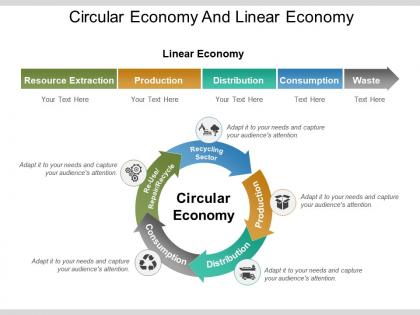
Be able to effortlessly display your data using our latest deigned circular economy and linear economy presentation graphics. This 2 in 1 business template has been designed using high resolution and premium quality slides which will help you enhance the quality of your work. Using this circular economy and linear economy PPT presentation you will be able to discuss various business-related processes like resource extraction, production, distribution, consumption, waste, recycling sector, production, re-use, repair, etc. This circular cycle diagram PowerPoint presentation uses the images of a linear timeline representation and a round circle diagram accompanied with editable text holders. This business economy business template has been created using flat designs which will make your work very understandable and convenient for your audience to understand. We assure you that the slides used in this deck of predesigned slides are totally original which removes all the scope of duplicity. So if you wish the win hearts of all your stakeholder we highly recommend that you hit the download button and take advantage of the given features of this slideshow. You have got your task cut out. Put it all in place with our Circular Economy And Linear Economy Presentation Graphics.
People who downloaded this PowerPoint presentation also viewed the following :
Content of this Powerpoint Presentation
Description:
This image presents a comparison of Circular Economy and Linear Economy principles. The top half of the image, labeled "Linear Economy," shows a traditional production flow where resources are extracted, then enter production, distribution, consumption, and finally become waste.
In contrast, the bottom half illustrates the "Circular Economy" concept with a loop integrating consumption, production, distribution, and the recycling sector. In this model, materials and products are reused, repaired, remanufactured, and recycled, minimizing waste and the need for new resources. This visual indicates a sustainable approach where the life cycle of products is extended and the environmental footprint reduced.
Use Cases:
This slide can be used across a range of industries interested in sustainability and efficient resource management:
1. Environmental Policy:
Use: To explain sustainable economic models to policymakers.
Presenter: Environmental consultant.
Audience: Government officials.
2. Manufacturing:
Use: Education on sustainable production practices.
Presenter: Sustainability director.
Audience: Company executives and operational staff.
3. Waste Management:
Use: Discussing the importance of integrating recycling.
Presenter: Recycling program manager.
Audience: Waste collection and processing personnel.
4. Educational Institutions:
Use: Teaching students about economic models.
Presenter: Economics or environmental science professor.
Audience: University students.
5. Retail and Distribution:
Use: Showcasing sustainable supply chain practices.
Presenter: Supply chain manager.
Audience: Retail management and logistics teams.
6. Construction:
Use: Promoting the reuse and recycling of building materials.
Presenter: Green building expert.
Audience: Architects, builders, and developers.
7. Corporate Social Responsibility (CSR) Initiates:
Use: To demonstrate commitment to sustainable business practices.
Presenter: CSR manager.
Audience: Stakeholders and shareholders.
Circular economy and linear economy presentation graphics with all 5 slides:
Generate interest in human history with our Circular Economy And Linear Economy Presentation Graphics. Give an account of heroic deeds.
FAQs for Circular economy and linear
So basically it's "design out waste, keep stuff in use longer, and help natural systems bounce back." Instead of that old take-make-toss approach, you're creating closed loops. Most companies just grab resources, make products, sell them, then whatever happens next isn't their problem. Circular thinking flips that - you focus on reusing, fixing, refurbishing, recycling. Keep materials moving through the system as long as possible. It's kinda like how nature works, honestly. Nothing really gets wasted because one thing's trash becomes another's treasure. Start by asking where your waste goes and whether it could be useful to someone else.
Honestly, start by ditching the whole "break it so they buy new ones" mentality and design stuff that actually lasts. Look at where you're wasting materials right now - there's probably tons you could loop back into production. Find suppliers who already get this circular thing, trust me it beats trying to convince the stubborn ones. Product-as-a-service is where it's at - you keep the product, handle repairs, whole lifecycle deal. Don't go crazy though. Pick one product line, test it out, see what breaks (figuratively speaking). Once you've got proof it works, then you can roll it out everywhere else.
Tech is what makes circular economy stuff actually work at scale. IoT sensors track materials through their whole lifecycle, AI optimizes recycling, and blockchain verifies sustainability claims (though blockchain feels overhyped sometimes tbh). Digital platforms connect waste producers with companies that need those materials as inputs. Advanced sorting tech separates materials way more precisely than before. 3D printing lets you manufacture and repair things locally too. Don't just chase whatever's trendy though - pick technologies that solve your actual circular economy problems first.
Honestly, the "5 R's" thing is pretty solid - refuse stuff you don't actually need, reduce what you buy, reuse creatively, repair instead of tossing, and recycle right. I've been hitting up thrift stores way more lately and it's kind of addictive finding cool stuff! Quality beats quantity every time. Look for companies that'll take their products back for refurbishment. Also, sharing or renting things you barely use makes sense financially too. Composting is easier than it sounds. Maybe start with just one area like clothes or electronics - buy refurbished, donate what still works, or find take-back programs.
Oh there are so many good ones! Patagonia does that repair and resale thing - keeps stuff out of landfills plus customers love them for it. Interface carpet went carbon negative by totally redoing how they manufacture and using recycled materials. Dell's ocean plastic packaging is honestly genius, turning literal waste into something useful. Unilever cut tons of packaging waste with their refillable lines across different brands. Each company just found what worked for their industry, you know? I'd pick one that's similar to your sector and really dig into their ROI numbers - that'll help you make the business case way easier.
So basically, circular economy flips the whole "make-use-toss" thing on its head. You keep stuff cycling through repair, reuse, recycling - honestly way smarter than what we do now. Products get designed to last longer and come apart easily, which means less mining for new materials upfront. When something dies, those parts become the raw materials for the next thing instead of just trash. Creates these closed loops that cut waste AND reduce the need for fresh resources. My advice? Start looking at your own processes first - find one loop you could close. Even small changes add up.
Honestly, the money thing hits first - retrofitting your whole operation isn't exactly pocket change. Then you've got to completely rethink your supply chain, which is a headache. Regulations are still stuck in the old linear mindset too, so you're swimming upstream there. Consumers say they want sustainable stuff but then balk at paying extra (go figure). Oh, and good luck finding reliable suppliers for recycled materials - that's been a real pain point for most companies I know. My advice? Don't go crazy trying to change everything overnight. Pick one product line, test it out, see what actually works.
Honestly, the best policies mix rewards with punishments. Tax breaks for companies designing reusable stuff, tougher waste rules, that kind of thing. Extended producer responsibility is huge - basically forces manufacturers to deal with their products forever, not just dump and run. Public procurement helps too when governments actually buy circular products. Infrastructure matters - repair centers, recycling facilities, all that. Oh and if you want to push for this locally? Find your area's sustainability groups first. They'll know exactly which politicians are already on board vs. the ones who'll just nod politely and ignore you.
So you'll definitely want to look at material circularity rate first - basically how much stuff you're keeping in use vs throwing away. Waste diversion and resource productivity are solid picks too. Product lifespan extensions, energy savings, water savings - all good options. Honestly, some companies go overboard tracking economic stuff like cost savings per ton recovered or circular product revenue. My advice? Pick maybe 3-5 metrics that actually match what you're trying to do. Don't track everything just because you can - that's how you end up drowning in data. Start simple, then add more later if you need to.
Honestly, circular economy stuff is creating way more jobs than people realize. Recycling and waste management are obvious ones, but there's also product repair services, sustainable design, supply chain work. Those repair cafes are everywhere now - kinda cool actually. Companies need sustainability consultants and people who can redesign their whole business models around reuse. Even green tech specialists are in demand. The thing is, these aren't just niche "eco jobs" anymore. Pretty much every industry is moving this direction, so the skills are becoming mainstream requirements.
Hey! So circular economy is just keeping stuff in use instead of tossing it after one go. Most climate damage comes from digging up materials and making new things constantly - it's honestly wild how much energy that wastes. When you repair, reuse, and recycle everything, you're cutting emissions at the source. Think of it like... giving the planet better habits? (okay that's cheesy but whatever). Each product designed to last and cycle back through saves future carbon AND makes money. I'd start by tracking where your materials go - you'll spot opportunities everywhere.
So manufacturing's obvious - they can flip their whole model around, make stuff that's actually reusable. Fashion too, though honestly they waste SO much fabric it's ridiculous. Tech companies are crushing it with device refurbishment and pulling out all those valuable metals from old phones. Food industry's got huge potential since we literally toss 30% of everything we grow (wild, right?). Construction's interesting because concrete and steel recycling is actually pretty profitable. If you're thinking career-wise, look for companies already doing take-back programs or turning waste into resources.
Honestly, schools are your best bet - kids go crazy for this sustainability stuff. Partner with local groups on composting or repair cafés. Set up programs where people can bring your products back for fixes or recycling, maybe hire locally to run those. Source materials from nearby businesses instead of shipping from who knows where. The whole thing needs to work for everyone though - they get jobs and useful services, you get loyal customers and less waste. I'd start with just one pilot program and see how it goes before expanding.
So circular economy is pretty genius actually - you're basically keeping stuff in use way longer instead of just tossing it. Design things to last, fix them when they break, recycle what you can't repair. Way less mining for new materials, fewer emissions, less junk in landfills. Money-wise it's solid too - you save on materials, create new income from "waste" products, plus people really do care about buying from sustainable companies now. I'd honestly start by just looking at what you're throwing away and see what could get a second life or be built better from the start.
Honestly, education is huge for getting people into circular economy stuff. Most folks think recycling covers it, but there's way more to it. You gotta show them how companies actually design out waste and keep materials cycling longer - that's where it gets interesting. Make it personal though. Talk about how it saves them money or creates local jobs they can see. I always start with examples from brands people already know, then tie it back to choices they're making anyway. Once they get that connection, they start thinking differently about what they buy and where they work.
-
Great quality product.
-
Very unique and reliable designs.