

Virtuous cycle for economic development




Try Before you Buy Download Free Sample Product
 Impress Your
 Audience
 100%
100% Editable
 Save Hours
 of Time


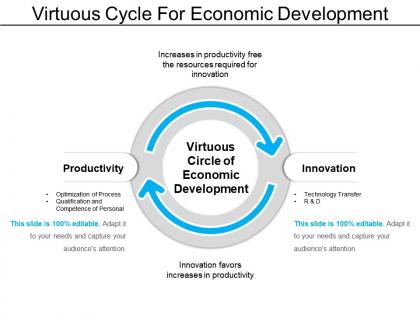
Utilize this Virtuous Cycle For Economic Development PowerPoint presentation to explain the economic development pattern to your employees. The driving force of accelerating economic growth can be illustrated with this money management PPT layout. The chain of events that impact the business economy can be discussed with your employees using this economic advancement PowerPoint theme. The relation between productivity and innovation can be showcased with this business growth PPT layout. The factors increasing productivity like optimization of process, qualification and skill set` of the staff members can be highlighted with this economic management PowerPoint layout. The increase in outcome results in the need for more research work. Also, in order to promote innovation, your firm’s R&D and technology transfer improvement can be discussed with your colleagues by incorporating this virtuous cycle PPT theme. Download this business management PowerPoint layout to portray the direct correlation between company productivity and enterprise innovation techniques.
People who downloaded this PowerPoint presentation also viewed the following :
Virtuous cycle for economic development with all 5 slides:
Benefit from the efforts of our Virtuous Cycle For Economic Development team. They have created the right vehicle for your ideas.




FAQs for Virtuous cycle
Key sustainability principles organizations should adopt include environmental stewardship, social responsibility, economic viability, circular economy practices, and stakeholder engagement. These principles enable businesses to reduce operational costs, enhance brand reputation, and meet regulatory requirements, with many companies in manufacturing, retail, and technology finding that sustainable practices ultimately deliver competitive advantage and long-term resilience.
Businesses can measure sustainability impact through carbon footprint assessments, energy consumption tracking, waste reduction metrics, water usage analysis, and supply chain evaluations. These comprehensive measurements enable organizations to identify improvement opportunities, set meaningful targets, and demonstrate environmental responsibility to stakeholders, while many companies finding that systematic tracking ultimately delivers cost savings and enhanced competitive positioning.
Renewable energy plays a crucial role in sustainability by reducing carbon emissions, decreasing dependency on fossil fuels, minimizing environmental impact, and creating long-term economic value. Through solar, wind, and hydroelectric technologies, organizations across manufacturing, healthcare, and retail sectors achieve operational cost reductions, regulatory compliance, and enhanced brand reputation, ultimately delivering competitive advantage in an increasingly environmentally-conscious marketplace.
Sustainability practices integrate into supply chain management through supplier auditing for environmental standards, implementing circular economy principles, optimizing transportation routes to reduce emissions, and establishing waste reduction protocols. These approaches enable companies to minimize environmental impact while reducing costs, with many manufacturers and retailers finding that sustainable supply chains ultimately deliver competitive advantage and enhanced brand reputation.
Small businesses commonly face sustainability challenges including limited financial resources for green initiatives, lack of sustainability expertise, difficulty accessing eco-friendly suppliers, complex regulatory compliance requirements, and measuring environmental impact effectively. These obstacles often seem overwhelming initially, but many small enterprises find that strategic approaches like energy efficiency improvements, waste reduction programs, and sustainable supply chain partnerships ultimately deliver cost savings, enhanced brand reputation, and competitive advantages in increasingly environmentally-conscious markets.
Companies can engage employees in sustainability initiatives through green teams, sustainability training programs, incentive systems, volunteer opportunities, and transparent progress communication. These approaches streamline participation by connecting environmental goals to daily work activities, recognizing contributions, and fostering collaborative problem-solving, with many organizations finding that engaged employees ultimately deliver enhanced innovation, reduced operational costs, and stronger workplace culture.
Sustainability certifications deliver enhanced brand reputation, regulatory compliance, operational cost reductions, improved stakeholder trust, and competitive market positioning for organizations across industries. These credentials enable companies to attract environmentally conscious consumers, streamline resource management, and access green financing opportunities, with many financial institutions and retail chains finding that certified sustainability practices ultimately drive both revenue growth and operational efficiency.
Sustainable design influences product development by integrating eco-friendly materials, energy-efficient manufacturing processes, and circular economy principles from initial concept through production. This approach enables companies to reduce environmental impact while meeting consumer demand for responsible products, with many organizations finding that sustainable practices ultimately deliver cost savings, enhanced brand reputation, and competitive advantage in increasingly conscious markets.
Cities can implement green building standards, renewable energy systems, efficient public transportation, waste reduction programs, and urban green spaces to promote sustainability. These strategies enhance environmental quality by reducing emissions, conserving resources, and improving air quality, with many municipalities finding that integrated approaches ultimately deliver cost savings and improved citizen well-being.
Waste management optimization involves implementing circular economy principles, advanced recycling technologies, waste-to-energy systems, smart collection routes, and comprehensive reduction strategies. Through IoT sensors and AI analytics, municipalities and corporations streamline operations while minimizing landfill dependency, ultimately delivering cost savings, enhanced resource recovery, and significant environmental benefits in increasingly sustainability-focused markets.
Water conservation reduces resource depletion, minimizes environmental impact, and ensures long-term availability for future generations while cutting operational costs. Organizations across manufacturing, hospitality, and agriculture increasingly find that strategic water management enhances efficiency, regulatory compliance, and stakeholder trust, ultimately delivering competitive advantage in an environmentally conscious marketplace.
Technology drives sustainable practices by enabling precision monitoring, optimizing resource consumption, and automating eco-friendly processes across industries. Smart sensors in manufacturing reduce waste by 30%, AI optimizes energy grids for renewable integration, and IoT systems streamline water management in agriculture, ultimately delivering cost savings while enhancing environmental performance for competitive advantage.
Adopting sustainability in business operations delivers significant cost reductions through energy efficiency, waste minimization, and resource optimization, while creating new revenue streams and competitive advantages. Companies across manufacturing, retail, and financial services increasingly find that sustainable practices enhance operational efficiency, attract environmentally conscious consumers, and ultimately strengthen long-term profitability and market positioning.
Consumers influence corporate sustainability practices by making purchasing decisions based on environmental values, demanding transparency through social media advocacy, and supporting companies with verified green credentials. Through boycotts, sustainable product choices, and vocal engagement, consumers drive market demand that compels businesses to adopt eco-friendly practices, ultimately delivering competitive advantages for environmentally responsible companies.
Education serves as the foundation for sustainability awareness by providing communities with scientific knowledge, practical skills, behavioral insights, and collective action strategies. Through school programs, community workshops, and public campaigns, educational initiatives enable individuals to make informed environmental choices, adopt sustainable practices, and advocate for policy changes, ultimately creating environmentally conscious communities that drive lasting ecological and economic benefits.
-
Editable templates with innovative design and color combination.
-
Excellent work done on template design and graphics.