


Business life cycle diagram powerpoint ideas




Try Before you Buy Download Free Sample Product
 Impress Your
 Audience
 100%
100% Editable
 Save Hours
 of Time


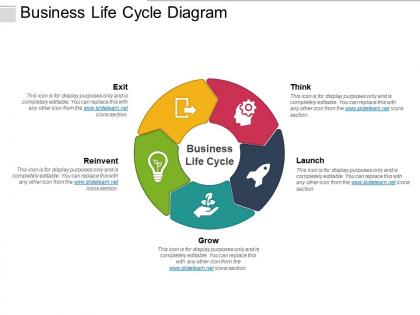
Business life cycle diagram PowerPoint ideas is a perfect slide for the business process presentation and different phases of product development. This five stages of business lifecycle presentation model are used generally during strategic planning or the analysis of a business model. The five phases as mentioned in this PPT are think, launch, grow, reinvent and exit. Presenters can use this business template to show the above said stages precisely. When the product is studied in relation to these five stages of business growth presentation template, it gives a clear cognition of, in which stage the organization’s product or services have reached. This presentation is perfect for the comparison of two products, or two strategy models. Presenters can illustrate their strategies on the surface of the colorful arrow, and display their conclusions too. This business life-cycle PPT representation can be used for academic, corporate and other organizations where the concepts which have five steps or five applications to be showcased. Find the ideal format to follow with our Business Life Cycle Diagram Powerpoint Ideas. It helps arrange the clutter.
People who downloaded this PowerPoint presentation also viewed the following :
Business life cycle diagram powerpoint ideas with all 5 slides:
Handle irksome interruptions with our Business Life Cycle Diagram Powerpoint Ideas. Ensure continued interest in your idea.



FAQs for Business life cycle
So there's basically 5 stages: startup, growth, maturity, renewal/decline, and exit. First you launch and try to get into the market. Growth is when your revenue actually starts climbing - that's the fun part. Then comes maturity where everything kind of plateaus. Honestly, way too many businesses just get lazy here and coast. After that crossroads, you either pivot and innovate to renew yourself, or you slip into decline. Eventually there's an exit - selling, merging, or just shutting down. The cool thing is you're not stuck on autopilot, especially during maturity. That's where smart moves really matter.
Honestly, knowing where you are in the business cycle is a game changer. Each stage has totally different challenges - what works during startup will wreck you in growth phase. I've seen so many founders burn through cash because they're still thinking like a scrappy startup when they should be scaling smart. Growth, maturity, decline - they all need different strategies. You'll make way better calls on hiring, spending, and when to pivot if you can read the signs. Plus you won't get blindsided by the predictable stuff that kills businesses. My friend's company almost tanked because they didn't see the shift coming.
Make a clear timeline showing all five stages - startup, growth, maturity, decline, then renewal/exit. Use different colors for each so it's easy to spot where any business sits. Revenue and profit curves are clutch (they basically tell the whole story). Add little callout boxes with the main challenges for each phase - but honestly don't overthink it. The whole thing should be scannable in like 30 seconds. Oh, and keep those profit lines super visible since that's what everyone really cares about anyway.
Yeah totally - industry life cycles are all over the place speed-wise. Tech companies can blast through intro and growth in like 2-3 years, but manufacturing takes forever. Healthcare and utilities just chill in maturity phase for ages since people always need power and meds. Fashion moves crazy fast though, constantly reinventing itself. Oh and entertainment too obviously. It really depends on your regulation stuff, how much money you need upfront, and how quickly things change in your space. I'd say don't compare your timeline to some random business case study - stick to companies actually in your industry or you'll drive yourself nuts.
So basically, these business life cycle diagrams show you what stage you're at - startup, growth, maturity, whatever - and help you figure out what to do next. Pretty useful for quarterly planning tbh. Like if you're in growth mode, you'll know to pour money into expansion. Maturity phase? Time to cut costs and optimize. It's kind of like GPS for business strategy - shows you the route ahead. You can also see how you stack up against competitors and when it might be smart to shake things up. Definitely worth pulling out during your next strategy meeting.
So market research totally changes depending on where your business is at. Starting out? You're basically just trying to figure out if people actually want your thing - which honestly, way too many founders skip and then wonder why they're struggling. Once you're growing, it's all about keeping customers happy and finding new opportunities. When you hit that mature phase, you're watching competitors and trying to catch market shifts early. And if things start declining... well, that's when you research whether to pivot or just call it quits. The trick is asking the right questions for whatever stage you're dealing with.
Look, cash flow changes big time as your company grows. When you're starting out? You're hemorrhaging cash while building everything - just stretch those dollars and hunt for funding. The growth phase is honestly chaos because money's flowing in but you're dumping it all back into scaling. Once you hit maturity, things get way more predictable. You can actually plan ahead and optimize how cash moves through operations. If decline hits, you're basically doing damage control - preserving what you've got while figuring out your next move. My advice: check cash weekly when you're small, then shift to monthly once things stabilize.
Honestly, growth stage is brutal - you're basically outgrowing everything at once. Cash flow becomes this constant stress because you're spending to keep up with demand but revenue hasn't caught up yet. Quality starts slipping when you can't hire fast enough (been there!). Your scrappy startup vibe? Gone. Suddenly you need actual processes or everything breaks. But don't over-systematize too early - kills the agility that got you here. I'd tackle cash projections first since running out of money ends the game pretty quick. Then focus on systematizing whatever's actively on fire. The culture stuff... honestly that's harder to fix once it's broken.
Look, you gotta shake things up before you're forced to. Netflix didn't wait for DVDs to completely die - they jumped to streaming while still making money. That's the move. Invest in R&D now, listen to what customers actually want (not what they say they want), and honestly? Sometimes you need to kill your own bestsellers. I know it sounds crazy when business is good, but that's literally the perfect time. You've got cash flow and breathing room to experiment. What assumptions are you making about your business that might be total BS in five years? Start there.
Look, when things are going downhill you've gotta watch your cash flow like a hawk - burn rate, runway, whatever revenue is still trickling in. Customer churn gets ugly fast so track that weekly, not monthly. Everything moves too quick to wait around. Cost per unit and overhead become critical since you'll probably slash expenses soon. Honestly, retention costs can be depressing to calculate but you need the real numbers. Asset values matter too if you're thinking about selling stuff off. The whole point is getting that real-time picture so you can decide whether to pivot, bail, or just shut it down properly.
So basically the diagram gets everyone on the same page about where you actually are in the business. Half your team thinks you're still scrappy startup mode, the other half is already planning like you're Google - super confusing. When you bring it to meetings, people can finally align on what should be priority right now vs later. Each stage has totally different challenges anyway. I've seen teams waste so much time arguing about resources when they're not even talking about the same phase. Just throw one up on the screen next meeting - you'll be shocked how fast the random debates stop and real strategy starts happening.
So there's a bunch of ways to visualize this stuff. The S-curve is probably your best bet - it shows those classic phases like startup, growth, peak, then decline mapped against revenue. Bell curves work too if you want to highlight when performance peaks. Honestly, circular diagrams are kinda trendy right now since they show how companies can reinvent instead of just dying (though most don't pull that off anyway lol). But if you're presenting to execs? Just go with a simple line graph. They eat that up - clean trajectory with key milestones marked out. Way easier to follow.
Look, innovation is like rocket fuel for whatever stage your business is in. Early on? It helps you stand out and get customers faster. Growing phase means you're constantly innovating to stay ahead and find new markets. But here's where most companies screw up - they get comfortable when they hit maturity. That's actually when you need innovation most! Without it, you'll just slide into decline. Smart move is building this stuff into your company culture from day one. Trust me, trying to innovate your way out of a downward spiral is brutal.
Okay so when you're just starting out, cash and talent are everything - bootstrapping can only take you so far, you know? Growth phase is different though. You're suddenly dealing with scaling issues, so operational systems and decent management become way more important. Once you hit maturity, it's about protecting what you've built. Strong customer relationships, efficient processes - that stuff matters most then. Decline stage is tricky (and honestly where most companies mess up). They're still acting like they're growing when really they need innovation resources and the ability to pivot fast. It's brutal but true. Figure out which stage you're actually in right now, then check if you're putting money into the right areas for that phase.
So it really depends on what stage you're at. Starting out? You've gotta focus on just getting people to know you exist - like, literally nobody has heard of you yet. Once you hit growth mode, throw everything at scaling what's already working and grab market share fast. Maturity is trickier though - that's when you're fighting for loyalty and trying to stand out, but honestly most companies just phone it in at this point. If you're declining, either innovate like crazy or just milk whatever's left. The trick is being real about where you actually are, not where you think you should be.
-
Innovative and attractive designs.
-
Visually stunning presentation, love the content.
-
Much better than the original! Thanks for the quick turnaround.
-
Really like the color and design of the presentation.