

Key project deliverables and timeline ppt slide




Try Before you Buy Download Free Sample Product
 Impress Your
 Audience
 100%
100% Editable
 Save Hours
 of Time


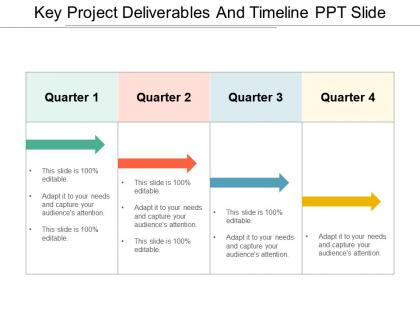
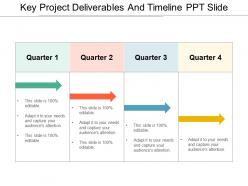
We at SlideTeam understand your need for a professional, easy to learn and versatile PPT template. Our key project deliverables and timeline PPT slide is a simple slide which conveys the complex and relevant subject very beautifully. The column diagram template is created as a four timeline model presentation. Such project timeline PPT presentation visual is useful to present the stages of business process spread across four quarters. As a project timeline presentation graphic, the diagram is used to show the chronology of development in a horizontal format. Project deliverables timeline presentation PowerPoint graphic can be used to discuss the different phases of project development with management. When using this project deliverable presentation infographic, the users can talk about the project milestones, it's goals and targets that must be achieved within a stipulated time period. The editable PPT diagram enables users to execute multiple changes easily. Such a slide can also be used for the presentation of company objectives, agenda vision, and mission, etc. Display financial discipline with our Key Project Deliverables And Timeline Ppt Slide. Cut down on frivolous expenditure.
People who downloaded this PowerPoint presentation also viewed the following :
Key project deliverables and timeline ppt slide with all 5 slides:
All the choices available in our Key Project Deliverables And Timeline Ppt Slide are equally good. Be able to identify credible alternatives.


FAQs for Key project deliverables and
Common key deliverables include project charters, scope statements, work breakdown structures, risk assessments, status reports, quality documentation, and final project reports. These deliverables streamline project execution by establishing clear expectations, maintaining stakeholder alignment, and ensuring accountability across phases, with organizations in healthcare, construction, and technology finding that standardized deliverables significantly enhance project success rates and operational efficiency.
Clear deliverables enhance team collaboration by establishing shared expectations, defining individual responsibilities, creating measurable milestones, and providing structured communication touchpoints throughout the project lifecycle. With defined outputs and timelines, teams streamline coordination, reduce misunderstandings, and maintain alignment on priorities, ultimately enabling faster decision-making and more efficient resource allocation across departments.
Stakeholder engagement ensures project deliverables align with business needs, user requirements, and organizational objectives through continuous feedback, requirement validation, and priority setting. Active stakeholder involvement throughout planning phases helps project teams avoid scope creep, reduce costly revisions, and deliver outcomes that drive measurable value, ultimately enhancing project success rates and organizational satisfaction.
Project managers can effectively prioritize deliverables by using impact-versus-effort matrices, stakeholder feedback sessions, and critical path analysis to identify high-value, time-sensitive components. Through strategic resource allocation and phased delivery approaches, organizations streamline project execution, reduce bottlenecks, and maintain quality standards, with many teams finding that transparent communication and flexible milestone adjustments ultimately deliver better outcomes within compressed timeframes.
**INPUT**: What methodologies can be applied to create an accurate project timeline? **OUTPUT**: Effective timeline methodologies include Critical Path Method (CPM), Gantt charts, Agile sprinting, Work Breakdown Structure (WBS), and Monte Carlo simulation. These approaches streamline project planning by identifying dependencies, allocating resources strategically, and building in buffer time, with many organizations finding that combining multiple methodologies delivers enhanced accuracy and competitive advantage. [Word count: 55 words]
Gantt charts and timelines enhance project visibility by providing clear visual representations of task dependencies, resource allocation, milestone tracking, and progress status across all project phases. These tools streamline accountability by enabling team members to identify bottlenecks, monitor deliverable deadlines, and assess performance metrics in real-time, ultimately delivering improved coordination and strategic project outcomes for organizations.
Poorly defined deliverables and timelines create scope creep, budget overruns, resource misallocation, missed deadlines, and stakeholder confusion throughout project execution. These challenges ultimately lead to team frustration, client dissatisfaction, and project failure, with many organizations finding that unclear expectations significantly compromise project success and damage long-term business relationships.
Ensuring deliverables align with project goals requires establishing clear success criteria, conducting regular milestone reviews, and maintaining stakeholder feedback loops throughout the project lifecycle. Many organizations implement structured governance frameworks that include progress assessments, scope validation, and objective measurement tools, ultimately delivering projects that meet strategic business outcomes while minimizing costly scope creep and timeline delays.
Feedback loops enable continuous refinement of deliverables by facilitating regular stakeholder input, identifying gaps early, and allowing iterative improvements throughout project phases. Through systematic review cycles, project teams can adjust specifications, enhance quality standards, and align outputs with evolving requirements, ultimately delivering more precise outcomes while reducing costly revisions and ensuring stakeholder satisfaction.
Changing project scopes significantly impact timelines by requiring additional resource allocation, extended development phases, and revised milestone schedules, often resulting in delayed deliverables and increased costs. These scope modifications force project managers to reassess priorities, reallocate team members, and communicate revised expectations to stakeholders, ultimately affecting project quality and client satisfaction if not managed strategically.
Project management tools that assist in tracking deliverables and timelines include Asana, Monday.com, Microsoft Project, Trello, and Gantt chart software like Smartsheet. These platforms streamline project oversight by enabling real-time progress monitoring, automated deadline alerts, and collaborative task management, with many organizations finding that integrated dashboards ultimately deliver enhanced visibility and improved project completion rates.
Historical data from previous projects informs future deliverable planning by revealing patterns in task duration, resource requirements, and potential bottlenecks, enabling more accurate timeline estimates and risk mitigation strategies. Organizations increasingly leverage this data to optimize resource allocation, identify recurring challenges, and establish realistic milestones, with many project teams finding that data-driven planning significantly reduces delays and enhances overall delivery success rates.
Effective delay mitigation strategies include proactive risk assessment, buffer time allocation, resource contingency planning, regular milestone reviews, and stakeholder communication protocols. These approaches streamline project execution by identifying bottlenecks early, ensuring adequate resource availability, and maintaining transparency with clients, ultimately delivering consistent timeline adherence and enhanced project reliability across organizations.
Cultural differences significantly impact international project deliverables through varying communication styles, decision-making processes, quality standards, documentation preferences, and timeline expectations. These variations can present both challenges and opportunities, with many global organizations finding that culturally-adapted deliverable frameworks enhance stakeholder satisfaction, streamline cross-border collaboration, and ultimately deliver more successful project outcomes.
Success metrics for project deliverables include quality standards adherence, budget variance, timeline compliance, stakeholder satisfaction scores, and performance against defined acceptance criteria. These measurements enable organizations to assess deliverable effectiveness through cost efficiency, functionality validation, and user adoption rates, with many project managers finding that combining quantitative and qualitative metrics ultimately delivers comprehensive insights for future project optimization and strategic planning improvements.
-
Wonderful templates design to use in business meetings.
-
Easily Editable.
-
The Designed Graphic are very professional and classic.
-
Visually stunning presentation, love the content.