

Project background timeline ppt template





Try Before you Buy Download Free Sample Product
 Impress Your
 Audience
 100%
100% Editable
 Save Hours
 of Time


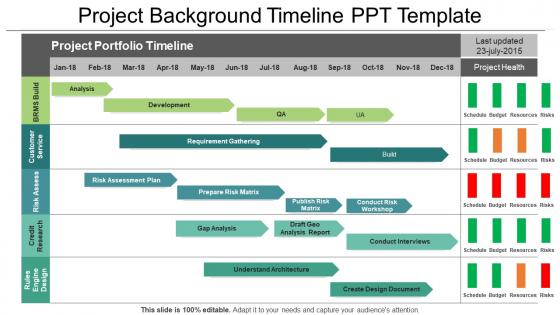
Present your project timeline with our roadmap project background timeline PowerPoint Template. The Presentation Slideshow has been created to meet your business requirements. With the help of our PPT graphic you can create your project implementation plan and make strategic plans to guide your employees towards success. Without an implementation strategy, it is very difficult to identify how you will achieve your stated goals and objectives. Knowing how to create a project timeline is one of the most essential skills a project manager needs to develop in the early stages of his or her career. So, make use of this creative PPT Diagram to make an impact and measure the short term and long term performance so that you can achieve your objectives easily. Most importantly our slide designs are easy to customize and you can change the colors, fonts, size, etc. as per your convenience. You may also check our other PowerPoint slides that can easily fit into your presentation. You just have to download, insert and then share our visual slide with your audience. So, share the business success with your stakeholders, customer, investors and associates using our innovative PPT designs. Get folks going 'Hear Hear' with our Project Background Timeline Ppt Template. Applause will be automatic and forthcoming.
People who downloaded this PowerPoint presentation also viewed the following :
Project background timeline ppt template with all 5 slides:
Give form to your desires with our Project Background Timeline Ppt Template. You will find them actually achievable.

FAQs for Project background
Start with your end date and work backwards - way easier to catch problems early. Map out the big milestones and deliverables first, then figure out what depends on what. Honestly, the critical path thing sounds fancy but it's just tracking which tasks can't be delayed without screwing everything up. Build in buffer time because projects always run late (learned that one the hard way). Make sure everyone knows who's doing what and when you'll need resources. Oh, and make it visual - nobody wants to dig through walls of text to figure out deadlines.
Honestly, Gantt charts are a game changer - way better than those messy spreadsheets nobody wants to look at. Your stakeholders can instantly see what's overlapping, who owns what tasks, and if anything's falling behind schedule. The visual bars just make sense, you know? I always color-code mine by team (makes meetings so much smoother). One thing though - you've gotta keep updating it or people will stop trusting it. Oh, and dependencies become super obvious which saves you from those awkward "wait, we can't start this yet" moments in meetings.
So Monday.com and Asana are pretty solid picks - both have nice visual timelines and work great for team stuff. ClickUp's another good one, though honestly their interface can be a bit much sometimes. If you want something more old-school, TeamGantt and GanttPRO do the job fine. Timeline JS is perfect if you're presenting to stakeholders since it looks really polished. Really depends what you need it for - daily project management or just showing off milestones? I'd grab free trials of like 2-3 and see what feels right for your team.
Ugh, the worst mistake is totally underestimating how long stuff takes. I swear, every single project I've done has run over. Add like 20-30% buffer time to everything - seriously. Don't make your timeline super rigid either, because things will change. Dependencies are huge too - waiting on other people or tasks that can't start until something else finishes. Oh, and get input from stakeholders early or you'll be redoing everything later (learned that the hard way). Short version: make your timeline, then pad it. You'll actually finish on time for once.
Okay so project timelines are clutch because they stop people from constantly asking "wait when's this due again?" Everyone can see what's happening when. Stakeholders know exactly when you need their input and can actually plan around your deadlines. Trust me, it saves you from those super awkward moments when someone's like "oh I was supposed to review that last week?" The visual part helps tons too - people spot bottlenecks way faster. Set up regular check-ins to keep everyone on the same page and catch problems before they blow up.
Okay so for agile stuff, forget those crazy detailed timelines. Break everything into sprints instead - like 1-4 weeks each. Map out your big milestones and release dates first, but don't stress about every tiny detail upfront. That's honestly the best part about agile! Fill in specifics as you go, sprint by sprint. Burndown charts are super helpful for tracking where you're at. Oh and definitely keep things flexible since requirements change constantly (they always do). Start with your major releases, then work backwards to plan maybe your first 2-3 sprints in detail.
Okay so first thing - break stuff down into smaller pieces. Week-long tasks max, anything bigger needs chopping up. Buffer time is huge because trust me, everything takes longer than you think (learned that one the hard way lol). Get the actual team involved in estimating since they're doing the work, not you. Historical data helps if you've got similar projects to compare against. Don't forget dependencies - some tasks can't start until others finish. Oh and check if people are actually available when you need them. Honestly, I'd rather under-promise and look like a hero than constantly explain why we're behind.
Make your milestones stand out with bold colors or bigger icons - anything that grabs attention. I always use a totally different color scheme for milestones vs regular tasks. Works every time. Add little callout boxes with key details or metrics so people get why each milestone matters. Oh, and definitely number them! Makes it way easier when everyone's trying to reference specific ones during meetings. If you're presenting this live, just pause at each milestone for emphasis. Brief impact statements next to each one help too - stakeholders love seeing the "why" behind everything.
Dependencies are just the "this happens before that" connections between tasks. Like you can't paint walls before building them, obviously. Map these out early and you'll see your critical path - basically the minimum time everything will take. I learned this the hard way on a project last year. Miss these relationships and your whole timeline gets wrecked. The tricky part is spotting all of them upfront during planning, then actually tracking them as you go. Otherwise delays snowball fast and suddenly you're explaining to everyone why you're three weeks behind.
Think of your project timeline as a crystal ball for spotting trouble before it hits. Those tight deadlines? Red flags. Multiple teams working at once? That's where things get messy fast. I always build in buffer time because honestly, Murphy's Law is real in project management. The visual layout makes it obvious which tasks are make-or-break - if they slip, your whole project's toast. Schedule risk check-ins right before those sketchy phases hit. You'll thank yourself later when you're not scrambling to fix disasters that could've been prevented.
Honestly, always pad your estimates by like 10-20% because stuff WILL take longer than you think. Break everything into smaller chunks so when things go sideways (and they will), you're not totally screwed. Figure out what absolutely has to get done vs what would be nice to have - that critical path thing is real. Check in with people regularly too, otherwise scope creep will eat your timeline alive. Oh and document what's flexible now while you can still think straight. Way better to flag delays early than panic at the deadline. Trust me on this one.
Honestly, color coding is a game changer for timelines. Your brain picks up colors way faster than text, so you can see patterns instantly. I usually do blue for dev work, green for testing, red for anything urgent - you get the idea. When you're showing it to higher-ups who just want the overview, they'll actually thank you for it. Oh, and don't make it look like a rainbow exploded. Keep it simple with maybe 4 colors tops and throw in a little legend so people know what's what.
Honestly, timelines are what separate real proposals from pipe dreams. When you show stakeholders the actual steps and dates, they know you're not just throwing around ideas. Break yours into phases with milestones - way easier for busy execs to scan quickly. It also saves you from those awkward "wait, how long will this take?" questions mid-pitch. Nobody wants surprise delays popping up later either. Decision-makers need concrete info to figure out if they can actually fund this thing and when. Plus it proves you can deliver what you're promising instead of just talking big.
Oh man, you gotta dig into your old project timelines - they're like a crystal ball for planning. I learned this the hard way after being way too optimistic for years. Look for patterns in your data: testing probably took 30% longer than you thought, or those stakeholder reviews always added two weeks (they're notorious for this). Similar projects with the same team size work best for comparisons. Honestly, I wish I'd started tracking actual vs. planned timelines sooner. Now I can finally give realistic estimates instead of making everyone mad when stuff runs late.
Honestly, Gantt charts are your best bet - they show everything on a timeline so you can spot problems fast. Kanban boards are solid too, moving those cards around is weirdly satisfying lol. You could also just track major milestones if you don't want to overcomplicate things. For agile stuff, burndown charts work really well since they show how much work's left. Oh, and whatever you choose, actually USE it during team meetings. I've seen too many beautifully crafted project trackers just sitting there ignored while everything falls apart.
-
Awesomely designed templates, Easy to understand.
-
Very unique, user-friendly presentation interface.