


Economics development strategies ppt presentation




Try Before you Buy Download Free Sample Product
 Impress Your
 Audience
 100%
100% Editable
 Save Hours
 of Time


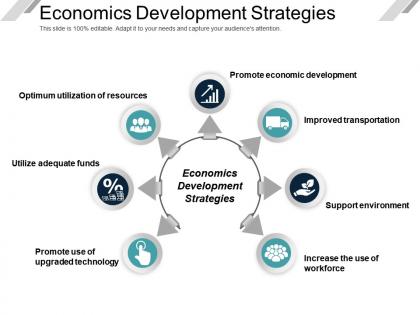
Introducing Economics Development Strategies PPT Presentation. With the assistance of this PowerPoint presentation template, you can create plans to increase the economic democracy. You can showcase the importance of financial strategies using the PPT slide. If you want to generate a report on entire commercial growth revenue, then use our PowerPoint presentation template. There are numerous factors such as to improve transportation, increase the use of the workforce, utilize adequate funds, promote economic development which you can mention with the help of our PowerPoint presentation template. The strategy of unbalanced growth PPT slide contains high-grade icons with which you can make your presentation even more reliable and engaging. By using a PowerPoint presentation template, you can name the different areas which are suffering from poverty and a minimum supply of resources. You can show a comparison between the developed, underdeveloped, and non-developed countries using this PPT slide. Therefore, download this ready-to-use PowerPoint presentation template and promote the use of upgraded technology.
People who downloaded this PowerPoint presentation also viewed the following :
Economics development strategies ppt presentation with all 5 slides:
Get folks to back you till the end with our Economics Development Strategies Ppt Presentation. It will enable you to enlist their help.




FAQs for Economics development
So PPPs are pretty solid for development projects - you're mixing government resources with private sector speed and cash. Private companies handle stuff like airports or broadband way faster than bureaucrats ever could (sorry, but it's true). Government gets infrastructure they can't afford solo, private sector gets steady money coming in. Communities win because projects actually get done instead of sitting in committee forever. Cost-wise it beats going fully public most of the time. Definitely worth checking out early if you're planning anything big.
Look, infrastructure's gotta be rock solid first - transport, utilities, internet. Investors bail if they can't operate smoothly. Tax breaks help but honestly everyone does that now so whatever. The real magic happens through relationships though. Trade missions work, investment agencies are decent, and don't sleep on your diaspora connections abroad - they're goldmines. Oh and here's the thing: figure out what industries actually fit your region's strengths first. Then go hard after those specific sectors instead of trying to attract everyone and their mom.
Mixed-use development is huge - plus getting public transit right. Innovation districts work too, where startups can actually cluster together and feed off each other's energy. Green infrastructure hits two birds with one stone since it creates local jobs while making neighborhoods way more livable. Honestly, I'd focus way more on small business support than trying to land some massive corporate headquarters. Those local entrepreneurship programs usually give you better bang for your buck anyway. Don't put all your eggs in one basket though. Layer different strategies and start with what your city's already good at.
Dude, tech is like a shortcut for developing countries - they literally skip whole steps other places had to go through. Kenya's crushing it with mobile banking while Southeast Asia built massive e-commerce empires. The crazy part? They just bypass old infrastructure entirely. Why build landlines when everyone can have smartphones, right? These innovation hubs pull in foreign cash and create actual good jobs. Productivity shoots up across different industries too. If you're eyeing investment opportunities there, just watch how fast they adopt new tech and what their governments are doing digitally. Pretty reliable way to predict where things are headed.
Dude, workforce programs are honestly genius for local economies. They create this whole pipeline of skilled workers that makes companies want to set up shop in your area. Why? Because businesses hate having to relocate people or spend months training from scratch - it's expensive and annoying. Short version: better jobs show up, wages go up, unemployment drops. Plus your existing companies are way less likely to bail for somewhere else. The trick though is focusing on industries that are actually growing near you, not just whatever's hot on LinkedIn right now. Otherwise you're just training people for jobs that don't exist yet.
Dude, community engagement is honestly your best bet for getting economic development right. Locals actually know their area - they'll catch issues you'd miss completely. I've watched so many projects fail because planners didn't bother asking residents what they thought first. Big mistake. You want people on your side, not fighting you every step. Plus engaged communities stick around to keep things going after the initial launch. My advice? Start with listening sessions or quick surveys before you plan anything major. Trust me, it'll save you tons of trouble down the road.
Track job numbers, wage growth, and unemployment first - that's your foundation. But honestly? Those miss half the picture. Business retention rates matter just as much, plus new startups and investment coming in. Housing costs and population trends show if people actually want to stick around long-term. Monthly dashboards are clutch for catching problems early. Oh, and don't sleep on quality of life stuff - it's what makes everything else sustainable. You'll want both short and long-term metrics to really know what's working.
Look, infrastructure is honestly what makes or breaks a region's economy. Companies need reliable power, fast internet, good roads - the basics. Without them, businesses just pack up and leave (obviously not great for jobs). Here's the thing though - every dollar you put into infrastructure usually creates like 2-3 dollars in economic activity afterward. Pretty solid return if you ask me. Roads, broadband, utilities, transport systems - they're what keep businesses around and attract new ones. Start by figuring out your biggest gaps first. Makes the most sense.
So there are basically three things that'll make the biggest difference: getting them money, helping with the business side of things, and making government stuff less of a nightmare. Microloans are clutch here - way easier than dealing with banks. Set up some kind of mentorship thing too where people who've done this before can show newbies the ropes. But honestly? The permit and licensing mess is probably where you'll see the biggest wins. Create like a one-stop shop so they're not running around to five different offices. Oh, and definitely survey local businesses first to see what's actually driving them crazy - no point fixing stuff that isn't broken.
So there's a bunch of ways to tackle income inequality, but honestly none of them work great by themselves. Progressive taxes and raising minimum wage are probably the most obvious ones. Job training programs help too, though they take forever to show results. Education and infrastructure investments are solid long-term plays - they don't fix things overnight but they're worth it. Oh, and don't sleep on small business support and affordable housing stuff. My advice? Figure out what's driving inequality in your specific area first, then pick like 2-3 approaches that actually target those problems. Otherwise you're just throwing money around hoping something sticks.
Yeah, tax incentives absolutely sway where businesses set up shop. Companies aren't stupid - if one state's offering property tax breaks and R&D credits while another isn't, guess where they're going? I mean, it's literally free money. Sure, you still need decent infrastructure and workers, but honestly? When two places are pretty similar otherwise, those tax breaks usually seal the deal. My cousin's company moved their whole operation to Tennessee just for the incentives. So if you're looking at expansion spots, dig into all the tax stuff - not just corporate rates but every credit they're throwing around.
Look, education is basically the backbone of any strong economy - you can't really have one without the other. Good schools create the skilled workers that businesses actually want to hire. Better jobs mean people spend more money locally, which creates this whole cycle of growth. Plus educated workers pay more taxes, so there's that benefit too. I know it sounds super basic, but politicians always seem to forget this when they're cutting budgets. The trick is making sure your local programs match what industries in your area need. Otherwise you'll have graduates with degrees but no relevant jobs waiting for them.
Honestly, it's way simpler than most people make it out to be. Make environmental assessments mandatory for big projects from day one - don't tack them on later. Green businesses should get tax breaks and grants, obviously. Focus on stuff like renewable energy and eco-tourism since they actually create decent jobs while helping the planet. The trick is showing everyone that going sustainable usually saves money down the road. Less waste, lower resource costs, fewer regulatory headaches. I'd start by figuring out which parts of your current economy could go green first - like, what's the low-hanging fruit? Once you get some wins, the rest follows pretty naturally.
Oh man, rural development is rough. Infrastructure's usually garbage - crappy internet, bad roads, you know the drill. Makes it super hard to get businesses interested. The worst part? All the smart young people bail for cities and never look back. Can't really blame them honestly. Your tax base ends up tiny compared to metros, so there's way less money for projects. Cities can throw around massive incentives that you just can't match. Best bet is playing to what you've actually got - natural resources, maybe some tourism angle, farming stuff. Partner up with state programs or nonprofits to make your budget stretch further.
So global trade is kinda a double-edged sword for local economies, you know? Sure, your businesses can suddenly sell to way bigger markets, and foreign investment starts rolling in. Plus there's all this knowledge transfer happening that sparks innovation. But man, the competition can be ruthless - local companies get crushed by cheap imports sometimes. And when global markets go crazy, your town feels it too. I think the trick is playing it smart. You want to jump on those export opportunities and trade deals while also making sure your workforce stays competitive. Building up industries that can actually hold their own globally - that's where the real money is.
-
Design layout is very impressive.
-
Understandable and informative presentation.