

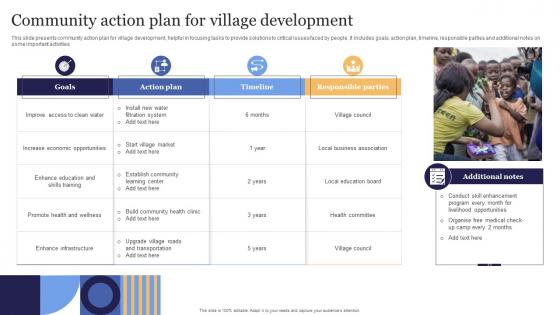
Community Action Plan For Village Development




Try Before you Buy Download Free Sample Product
 Impress Your
 Audience
 100%
100% Editable
 Save Hours
 of Time


This slide presents community action plan for village development, helpful in focusing tasks to provide solutions to critical issues faced by people. It includes goals, action plan, timeline, responsible parties and additional notes on some important activities.
People who downloaded this PowerPoint presentation also viewed the following :
Community Action Plan For Village Development with all 6 slides:
Use our Community Action Plan For Village Development to effectively help you save your valuable time. They are readymade to fit into any presentation structure.





FAQs for Community Action Plan
Key indicators of sustainable village development include improved access to clean water and sanitation, reliable electricity, quality healthcare facilities, educational institutions, and diversified economic opportunities. These indicators work together by enhancing living standards, reducing poverty, and building community resilience, with many rural communities finding that integrated approaches to infrastructure, education, and economic development ultimately deliver long-term prosperity and self-sufficiency.
Technology enhances agricultural productivity through precision farming tools, IoT sensors, drone monitoring, mobile apps for weather forecasting, and automated irrigation systems. These innovations enable farmers to optimize crop yields, reduce resource waste, and access real-time market data, with many rural communities finding that strategic technology adoption delivers sustainable income growth and competitive agricultural advantages.
Local governance and community participation serve as foundational pillars for successful village development, ensuring projects align with actual needs, cultural contexts, and long-term sustainability goals. Through participatory planning, transparent resource allocation, and community-led implementation, villages achieve higher project success rates, enhanced local ownership, and sustained economic growth, with many rural development programs finding that resident involvement ultimately delivers more effective infrastructure improvements and social cohesion.
Integrating traditional practices with modern methods enhances village development by combining local knowledge with contemporary technologies, preserving cultural identity while improving infrastructure, and creating sustainable economic models that respect community values. This strategic combination enables villages to access modern healthcare, education, and communication systems while maintaining agricultural traditions, ultimately delivering enhanced quality of life with preserved cultural authenticity.
Best practices for ensuring clean water and sanitation access include community-led water management programs, decentralized treatment systems, hygiene education initiatives, sustainable financing models, and local maintenance training. These approaches streamline implementation by engaging residents directly, utilizing appropriate technologies, and building local capacity, with many rural development organizations finding that community ownership ultimately delivers lasting improvements and reduces long-term operational costs.
Education and skill development programs drive village economic growth by enhancing local workforce capabilities, creating entrepreneurship opportunities, and attracting sustainable employment initiatives. Through vocational training, digital literacy, and agricultural modernization courses, rural communities develop diverse income streams, reduce urban migration, and build self-sustaining economies, with many villages finding increased household incomes and improved quality of life.
Strategies include microfinance programs, skill development training, leadership roles in local governance, healthcare access initiatives, and education opportunities for girls and women. These approaches enhance economic independence, decision-making capabilities, and community participation, with many rural development organizations finding that women's empowerment accelerates overall village prosperity, improved family health outcomes, and sustainable economic growth.
Microfinance and small business support stimulate rural economies by increasing local income, creating employment opportunities, reducing dependency on agriculture, and enabling entrepreneurship development. These financial services empower farmers, artisans, and small retailers to expand operations, invest in equipment, and diversify revenue streams, ultimately delivering enhanced economic resilience and improved living standards across village communities.
Villages face environmental challenges including water contamination, deforestation, soil degradation, waste management issues, and climate change impacts like droughts and floods. Through sustainable farming practices, renewable energy adoption, and community-based conservation programs, villages can enhance resource management, improve resilience, and create healthier ecosystems, with many rural communities finding that integrated environmental strategies ultimately deliver both ecological benefits and economic opportunities.
Sustainable village tourism develops through community-led initiatives, heritage site conservation, traditional craft workshops, local guide training, and authentic cultural experiences. These approaches enable villages to generate income while preserving customs and traditions, with many rural communities finding that controlled tourism development enhances cultural pride, creates employment opportunities, and funds preservation efforts without compromising authenticity.
Infrastructure development serves as the critical bridge connecting rural communities to urban markets through improved transportation networks, reliable telecommunications, enhanced logistics systems, and upgraded utilities. These improvements enable farmers and rural entrepreneurs to access broader customer bases, reduce transportation costs, and participate in digital marketplaces, with many agricultural cooperatives finding that better road connectivity and internet access significantly expand their market reach and profit margins.
Renewable energy sources power village development through solar panels for electricity, wind turbines for mechanical power, biogas systems for cooking fuel, and micro-hydroelectric generators for consistent energy supply. These technologies enable rural communities to operate schools, healthcare facilities, water pumping systems, and small businesses independently, while reducing operational costs and creating sustainable economic opportunities that attract investment and improve quality of life.
Climate change significantly impacts rural development through altered precipitation patterns, temperature extremes, crop yield variations, water scarcity, and increased natural disasters. These challenges present both risks and opportunities, with many rural communities finding that implementing climate-smart agriculture, diversified income sources, improved water management systems, and resilient infrastructure ultimately delivers enhanced food security, economic stability, and long-term sustainability.
Collaborative partnerships enhance village development by combining governmental resources, NGO expertise, and local knowledge to create comprehensive solutions. These strategic alliances streamline resource allocation, improve project sustainability, and ensure community ownership, with many rural development initiatives finding that integrated approaches deliver faster implementation, reduced costs, and more culturally appropriate outcomes than isolated efforts.
Village development program success should be measured through infrastructure accessibility, income generation rates, educational enrollment levels, healthcare service utilization, and community participation indicators. These metrics enable organizations to track tangible improvements in living standards, economic opportunities, and social cohesion, with many development agencies finding that combining quantitative data with qualitative community feedback delivers the most comprehensive assessment of long-term sustainable progress.
-
The customer care of SlideTeam is very responsive. I was having a payment issue and they fixed it for me in no time.
-
Content of slide is easy to understand and edit.