Social Media Marketing Strategy Development Action Plan

Rating:
80%
Social Media Marketing Strategy Development Action Plan
Slide 1 of 6
Favourites Favourites

Try Before you Buy Download Free Sample Product

Audience Impress Your
Audience
Editable 100%
Editable
Time Save Hours
of Time
The Biggest Sale is ending soon in
0
0
:
0
0
:
0
0
Rating:
80%
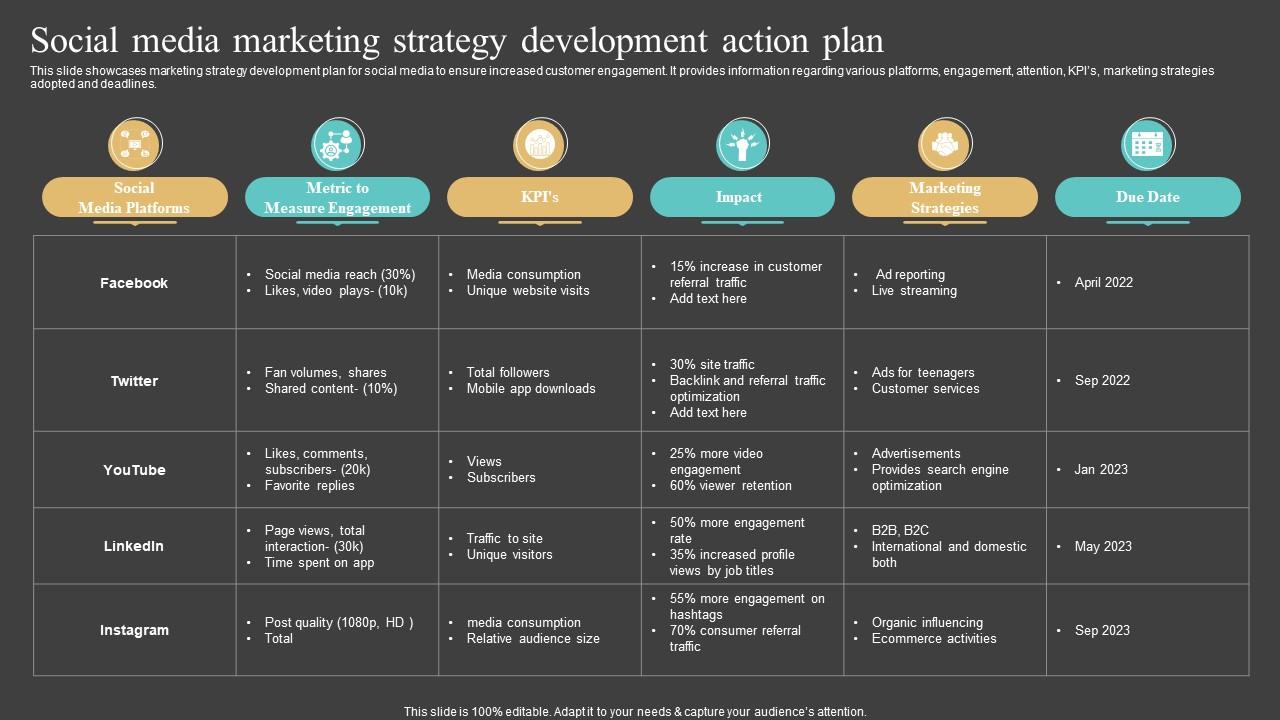
This slide showcases marketing strategy development plan for social media to ensure increased customer engagement. It provides information regarding various platforms, engagement, attention, KPIs, marketing strategies adopted and deadlines. Introducing our Social Media Marketing Strategy Development Action Plan set of slides. The topics discussed in these slides are Social Media Platforms, Measure Engagement, Marketing Strategies. This is an immediately available PowerPoint presentation that can be conveniently customized. Download it and convince your audience.

FAQs for Social Media Marketing Strategy

Key components include audience research and targeting, content planning and creation, platform selection, engagement strategies, and performance analytics. These elements work together by identifying ideal customers, delivering relevant content across appropriate channels, fostering meaningful interactions, and measuring results, with many businesses finding that this strategic combination drives brand awareness, customer loyalty, and ultimately sustainable growth.

Businesses measure social media ROI by tracking conversion rates, customer acquisition costs, engagement metrics, brand awareness levels, and revenue attribution from social channels. Through analytics tools like Google Analytics and platform insights, companies monitor lead generation, sales conversions, and customer lifetime value, ultimately delivering measurable returns with many organizations finding 3-5x revenue increases from strategic social investments.

Target audience research fundamentally shapes social media strategy by identifying demographics, preferences, platform behaviors, content consumption patterns, and engagement triggers that drive purchasing decisions. This research enables businesses to create targeted campaigns, select optimal platforms, craft resonant messaging, and allocate resources strategically, with many organizations finding that data-driven audience insights deliver significantly higher engagement rates and conversion outcomes.

User-generated content enhances social media marketing campaigns by increasing authenticity, expanding reach through organic sharing, and building stronger community engagement around brands. Through customer testimonials, product reviews, and branded hashtag campaigns, businesses streamline content creation while delivering higher conversion rates, reduced marketing costs, and enhanced customer trust, ultimately creating sustainable competitive advantage.

**INPUT**: What are the best practices for choosing the right social media platforms for a brand? **OUTPUT**: Best practices include analyzing target audience demographics, evaluating content format preferences, assessing resource requirements, studying competitor presence, and aligning platform strengths with business objectives. These strategic approaches streamline platform selection by matching audience behavior with brand capabilities, content types, and engagement goals, ultimately delivering focused marketing efforts and enhanced customer connections across increasingly competitive digital landscapes. **Word count: 56 words**

Brand storytelling enhances social media marketing by creating emotional connections, building authentic relationships, and differentiating brands through compelling narratives that resonate with target audiences. Through consistent storytelling across platforms, businesses humanize their brand, increase engagement rates, and foster customer loyalty, with many companies finding that narrative-driven content generates significantly higher shares and conversions than traditional promotional posts.

Common social media marketing pitfalls include inconsistent posting schedules, ignoring audience engagement, over-promoting products, neglecting analytics, and posting without strategic planning. These mistakes can significantly damage brand credibility and reduce reach, with many businesses finding that avoiding these errors through systematic content planning and community management ultimately delivers stronger customer relationships and improved conversion rates.

Businesses leverage analytics to optimize social media campaigns by tracking engagement metrics, analyzing audience demographics, monitoring conversion rates, and measuring ROI across platforms. Through data-driven insights, companies can refine content timing, adjust targeting parameters, and reallocate budgets toward high-performing channels, ultimately enhancing customer reach and driving measurable business growth.

Strategies to increase social media engagement include creating interactive content like polls and Q&As, posting consistently during peak audience hours, using relevant hashtags, sharing user-generated content, and responding promptly to comments. These approaches enhance audience connection by fostering community dialogue, building brand authenticity, and encouraging participation, with many businesses finding that consistent engagement ultimately delivers stronger customer relationships and improved brand loyalty.

Brands should manage online reputation through consistent monitoring, proactive engagement, authentic responses to feedback, and strategic content alignment across all platforms. This approach enables companies to address concerns quickly, build customer trust, and maintain brand consistency, with many organizations finding that integrated reputation management ultimately delivers stronger customer relationships and competitive advantage in increasingly crowded digital markets.

Timing and frequency in social media posting significantly impact audience engagement, content visibility, and brand reach by aligning with peak user activity, maintaining consistent brand presence, and optimizing algorithm performance. Strategic posting schedules enable businesses to maximize engagement rates, build stronger customer relationships, and achieve better ROI, with many organizations finding that data-driven timing strategies ultimately deliver enhanced brand awareness and competitive advantage.

Influencers can be effectively integrated through strategic partnership selection, authentic content collaboration, cross-platform campaign coordination, performance tracking, and long-term relationship building. By aligning influencer audiences with target demographics, brands in retail, beauty, and fitness sectors streamline brand awareness while enhancing customer trust, ultimately delivering higher engagement rates and measurable conversion growth.

Social media advertising serves as a targeted amplification tool within comprehensive marketing strategies, enabling precise audience segmentation, brand awareness acceleration, and direct conversion tracking. These paid campaigns complement organic content by reaching broader demographics, retargeting website visitors, and delivering measurable ROI, with many businesses finding that strategic social advertising significantly enhances overall marketing performance and customer acquisition costs.

Brands create compelling visuals through consistent color schemes, high-quality imagery, strategic typography, brand-aligned graphics, and platform-optimized formats. These visual elements enhance audience engagement by establishing recognizable brand identity, increasing content shareability, and driving higher interaction rates, with many retail and hospitality companies finding that cohesive visual strategies significantly boost their social media performance and customer loyalty.

Effective approaches include responding promptly with empathy, taking conversations private when appropriate, addressing concerns transparently, monitoring sentiment regularly, and developing clear escalation protocols. These strategies enhance brand reputation by demonstrating accountability and customer care, with many organizations finding that thoughtful responses to criticism ultimately strengthen customer relationships and showcase their commitment to service excellence.

Ratings and Reviews

80% of 100
Review Form
Write a review
Most Relevant Reviews
  1. 80%

    by Byrne Cruz

    Unique and attractive product design.
  2. 80%

    by Dion Dunn

    Great quality slides in rapid time.

2 Item(s)

per page: