


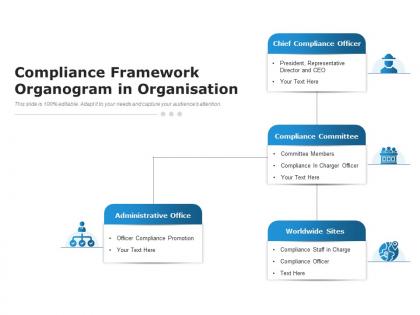
Compliance framework organogram in organisation




Try Before you Buy Download Free Sample Product
 Impress Your
 Audience
 100%
100% Editable
 Save Hours
 of Time


Handle delinquents with our Compliance Framework Organogram In Organisation. Generate genuine hope in their hearts.
People who downloaded this PowerPoint presentation also viewed the following :
Compliance framework organogram in organisation with all 2 slides:
Generate genuine hope in the despondent hearts with our Compliance Framework Organogram In Organisation. It helps handle the delinquent.

FAQs for Compliance framework
Key components of an effective compliance framework include governance structures, risk assessment protocols, policy documentation, monitoring systems, and training programs. These elements work together by establishing clear accountability, identifying potential violations, standardizing procedures, and ensuring continuous oversight, with many organizations finding that comprehensive frameworks significantly reduce regulatory risks while enhancing operational efficiency.
Organizations tailor compliance frameworks through risk assessments, regulatory mapping, stakeholder consultation, and continuous monitoring aligned with specific industry standards. Financial institutions implement anti-money laundering protocols while healthcare organizations focus on HIPAA requirements, with many finding that sector-specific customization streamlines audits, reduces violations, and ultimately delivers stronger regulatory adherence and competitive positioning.
Risk assessment serves as the foundation for developing effective compliance frameworks by identifying potential regulatory violations, operational vulnerabilities, and strategic threats that organizations face. Through comprehensive risk analysis, companies can prioritize compliance initiatives, allocate resources strategically, and design targeted controls that address their most critical exposures, ultimately delivering enhanced regulatory protection and operational resilience.
Technology enhances compliance framework implementation by automating monitoring processes, centralizing documentation systems, and providing real-time risk assessment capabilities. Through AI-powered analytics and integrated reporting platforms, organizations streamline audit preparations, minimize human error, and ensure consistent policy enforcement across departments, ultimately delivering faster regulatory responses and reduced compliance costs.
Organizations commonly face resource constraints, complex regulatory landscapes, siloed departmental operations, outdated technology systems, and inadequate staff training when establishing compliance frameworks. These challenges can significantly impact implementation timelines and effectiveness, with many financial services and healthcare institutions finding that strategic planning, cross-functional collaboration, and phased technology upgrades ultimately deliver streamlined processes and enhanced regulatory adherence.
Compliance frameworks should be reviewed annually at minimum, with updates triggered by regulatory changes, business expansions, or significant operational shifts. Many organizations conduct quarterly assessments to monitor emerging regulations and industry standards, while financial services and healthcare sectors often implement continuous monitoring systems, ultimately ensuring frameworks remain effective and aligned with evolving compliance landscapes.
Compliance framework effectiveness metrics include audit findings frequency, regulatory violation rates, incident response times, employee training completion rates, and policy adherence percentages. These measurements enable organizations to track risk mitigation, streamline reporting processes, and demonstrate regulatory alignment, with many financial institutions and healthcare organizations finding that regular metric analysis ultimately delivers improved operational transparency and reduced compliance costs.
Employee training integrates into compliance frameworks through regular educational programs, role-specific modules, continuous assessment protocols, and updated curriculum reflecting regulatory changes. These programs streamline compliance adherence by establishing clear expectations, reducing violation risks, and ensuring consistent organizational standards, with many financial services and healthcare institutions finding that systematic training ultimately delivers measurable compliance outcomes and operational efficiency.
Regulatory compliance frameworks focus on adhering to external government laws, industry regulations, and statutory requirements like GDPR or SOX, while corporate compliance frameworks encompass internal policies, ethical standards, risk management, and governance structures. Many organizations find that integrating both approaches creates comprehensive oversight, with regulatory compliance ensuring legal adherence and corporate compliance driving operational integrity, ultimately delivering reduced risk exposure and enhanced stakeholder confidence.
International regulations significantly influence local compliance frameworks by establishing baseline standards, harmonizing cross-border requirements, and creating consistent reporting protocols that organizations must integrate domestically. Many multinational corporations, financial institutions, and healthcare organizations find that aligning local frameworks with international standards like GDPR, Basel III, or ISO requirements streamlines operations while ensuring global regulatory consistency and competitive market access.
A compliance framework supports ethical business practices by establishing clear policies, mandatory training programs, transparent reporting mechanisms, regular auditing processes, and consistent enforcement protocols. These structured approaches enable organizations across healthcare, finance, and manufacturing to minimize misconduct risks, enhance stakeholder trust, and maintain regulatory alignment, ultimately delivering sustainable competitive advantage through ethical operations.
Organizations ensure stakeholder buy-in for their compliance framework by demonstrating clear business value, involving key stakeholders in development processes, and communicating how compliance reduces operational risks while enhancing competitive positioning. Through transparent reporting, regular training sessions, and showcasing cost savings from avoided penalties, companies build strong support across departments, ultimately creating a culture where compliance becomes integral to strategic success.
Documentation serves as the foundation of compliance frameworks by providing evidence of adherence, creating audit trails, and establishing clear procedures for regulatory requirements. It enables organizations to demonstrate accountability, streamline compliance processes, and mitigate risks during audits, with many financial services and healthcare institutions finding that comprehensive documentation ultimately reduces penalties and enhances operational transparency.
Compliance frameworks strengthen corporate governance by establishing clear accountability structures, standardizing risk management processes, and ensuring regulatory adherence across all organizational levels. These frameworks enable boards to monitor performance more effectively, streamline decision-making protocols, and maintain stakeholder trust, with many organizations finding that robust compliance systems ultimately deliver enhanced operational transparency and competitive advantage.
Organizations can adopt regular compliance audits, stakeholder feedback integration, technology automation updates, benchmark assessments against industry standards, and cross-functional training programs for continuous framework improvement. Through systematic monitoring and adaptive processes, companies in healthcare, financial services, and manufacturing streamline regulatory adherence, enhance operational efficiency, and maintain competitive advantage while minimizing compliance risks and costs.
No Reviews