


Compliance committee organogram structure for business




Try Before you Buy Download Free Sample Product
 Impress Your
 Audience
 100%
100% Editable
 Save Hours
 of Time


Deter delinquency with our Compliance Committee Organogram Structure For Business. Build good citizens of the future.
People who downloaded this PowerPoint presentation also viewed the following :
Content of this Powerpoint Presentation
Description:
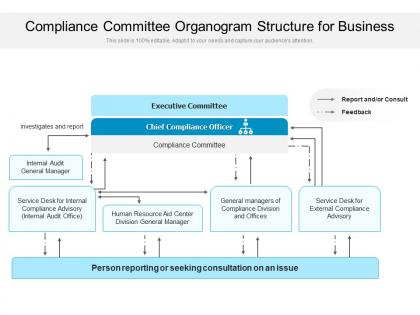
The image is a PowerPoint slide titled "Compliance Committee Organogram Structure for Business," which outlines the hierarchy and workflow of a typical compliance committee within an organization. The diagram is designed to show the reporting and advisory structure for compliance-related issues.
Text elements in the diagram include:
1. Executive Committee:
The top-level body that receives reports and feedback.
2. Chief Compliance Officer:
The executive is responsible for overseeing the compliance within the organization.
3. Compliance Committee:
A group that supports the Chief Compliance Officer and participates in investigations and reporting.
4. Internal Audit General Manager:
The manager is responsible for internal audits, and reporting to the Chief Compliance Officer.
5. Service Desk for Internal Compliance Advisory (Internal Audit Office):
The point of contact for internal compliance-related inquiries and support.
6. Human Resource Aid Center Division General Manager:
Manages HR-related compliance issues, reporting to the Compliance Committee.
7. General Managers of Compliance Division and Offices:
The leaders of specific compliance divisions, report to the Compliance Committee.
8. Service Desk for External Compliance Advisory:
Handles external compliance inquiries and advice.
Use Cases:
This slide can be adapted for use across various industries that require structured compliance mechanisms:
1. Banking:
Use: Outlining compliance structures for financial regulations.
Presenter: Chief Compliance Officer
Audience: Bank employees, regulatory bodies
2. Healthcare:
Use: Detailing compliance with healthcare laws and patient privacy.
Presenter: Compliance Director
Audience: Healthcare providers, hospital staff
3. Pharmaceuticals:
Use: Managing compliance with drug safety and marketing laws.
Presenter: Regulatory Affairs Head
Audience: Pharma employees, stakeholders
4. Education:
Use: Ensuring adherence to educational standards and regulations.
Presenter: Compliance Coordinator
Audience: Academic staff, administration
5. Manufacturing:
Use: Overseeing compliance with safety, environmental, and quality standards.
Presenter: Safety Officer
Audience: Factory managers, quality control teams
6. Energy:
Use: Directing compliance with energy regulations and standards.
Presenter: Compliance Manager
Audience: Energy sector employees, environmental agencies
7. Technology:
Use: Guiding compliance in data protection and software licensing.
Presenter: Legal and Compliance Executive
Audience: IT staff, software developers
Compliance committee organogram structure for business with all 2 slides:
Build good citizens of the future with our Compliance Committee Organogram Structure For Business. It helps deter delinquency.

FAQs for Compliance committee organogram
So a compliance committee is basically your company's watchdog crew - they monitor all the regulatory stuff and make sure you're not breaking any rules. They review audit results, investigate violations, and report straight to the board. Pretty important stuff, honestly. You'll want people from legal, risk, and operations on there. They set the compliance tone for everyone and approve policies. Think of them as the folks who keep you from accidentally stepping on regulatory landmines (which can get expensive fast). Their job is monitoring how well your compliance programs actually work in practice.
Quarterly meetings work for most compliance committees. High-risk industries might need monthly ones, especially when regulations are shifting. But honestly? Monthly can burn people out fast if you don't have enough real stuff to discuss - nobody wants to sit through status updates that should've been an email. Start with quarterly and see how it goes. You can always bump it up if things get crazy between meetings. Match your schedule to your actual workload and when regulatory deadlines hit. Oh, and definitely create a standard agenda so people aren't walking in blind.
So you'll need a good mix on that committee - definitely grab someone with legal chops and maybe a finance person who gets risk stuff. Operational folks are clutch too since they know what actually happens when policies hit the real world. Oh, and try to get someone from outside if you can swing it - they spot the obvious stuff we all miss when we're too close to it. Honestly, personalities matter as much as expertise. You want people who'll push back and ask hard questions, but aren't total nightmares to work with. Different perspectives save your ass later.
Honestly, it depends on how complicated your company is. I usually tell people to aim for 5-9 members - anything bigger and good luck getting everyone in the same room without it turning into chaos. You want someone from legal, operations, HR, finance, plus your compliance person. Maybe throw in a board member too. Don't overthink it though. Better to start small with like 5 people and see how it goes. You can always add more later if you're missing perspectives. I've seen too many committees fail because they tried to include everyone from day one.
Okay so definitely keep way more detailed minutes than you think you need. Who was there, what compliance stuff came up, how people voted on things. I learned this the hard way - vague notes will absolutely bite you later during audits. If someone disagrees with a decision, write that down too. Track who's supposed to do what by when. Store everything somewhere secure since auditors love requesting this stuff. Oh and use the same template every time - sounds boring but it actually makes your life easier and you won't forget important details.
So your compliance team basically sets up a tracking system for regulatory changes. They'll have people monitoring different regulatory bodies and subscribing to industry updates. Regular meetings happen to discuss new regs and figure out how they'll mess with your current processes - this gets wild depending on your industry, trust me. Implementation timelines get created, plus they identify what resources you'll need. Someone gets stuck owning each compliance update. Oh, and document everything in a regulatory change log. You don't want to lose track of this stuff later.
Start with getting leadership visibly on board - that's honestly half the battle right there. Build compliance into everyday stuff like onboarding and those lunch sessions people actually show up to. Make it relevant to what people do daily, not some abstract policy thing. You'll want clear reporting paths so folks aren't scared to speak up. Celebrate the wins publicly when teams nail compliance stuff. Oh, and definitely tie it to performance reviews - sounds harsh but people pay attention when it affects their ratings. The key is making it feel normal, not like extra work dumped on them.
Honestly, start with document management - it's a lifesaver for tracking policy changes and keeping everything in one place. Automated monitoring catches violations early, which saves you so much headache later. Remote meeting tools are obvious but data analytics dashboards are where it gets interesting - you'll actually see patterns you'd miss otherwise. Oh, and automated reporting is clutch for compliance metrics. Don't try to do everything at once though. Pick one thing first, maybe alerts or document stuff, then expand. My old company went overboard initially and it was a mess.
Honestly, the main headaches are always the same few things. Your compliance team gets pulled in a million directions while everyone else acts like they don't have to listen since nobody knows who actually makes the final call. Half the committee treats it like detention - they show up but mentally check out. Resource constraints hit hard too, which makes everything worse. You've gotta get crystal clear on who decides what, and make sure executives actually back you up instead of just saying they do. Regular training helps keep people awake, but real engagement comes from making sure the committee has actual authority. Otherwise you're just herding cats.
Get your conflict rules sorted before drama hits. Have everyone call out potential conflicts at each meeting - write it down too. Once someone's conflicted? They're out of that discussion completely, no voting allowed. Yeah it gets awkward but honestly better than the mess you'll have later. Maybe line up backup members for when this happens. Your committee charter should spell all this out super clearly so nobody can play dumb when conflicts come up. Oh and stick to the rules consistently - can't let people slide just because.
Track both the numbers and the softer stuff to get the whole picture. Incident response times, policy violations caught, training completion rates - that's your hard data. But also survey the departments you work with because honestly, if they hate dealing with your committee, something's wrong. Compliance program effectiveness matters most though - are you catching problems early or just putting out fires? Don't forget regulatory feedback and any penalties you've gotten. The real win is spotting risks before they blow up. I'd start with maybe 3-5 key metrics that match your biggest risk areas.
Set up monthly department liaisons - they're like compliance translators for each team. Coffee chats work way better than boring presentations, people actually ask questions when they don't feel attacked. Monthly Slack updates explaining *why* rules exist (not just "follow this because we said so") make a huge difference. Oh, and show up to their meetings sometimes instead of making them come to yours. Honestly, half of compliance issues happen because people think you're just there to bust them. When you prove you actually get their day-to-day struggles, everything gets easier.
Look, your compliance committee won't magically know what they're doing without proper training. They need regular updates on new regulations, risk assessment methods, and how to actually investigate stuff. Can't just rely on common sense here - I've watched committees crash and burn thinking they could figure it out as they go. Get them trained on compliance frameworks and interview techniques too. Oh, and soft skills matter more than people realize. Don't make it a one-and-done thing either. Quarterly sessions work well, plus you'll want to track who's completed what so you can spot any gaps.
So first thing - map out every compliance risk you can think of. Regulatory stuff, operational nightmares, reputation hits, all of it. Then figure out which ones are most likely to bite you and which would hurt the most. Get other departments involved too because honestly, they'll catch things you totally missed. Set up quarterly reviews to keep everything current - this can't be some document that just collects dust. Each risk needs someone owning it and a plan to deal with it. The whole point is making it actually useful, not just another corporate checklist nobody looks at.
So your compliance committee basically reports straight to the board of directors - they're like the board's scout team for risk stuff. Board members usually chair it or sit on it themselves, which makes sense since they need that direct line. Day-to-day monitoring and investigations happen at the committee level, then anything major gets bumped up to the full board. Honestly, I've seen companies mess this up by being vague about it. Short meetings work better than long ones, by the way. Just make sure your charter spells out exactly how often they meet and who reports what to whom.
No Reviews