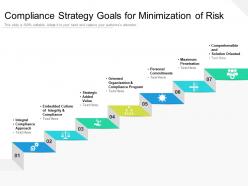
Compliance strategy goals for minimization of risk
Try Before you Buy Download Free Sample Product
Audience
Editable
of Time
Enable folks to enjoy the breaks with our Compliance Strategy Goals For Minimization Of Risk. Ensure the interim is interesting.
People who downloaded this PowerPoint presentation also viewed the following :
Content of this Powerpoint Presentation
Description:Â
The image portrays a slide from a presentation on Compliance Strategy Goals for Minimization of Risk. The slide is designed to be editable and aims at capturing the audience's attention. A step-by-step process is outlined from steps 1 to 7, each step presenting a strategic element of a compliance program aimed at reducing risk.
Step 01: Integral Compliance Approach -
This is about establishing a foundational approach that integrates compliance into the daily operations of the organization.
Step 02: Embedded Culture of Integrity & Compliance -Â
It focuses on creating a workplace culture that inherently values integrity and adherence to compliance norms.
Step 03: Strategic Added Value -Â
This step emphasizes on aligning the compliance strategy with the business strategy to add value to the organization.
Step 04: Oriented Organization & Compliance Program -Â
It suggests structuring the organization and its compliance program in a manner oriented towards achieving compliance goals.
Step 05: Personal Commitments -Â
It stresses the importance of individual commitment to compliance at all levels within the organization.
Step 06: Maximum Penetration -Â
This involves ensuring the compliance strategy is thoroughly implemented and understood throughout the organization.
Step 07: Comprehensible and Solution Oriented -Â
It highlights the need for the strategy to be easily understood and focused on practical solutions.
Use Cases:
This slide can be applied across multiple industries for various uses:
1. Financial Services:
Use: Establishing a robust compliance framework to navigate complex regulations
Presenter: Chief Compliance Officer
Audience: Compliance department
2. Healthcare:
Use: Aligning healthcare operations with regulatory standards and patient safety guidelines
Presenter: Healthcare Administrator
Audience: Medical staff and healthcare professionals
3. Manufacturing:
Use: Implementing safety and environmental regulations across the production process
Presenter: Safety Manager
Audience: Factory supervisors and workers
4. Technology:
Use: Ensuring products and processes adhere to privacy laws and cyber-security standards
Presenter: Data Protection Officer
Audience: IT and development teams
5. Education:
Use: Aligning institutional policies with educational standards and accreditation requirements
Presenter: University Dean or Compliance Coordinator
Audience: Faculty and administrative staff
6. Retail:
Use: Ensuring fair trade practices and regulatory compliance in supply chain management
Presenter: Operations Manager
Audience: Supply chain and store management teams
7. Energy:
Use: Overseeing regulatory adherence in terms of environmental impact and safety protocols
Presenter: Environmental Health and Safety Director
Audience: Engineers and field operators
Compliance strategy goals for minimization of risk with all 2 slides:
Brief the interns with our Compliance Strategy Goals For Minimization Of Risk. Guide them on how to act at the first instance.
FAQs for Compliance strategy goals for
The primary objectives of a compliance strategy include risk mitigation, regulatory adherence, operational standardization, stakeholder protection, and reputation management. These strategic frameworks streamline governance by establishing clear protocols, automating monitoring processes, and ensuring consistent practices across departments, with many organizations finding that robust compliance ultimately delivers competitive advantage, reduced legal exposure, and enhanced stakeholder trust.
Organizations effectively measure compliance strategy success through key performance indicators like audit results, regulatory violations, incident response times, training completion rates, and cost of compliance activities. These metrics enable businesses to track operational efficiency, minimize regulatory risks, and demonstrate ROI to stakeholders, with many financial services and healthcare organizations finding that comprehensive measurement frameworks ultimately deliver enhanced regulatory confidence and competitive advantage.
Risk assessment serves as the foundation for compliance strategy goals by identifying vulnerabilities, evaluating regulatory requirements, prioritizing resource allocation, and determining control mechanisms across operations. Through comprehensive risk analysis, organizations can establish targeted compliance objectives, streamline monitoring processes, and allocate resources strategically, ultimately delivering enhanced regulatory adherence and competitive advantage in increasingly complex business environments.
Companies align compliance strategy with business objectives by integrating regulatory requirements into strategic planning, establishing cross-functional governance committees, and embedding compliance metrics into performance dashboards. This strategic alignment enables organizations to transform compliance from a cost center into a competitive advantage, with many financial services and healthcare companies finding that proactive compliance frameworks streamline operations, reduce regulatory penalties, and accelerate market entry while building stakeholder trust.
Common compliance challenges include navigating complex regulatory requirements, managing resource constraints, ensuring employee training and awareness, maintaining consistent monitoring systems, and adapting to evolving legal frameworks. These obstacles often overwhelm organizations initially, but strategic planning, automated compliance tools, and cross-departmental collaboration help streamline processes, with many companies finding that systematic approaches ultimately deliver operational efficiency and reduced regulatory risks.
Organizations should revisit compliance strategy goals quarterly for tactical adjustments and annually for comprehensive strategic reviews, with additional assessments triggered by regulatory changes, business expansions, or significant incidents. This regular evaluation cycle enables companies to adapt to evolving regulations, shifting business priorities, and emerging risks, ultimately maintaining effective compliance programs while supporting organizational growth and minimizing regulatory exposure.
Regulatory change significantly impacts compliance strategy development by requiring organizations to reassess risk frameworks, update policies and procedures, and reallocate resources to address new requirements. These shifts often drive strategic transformation, with many companies finding that proactive compliance adaptation delivers competitive advantage, operational efficiency, and enhanced stakeholder trust.
Employee training integrates into compliance strategy goals by establishing comprehensive education programs, regular skill assessments, role-specific certifications, ongoing awareness campaigns, and performance monitoring systems. Through targeted learning modules, organizations enhance regulatory adherence, minimize violation risks, and strengthen ethical decision-making capabilities, while ensuring employees understand evolving requirements, ultimately delivering reduced compliance costs and improved organizational reputation.
**INPUT**: What metrics should be used to evaluate compliance strategy effectiveness? **OUTPUT**: Compliance strategy effectiveness metrics include incident reduction rates, audit completion times, regulatory violation frequencies, training completion percentages, and cost-per-compliance ratios. These measurements enable organizations to track operational efficiency, minimize regulatory risks, and demonstrate strategic value, with many financial services and healthcare institutions finding that comprehensive metrics ultimately deliver enhanced transparency and competitive advantage.
Technology enhances compliance strategy outcomes by automating monitoring processes, streamlining reporting workflows, and enabling real-time risk assessment across organizational operations. Through AI-powered analytics and integrated compliance platforms, financial institutions and healthcare organizations significantly reduce manual oversight burdens, accelerate regulatory reporting timelines, and maintain comprehensive audit trails, ultimately delivering enhanced accuracy and operational efficiency.
Leadership drives compliance culture by modeling ethical behavior, establishing clear expectations, allocating adequate resources, and consistently communicating compliance importance across all organizational levels. Through regular training initiatives, transparent reporting mechanisms, and accountability measures, executives demonstrate that compliance isn't merely regulatory obligation but strategic advantage, with many organizations finding that strong leadership commitment ultimately delivers reduced risk exposure, enhanced reputation, and sustainable competitive positioning.
Organizations ensure stakeholder engagement in compliance strategy through regular communication, collaborative policy development, comprehensive training programs, and establishing clear accountability frameworks. By involving key stakeholders in risk assessments, decision-making processes, and continuous monitoring, companies create shared ownership of compliance outcomes, ultimately delivering enhanced transparency, reduced regulatory risks, and stronger organizational alignment across all business units.
Key components include risk assessment protocols, regulatory monitoring systems, internal controls, employee training programs, and incident response procedures. These frameworks streamline compliance by identifying vulnerabilities early, automating regulatory updates, and establishing clear accountability structures, with many financial institutions and healthcare organizations finding that integrated approaches ultimately deliver reduced operational risks and enhanced regulatory confidence.
Organizations balance compliance with ethical considerations by integrating both legal requirements and moral principles into decision-making frameworks, establishing clear ethical guidelines alongside regulatory mandates, and creating governance structures that evaluate decisions through dual lenses. This strategic combination enables companies to exceed minimum standards while building stakeholder trust, with many finding that ethical compliance ultimately delivers competitive advantage and sustainable growth.
Compliance failures reveal critical lessons including inadequate risk assessment, poor communication across departments, insufficient training programs, and weak monitoring systems. These breakdowns, particularly evident in financial services and healthcare sectors, demonstrate that successful compliance requires continuous oversight, regular audits, and strong leadership commitment, ultimately delivering better risk management and regulatory confidence.
No Reviews