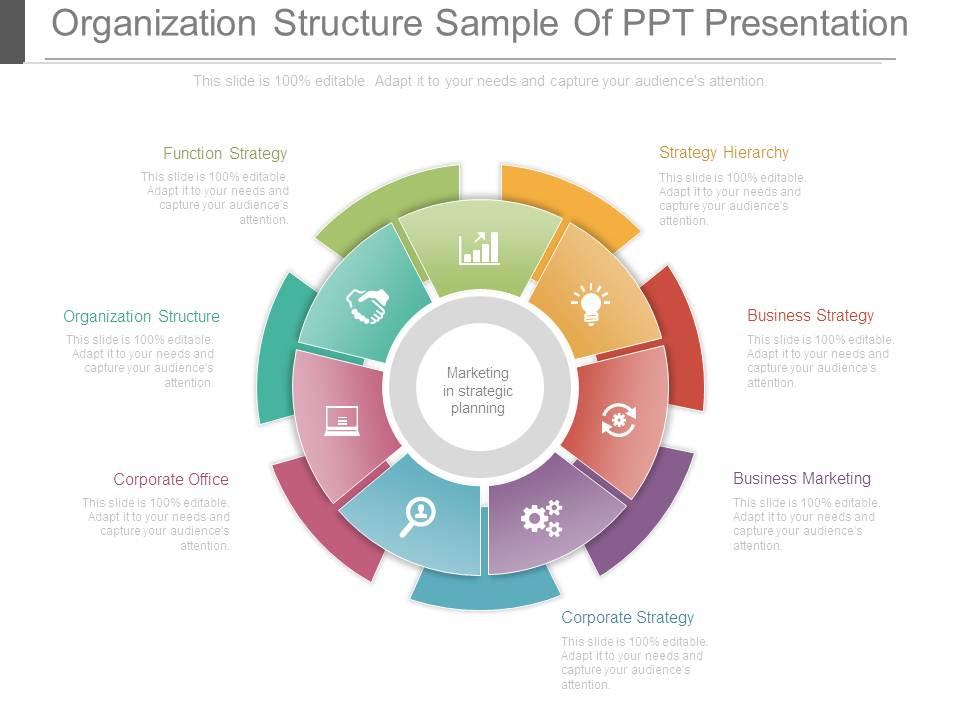
Organization structure sample of ppt presentation
Try Before you Buy Download Free Sample Product
Audience
Editable
of Time
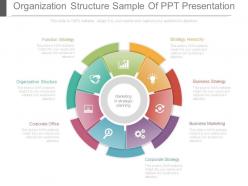
Elaborate on important instances with our Organization Structure Sample Of Ppt Presentation. Formulate guidelines for the future.
People who downloaded this PowerPoint presentation also viewed the following :
Organization structure sample of ppt presentation with all 7 slides:
Your achievements become a guiding force for all due to our Organization Structure Sample Of Ppt Presentation. You will be considered an icon.
FAQs for Organization structure sample
**INPUT**: What are the key components of an effective organizational structure? **OUTPUT**: Key components of an effective organizational structure include clear reporting relationships, defined roles and responsibilities, appropriate span of control, efficient communication channels, and strategic decision-making hierarchies. These elements streamline operations by eliminating confusion, enhancing accountability, and accelerating information flow, with many organizations finding that well-designed structures ultimately deliver improved productivity and competitive advantage.
Organizational structure significantly impacts employee performance and satisfaction by defining reporting relationships, communication flows, decision-making authority, and career advancement pathways. Clear hierarchies and well-defined roles enhance productivity, accountability, and job clarity, while flexible structures promote innovation and autonomy, with many organizations finding that strategic alignment between structure and culture ultimately delivers higher engagement and competitive advantage.
Flat organizational structures foster innovation by reducing bureaucratic barriers, encouraging direct communication across teams, enabling faster decision-making, and empowering employees at all levels to contribute ideas. These streamlined hierarchies facilitate rapid experimentation and creative collaboration, with many tech companies and startups finding that minimal management layers accelerate product development cycles and enhance competitive responsiveness.
Hierarchical organizational structures offer clear authority lines, defined reporting relationships, streamlined decision-making processes, enhanced accountability, and structured career progression paths. While this approach delivers operational efficiency and reduces role confusion, it can also limit innovation and slow communication flow, with many organizations finding that balancing hierarchy with collaborative elements ultimately enhances both control and agility.
Organizational structure aligns with strategic goals by determining how resources flow, decisions get made, and teams collaborate to execute priorities. Companies pursuing rapid innovation often adopt flatter structures for agility, while those focused on operational efficiency leverage hierarchical models, with many organizations finding that strategic alignment between structure and objectives directly impacts competitive advantage and market responsiveness.
Technology revolutionizes organizational structures by enabling flatter hierarchies, remote collaboration, automated decision-making, and real-time communication across global teams. Through cloud platforms, AI-driven analytics, and digital collaboration tools, companies streamline operations, reduce management layers, and enhance agility, with many organizations finding that technology-enabled structures deliver faster innovation and improved competitive positioning.
Organizational structure facilitates communication through clear reporting lines, defined channels, and streamlined decision-making processes, while hindering it through excessive hierarchies, departmental silos, and bureaucratic bottlenecks. Flat structures enable faster information flow and cross-functional collaboration, with many companies finding that matrix organizations enhance project coordination and innovation, ultimately delivering improved agility and competitive responsiveness.
Best practices for designing a flexible organizational structure include decentralized decision-making, cross-functional teams, streamlined reporting layers, adaptable role definitions, and robust communication channels. These approaches enhance organizational agility by enabling faster responses to market changes, promoting innovation through diverse collaboration, and reducing bureaucratic bottlenecks, with many companies finding that flexible structures ultimately deliver improved employee engagement and competitive advantage.
Cultural differences significantly influence organizational structure in multinational companies through varying communication patterns, decision-making hierarchies, authority relationships, and employee expectations across regions. Companies like Unilever and McDonald's adapt their structures by implementing hybrid models that blend centralized strategic control with localized operational flexibility, ultimately enabling better cultural integration while maintaining global consistency and competitive advantage.
Remote work fundamentally reshapes traditional organizational structures by flattening hierarchies, increasing communication transparency, and shifting focus from physical presence to performance-based outcomes. This transformation enables companies to access global talent pools, reduce operational costs, and create more flexible reporting relationships, with many organizations finding that distributed teams actually enhance collaboration and accelerate decision-making processes.
Flat and matrix organizational structures are most effective for startups, enabling rapid decision-making, cross-functional collaboration, and resource flexibility. These models streamline communication while minimizing hierarchical bottlenecks, with many tech startups and emerging companies finding that flat structures accelerate innovation, enhance adaptability, and deliver faster market responses in increasingly competitive landscapes.
Changes in leadership significantly impact organizational structure through strategic realignments, communication flow modifications, decision-making process adjustments, and cultural shifts. New leaders often restructure reporting hierarchies, redefine departmental roles, and implement fresh operational frameworks, with many organizations finding that these transitions ultimately enhance efficiency, streamline workflows, and deliver competitive advantages through improved strategic focus.
Project-based structures enable flexible resource allocation, faster decision-making, and enhanced innovation through cross-functional collaboration, while functional structures deliver operational efficiency, specialized expertise development, and clearer career paths. Many organizations find that project-based approaches accelerate time-to-market and customer responsiveness, whereas functional structures streamline processes and maintain consistent quality standards across departments.
Organizations can assess structural effectiveness by evaluating communication bottlenecks, decision-making speed, employee engagement levels, operational efficiency metrics, and alignment with strategic goals. Through regular organizational audits, performance analytics, and employee feedback systems, companies identify structural gaps that hinder growth, with many finding that outdated hierarchies significantly impact competitive responsiveness and innovation capacity.
Visual representation of organizational structure benefits internal communication by clarifying reporting relationships, streamlining decision-making processes, reducing confusion about roles and responsibilities, and enhancing transparency across departments. These visual tools enable employees to identify appropriate contacts quickly, facilitate cross-functional collaboration, and minimize communication delays, with many organizations finding that clear structural visibility ultimately improves workflow efficiency and reduces operational bottlenecks.
-
good!
-
good!
-
Unique design & color.
-
Presentation Design is very nice, good work with the content as well.