


Components Of Geothermal Power Plant Clean Energy Ppt Powerpoint Presentation Icon Samples




Try Before you Buy Download Free Sample Product
 Impress Your
 Audience
 100%
100% Editable
 Save Hours
 of Time


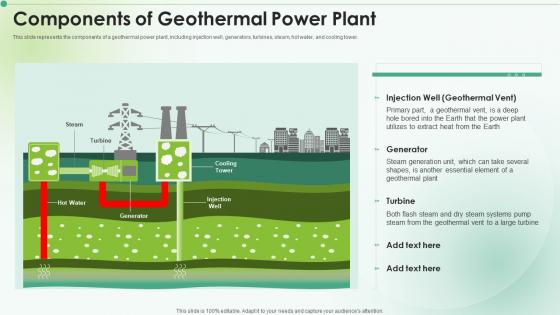
This slide represents the components of a geothermal power plant,including injection well,generators,turbines,steam,hot water,and cooling tower.
People who downloaded this PowerPoint presentation also viewed the following :
Components Of Geothermal Power Plant Clean Energy Ppt Powerpoint Presentation Icon Samples with all 6 slides:
Use our Components Of Geothermal Power Plant Clean Energy Ppt Powerpoint Presentation Icon Samples to effectively help you save your valuable time. They are readymade to fit into any presentation structure.





FAQs for Components Of Geothermal Power Plant Clean Energy Ppt Powerpoint
So basically you've got production wells pulling up the hot stuff from underground, then a separator splits the steam from liquid. Steam hits the turbines to make electricity - pretty cool how that works. After that, injection wells pump the cooled fluid back down where it came from. Oh and there's a condenser too that turns steam back to water, plus you'll probably see those big cooling towers. Honestly the well depth and temperature are what really matter for how well the whole thing runs, so definitely ask about that if you tour one.
Honestly, your reservoir data is gonna make or break the whole thing. High-temp, high-pressure? You're golden - just go with dry steam. Most places aren't that lucky though, so you'll probably need binary or flash systems. The chemistry matters too since some geothermal fluids will eat through your equipment if you pick the wrong materials. Flow rates tell you what size turbine to get, and depth affects your well setup and pumping needs. Temperature's huge - it controls efficiency and whether you can get away with air cooling or need towers. Don't even think about plant layouts until you've got solid reservoir numbers.
So heat exchangers are basically where all the magic happens in binary-cycle geothermal plants. They grab thermal energy from the hot geothermal fluid and pass it to a secondary working fluid - but here's the key part, the two fluids never actually mix. Why? The geothermal stuff is usually loaded with corrosive minerals that'll destroy your turbines if you're not careful. Instead, you heat up a clean secondary fluid (isobutane works great) until it vaporizes and spins the turbine. The whole thing's pretty clever actually. Just make sure you're maximizing heat transfer efficiency since that's what'll make or break your power output.
So geothermal efficiency is basically thermal efficiency - you take your electrical output and divide it by the heat energy coming from your resource. Most plants hit around 7-15%, which honestly doesn't sound impressive but it's actually not bad for this tech. The cool part is your "fuel" costs nothing after you drill the wells, unlike coal or gas plants that keep burning money. Oh, and definitely watch your capacity factor too - shows how much you're actually producing vs. what you could theoretically make. That metric can be pretty revealing.
Three big things to watch with geothermal plants: toxic gas handling, high-pressure steam, and ground subsidence. Hydrogen sulfide is nasty stuff - kills you fast even in tiny amounts, so your detection systems better be rock solid. Steam circuits need bulletproof pressure relief valves and emergency shutoffs. Oh, and monitoring ground movement is massive since pulling fluids out can make everything settle weird. Honestly, the whole industry learned this the hard way. Build in backup safety systems for everything because geothermal doesn't mess around when it goes sideways.
So you've got two main options depending on your water temp. High-temp stuff (300°F+) works great with flash steam - hot water basically explodes into steam when pressure drops. Pretty cool actually. For cooler sources, binary systems are where it's at - they use some other fluid that boils way easier than water, so even 150-300°F can work. I'd honestly check your field temps first though, since that'll tell you which route makes sense. No point overthinking it until you know what you're dealing with.
So there's basically three types, and it all depends on what you're working with underground. Dry steam is the simplest - just pipe the steam straight to your turbines. Problem is, those sites are super rare. Flash steam takes hot pressurized water and drops the pressure to make steam - that's what most plants use. Binary cycle is honestly the smartest approach though. Uses a secondary fluid that boils at way lower temps, so you can actually generate power from cooler geothermal sources. Temperature's gonna be your main deciding factor when you're scoping sites.
Yeah, so geothermal plants mostly use closed-loop systems - you're recycling the same water instead of constantly needing fresh supplies. After they extract the energy, the fluid goes right back into the reservoir. Pretty neat setup, honestly. Your waste is mainly mineral deposits and brine that separate out during the process. Plants filter this stuff and dispose of it per local regs, though some are starting to recover minerals for commercial use (kind of smart actually). Water consumption beats coal and gas plants by miles. You'll just need good protocols for handling the mineral buildup - that part's unavoidable.
Yeah, geothermal's pretty clean overall but there are definitely some downsides. You've got potential groundwater contamination since those fluids can have heavy metals and nasty chemicals. The drilling can actually cause small earthquakes too - not huge ones, but still. Oh, and the hydrogen sulfide thing makes everything smell like rotten eggs, though newer plants deal with that way better. Land can sink if they pull out too much fluid without pumping it back. Honestly, the footprint's still smaller than most energy sources though. Just make sure you check the local geology and water systems before picking a site.
So the new drilling tech is a game changer – you can reach way deeper and hotter geothermal spots that were impossible before. The directional drilling is honestly pretty crazy to watch. You'll get much higher power output since you're hitting those hotter reservoirs. Plus drilling costs drop and you finish projects faster. My buddy worked on one last year and said the temperature difference was night and day compared to shallow wells. ROI jumps big time with these methods. If you're doing any geothermal stuff, definitely check out the newer techniques first.
So basically the reinjection system pumps all that cooled water back underground after you've grabbed the heat from it. Without this, you'd totally drain your geothermal field and be screwed. It keeps the reservoir pressure up too, which stops the ground from sinking and messing up your equipment - nobody wants that headache. Most places legally require it anyway since you can't just dump geothermal water wherever. Oh, and space those reinjection wells far enough from your production ones or you'll cool down your heat source too fast. Learned that one the hard way!
So you need spots with really hot underground temps - like 300°F minimum. Rock formations have to be porous enough for water to flow through, plus you need water sources down there. Location is huge though - places near fault lines or volcanic areas are money. Iceland totally lucked out with this stuff! Drilling costs go crazy the deeper you go, so finding heat closer to surface saves you tons. Oh and make sure there's power lines nearby and the ground won't just swallow your plant. Definitely get geological surveys done first - trust me on that one.
Yo! So enhanced geothermal systems are huge right now - they let you extract heat even without natural water sources. Binary cycle plants are making lower-temp resources actually worth it, which is pretty sweet. Closed-loop systems circulate fluid through sealed underground pipes. Oh, and they're using drilling tech from oil/gas to hit deeper zones way more efficiently. Machine learning's helping optimize everything too, though honestly that's becoming standard everywhere these days. Fervo Energy's doing some really interesting work with enhanced systems if you want to check out real examples.
Honestly, the mineral buildup is probably gonna be your biggest headache. Those deposits will wreck your heat exchangers way faster than you think. You're also dealing with corrosive fluids that can eat through equipment - totally different from solar or wind where it's mostly weather and mechanical stuff. Water chemistry becomes this whole thing you have to monitor constantly. Plus you'll need people who get both the power side AND the geochemistry, which isn't cheap. My buddy worked at one and said they were always replacing components. Budget extra for chemical treatment systems from the start.
Honestly, geothermal is pretty smart financially. You're getting free fuel from the earth's heat - no coal or gas bills eating into your profits. Sure, the upfront investment hurts more than traditional plants, but these things run 24/7 with crazy high capacity factors, like 90%+. Way better than solar or wind that way. The real win? You don't have to stress about fuel price swings that can wreck your budget overnight. I've seen too many projects get burned by that. Maintenance is lighter too since there's less moving parts to break. Run the math over 20-30 years and geothermal typically comes out ahead, especially with carbon pricing getting stricter.
-
The customer care of SlideTeam is very responsive. I was having a payment issue and they fixed it for me in no time.
-
“The presentation template I got from you was a very useful one.My presentation went very well and the comments were positive.Thank you for the support. Kudos to the team!”