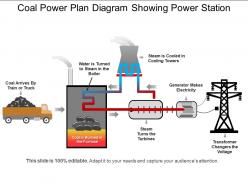
Coal power plan diagram showing power station
Try Before you Buy Download Free Sample Product
Audience
Editable
of Time
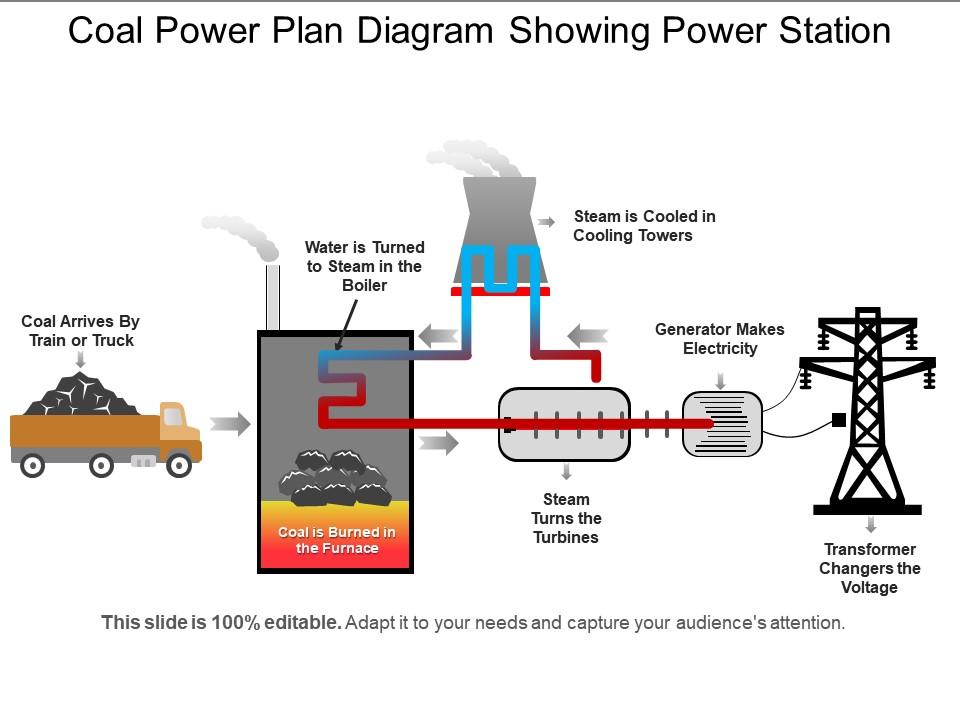
Employ Coal Power Plan Diagram Showing Power Station for presenting the coal energy generation process. This thermal power plant graphic consists of various stages such as the arrival of coal, boiling of coal and water, passing pressurized steam through a turbine, condensin, voltage charging, etc. Take the advantage of this PowerPoint infographic and present the various apparatus such as boiler, condenser, etc. which is required to facilitate the energy generation process. Explain the functions of various components such as condenser, boiler, economizer, etc. with this fossil fuel energy shape. Take the assistance of this power generation slideshow and clarify the electromagnetic principle on which a transformer works. This energy flow process diagram is completely adaptable to your business requirements, so you can replace the text with your own relevant content. Thus, download this thermal power station visual to explain the process of energy generation to engineers and project managers of your industry in a simple way.
People who downloaded this PowerPoint presentation also viewed the following :
Coal power plan diagram showing power station with all 5 slides:
Experience fulfilment with our Coal Power Plan Diagram Showing Power Station. You will be ecstatic with your achievement.
FAQs for Coal power plan diagram
Okay so basically you've got the boiler where they burn coal to heat up water. That creates steam which goes to the turbine, spins it, and that powers the generator to make electricity. Then there's the condenser and cooling tower to turn everything back to water - rinse and repeat. Don't forget about all the coal handling stuff too, like conveyor belts and crushers (honestly that part's pretty cool). The steam path is what you want to follow first when looking at these diagrams. Makes way more sense once you trace how the steam flows through everything.
So basically you dump powdered coal into this massive furnace and it burns crazy hot - like 2000°F hot. Hot gases rise up through tubes filled with water, turning it into steam. That steam spins the turbines and boom, electricity. The annoying part is getting the air-fuel mix just right so you burn everything cleanly without nasty emissions. Oh, and if you're looking at those efficiency charts, pay attention to heat transfer spots. That's where plants waste the most energy - honestly drives me nuts how much gets lost there.
Look, the boiler's basically where all the magic happens. You're burning pulverized coal in this combustion chamber that hits like 3,000°F - which is absolutely insane when you think about it. Water in the tubes around it turns into high-pressure steam. Then that steam gets superheated to around 1,000°F before it heads off to the turbines. Honestly, if your boiler isn't running efficiently, everything else just crumbles. That's why I always tell people to check boiler efficiency first when stuff starts going wrong. It'll save you hours of headaches.
So basically you burn coal to heat up water until it becomes steam. The steam gets super pressurized and hits these huge turbines - kinda like a waterwheel but with steam instead. Those turbines spin generators that make the actual electricity. Pretty cool how it works, honestly. The whole thing is just converting energy from one form to another: chemical energy in the coal becomes heat, heat makes steam, steam spins stuff, spinning creates electricity. When you're showing people around, just walk them through that chain reaction and they'll get it. Oh and the electricity travels through those big power lines you see everywhere to reach homes and businesses.
So there's basically three main types - bituminous is what most plants go with because it's got solid energy content and burns well. Anthracite is the cleanest burning but costs more and honestly, it's getting harder to source. Sub-bituminous has less sulfur which is nice for keeping emissions down, though you sacrifice some heat output. Really comes down to what's available near you and what your environmental regs look like. Oh, and obviously cost matters too. I'd start by seeing what coal suppliers are actually in your area, then match that up with your BTU needs. Location makes a huge difference here.
So basically coal plants have a bunch of different systems to clean up emissions. Electrostatic precipitators and baghouses catch all the particles floating around. Then scrubbers spray limestone into the gas to pull out sulfur dioxide - pretty clever actually. For nitrogen oxides they inject ammonia through these SCR systems that break it down into regular nitrogen and water. Mercury's the tricky one though, usually needs activated carbon. The whole thing can remove like 90% of most pollutants, but man does it eat up energy. If you're checking out a plant's environmental stuff, definitely ask about their specific setup and how well it actually works.
So the steam turbine is where all the magic happens - that's your electricity maker right there. High-pressure steam slams into these blades and spins the whole thing, which turns the generator. It's like a massive pinwheel but obviously way more complex. Honestly, without it you're just heating up really expensive water since that's what actually converts the heat from burning coal into spinning motion. When you're looking at those plant diagrams, follow the steam path to the turbine first. Makes the whole energy conversion thing click way easier.
So cooling towers are pretty straightforward - they take that super hot water from your condenser and cool it down for reuse. The water's still scorching after steam condenses back from the turbine. Hot water gets pumped to the top, trickles down through fill material while air flows upward. Evaporation and air circulation do their thing, and you get cooler water at the bottom. It's honestly crucial for plant efficiency since you're not burning through water and energy. Oh, and definitely keep an eye on cooling tower performance - when it starts slacking, your whole plant output takes a hit.
Oh man, coal plants are rough on the environment. CO2 emissions are the big one - they pump out tons and really drive climate change. Then you've got sulfur dioxide and nitrogen oxides causing acid rain and nasty smog. Air quality gets pretty terrible around these places, honestly. The coal ash disposal is a nightmare too since it's loaded with heavy metals that can leak into groundwater. They use massive amounts of water for cooling and steam. Oh, and if you're looking at sites, definitely check local regulations first - cleanup costs can be insane.
So coal plants are actually way different now than they used to be. Modern ones have all these scrubbers and filters that catch most of the nasty stuff before it hits the air. The boilers burn way more efficiently too - they can squeeze like 10-15% more power from the same amount of coal using these supercritical steam systems. Pretty crazy how much the tech has evolved, honestly. My buddy who works at a plant showed me some diagrams once and the emissions control section was massive compared to older designs. Still not great for the environment obviously, but the engineering improvements are legit impressive.
When you're looking at coal plant diagrams, start with the emergency response stuff - that's where you'll get the big picture of how they handle disasters. Look for the obvious safety gear like emergency shutdown controls and pressure relief valves. Fire suppression systems are scattered everywhere, plus you'll spot emission monitoring on the stacks. Honestly, all the red highlighting and warning symbols make these things look terrifying. They mark safety barriers around the crazy hot areas too. Oh, and cooling system safeguards - those are huge. The electrical isolation points are clearly marked since getting zapped isn't exactly ideal.
So coal transportation is basically getting raw coal from mines to your power plant - trains, trucks, barges, whatever works. Then you've got all these conveyor belts and storage yards to move it around before it gets pulverized. Honestly way more complicated than it sounds! The whole transportation setup feeds directly into your fuel handling systems, which then connects to where the actual burning happens in the boiler. Oh and definitely check out those conveyor routes when you're looking at plant layouts - they'll show you how everything flows through the facility.
So basically, supercritical plants run at way higher pressure and heat than subcritical ones. Subcritical stays under 3,200 psi, but supercritical goes above the critical point where water just turns to steam instantly - no bubbling like we saw in chem class. Efficiency-wise, supercritical wins big time. They hit around 40-45% compared to subcritical's 35-40%. Better efficiency means you're burning less coal for the same power output, which is obviously better for emissions too. Pro tip: when you're looking at plant specs, check the steam conditions first. It'll tell you right away what type you're dealing with, and honestly it's the quickest way to gauge how modern the setup is.
So coal plants are basically the workhorses that never call in sick - they'll run 24/7 no matter what the weather's doing. Solar and wind are great but honestly, they're unreliable when you need power RIGHT NOW. Coal gives you that steady baseload power that grid operators can count on. You can stockpile months worth of fuel on-site too, which is pretty smart. Oh, and there's this technical thing called inertia that helps keep the grid stable when demand suddenly jumps. Bottom line? It's all about having that predictable power you can dispatch whenever.
Dude, coal plants are getting hammered right now. Emissions rules keep getting tighter, carbon pricing is eating into profits, and everyone's mandating renewables instead. Communities hate them too - air quality complaints are everywhere. That whole "clean coal" thing? Total flop, nobody bought it. Permits take forever now, retrofitting costs are insane, and good luck getting approval for expansions. Oh, and the economics are getting worse by the year. If you're looking at coal investments, just know the regulatory stuff can tank a project before it even starts. Pretty rough industry to be in honestly.
-
Great product with highly impressive and engaging designs.
-
The content is very helpful from business point of view.