


Electrical power grid process framework





Try Before you Buy Download Free Sample Product
 Impress Your
 Audience
 100%
100% Editable
 Save Hours
 of Time


Our Electrical Power Grid Process Framework are explicit and effective. They combine clarity and concise expression.
People who downloaded this PowerPoint presentation also viewed the following :
Electrical power grid process framework with all 2 slides:
Give your audience a fulfilling experience. They will find our Electrical Power Grid Process Framework elevating.
FAQs for Electrical power
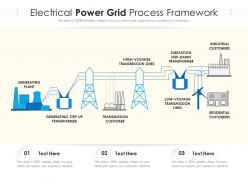
So you've got generation first - that's your power plants making electricity. Then transmission moves it long distances through those massive high-voltage lines. Distribution handles the local stuff, getting power to actual neighborhoods. Substations are scattered throughout, stepping voltage up and down as needed. Control systems keep everything balanced (honestly the most underrated part), plus you need protection systems and smart meters. Storage is becoming huge too. It's basically one giant interconnected web. I'd start by figuring out which piece your project hits first - everything else connects from there.
So smart grids are game-changers - they give you real-time control over your whole power network instead of just hoping everything works. The automated stuff is where it gets interesting: demand response kicks in automatically, you get maintenance alerts before things break, and load balancing happens without you touching anything. Renewable integration becomes way smoother too. Your customers can actually see their usage through smart meters, which honestly surprises me how much people care once they can track it. Oh, and if there's an outage, the system just reroutes power around it. I'd definitely start with pilot programs in your most critical areas first though.
Dude, our power grid is basically ancient - we're talking 1960s infrastructure trying to handle solar panels and EVs. It's wild. The whole system was built for power flowing one direction: big plant to your house. Now it's gotta deal with energy going both ways, plus wind and solar are super unpredictable. Honestly feels like trying to stream Netflix on dial-up sometimes. The grid just can't keep up with demand spikes either. Push for smart grid upgrades in your area and battery storage - that's really the only way we're gonna fix this mess without constant blackouts.
Yeah, renewables do mess with grid stability a bit. Wind and solar are unpredictable - can't exactly tell the sun when to shine, right? So matching power supply with what people actually need gets tricky, and you end up with voltage problems or frequency issues. But honestly, we've gotten pretty good at dealing with it. Smart inverters help a lot, plus battery storage and weather forecasting. Grid operators just have to stay on their toes - when renewable output suddenly drops, they fire up backup sources like gas plants or pull from batteries. It's definitely doable with the right setup.
So basically energy storage is like having a buffer for your power grid. Excess electricity gets stored in batteries when you don't need it, then gets released during peak times or outages. The response time on some of these systems is actually insane - we're talking milliseconds. You can use it for backup power too, which is clutch for hospitals and stuff that can't afford to go down. Oh and if you're doing any grid planning, I'd definitely start with storage in your most vulnerable spots first. Makes the biggest difference there.
So basically regulators are like referees for utility companies - they set all the rules about how they can build stuff, what they're allowed to charge, safety requirements, the whole deal. Companies can't just do whatever they want or jack up prices randomly. These policies affect everything from how fast the grid gets upgraded to how much renewable energy gets added in. Your electric bill? Yeah, that's influenced by this stuff too. Oh and if you're thinking about any grid projects, definitely check what the current rules are first - I've seen projects get totally screwed because someone didn't do their homework on regulations.
Look, power grids are basically huge networks of connected systems - SCADA, smart meters, control stuff - and hackers love targeting them. Most of this infrastructure wasn't built thinking about cyber threats, so it's pretty vulnerable honestly. When attacks work, you're talking blackouts across entire regions, hospitals losing power, even electricity market manipulation. It goes way beyond typical IT problems too - we're talking national security and public safety here. Oh and economic chaos obviously. Best approach? Treat grid infrastructure like any critical IT system and get serious about network segmentation.
Dude, AI is seriously a game-changer for grid stuff. Start with demand forecasting - that's your easiest win right there. It predicts power needs using weather patterns and usage data, which honestly feels like magic sometimes. Load balancing happens automatically, plus you get way faster fault detection. The cool part? It handles renewable energy way better than old-school methods since it actually adapts to all that variability. Oh, and it learns as it goes - my buddy's company saw huge improvements within months. Real-time optimization means fewer outages and smarter energy storage too.
So grid interconnections are like having backup plans for your electricity. Different regions link up their power grids, which is honestly pretty smart when you think about it. If one area has an outage, power flows in from somewhere else. Plus countries can trade energy - like if Germany has extra wind power, they'll sell it to France who needs it. This makes electricity cheaper and way more reliable. Renewables get tricky because wind doesn't always blow, but interconnected grids smooth that out since there's always power flowing from somewhere. Bottom line: shared grids mean better, cheaper electricity for everyone.
So demand response is when utilities can tweak your electricity use during busy times to keep everything running smooth. Like when it's blazing hot and everyone's blasting their AC - instead of cranking up those crazy expensive backup plants, they'll temporarily dial down stuff at businesses and homes that signed up. You actually get paid for letting them do this, which is honestly not bad. The grid stays stable, you make some cash. If you're thinking about it for your place, just figure out what equipment you could shut down for a bit without screwing up your main operations. Pretty straightforward stuff.
Yeah, grid expansion is tricky - you've got habitat issues from new transmission lines plus all the visual pollution (power lines are ugly, let's be honest). Construction messes with soil too. But here's what's interesting: expanding grids actually helps renewables since you can connect those remote wind farms to cities where people need power. There's some debate about electromagnetic effects, though I'm not sure how serious that really is. Short-term environmental hits versus long-term climate benefits - that's basically what you're weighing. Just make sure you do proper environmental assessments upfront so you can plan around the worst impacts.
So microgrids are pretty sweet - they let you generate power locally instead of depending on the main grid all the time. You can throw in solar panels, wind turbines, battery storage, whatever works for your community. When the power goes out, you're not stuck waiting around for utility crews because it runs independently. That's honestly the best part. Cuts down on transmission losses too since electricity doesn't have to travel as far. Plus you're using way more renewables at the local level, which is huge for sustainability. I'd start by figuring out what critical stuff in your area really needs backup power first.
So the power grid's basically getting flipped upside down right now. Everyone's putting solar panels on their roofs and adding battery storage, which breaks that old centralized system apart. Smart tech is everywhere - real-time monitoring, automated responses, the works. Honestly, the speed of change is crazy to watch. Most of it's driven by the climate push and making grids tougher against outages. Oh, and microgrids are popping up everywhere too. Keep an eye on energy storage projects near you - they're like a preview of what's coming next.
Dude, power quality stuff will absolutely wreck your day if you're not careful. Voltage spikes, harmonics, weird frequency issues - they'll crash your computers and make motors run like garbage. Industrial places get hit the worst since everything's so automated. I learned this the hard way at my last job when a small power hiccup shut down our entire line for 3 hours. Cost us a fortune. Honestly, just throw some monitoring equipment on your main power feeds. You'll spot problems early instead of dealing with expensive surprises later. Trust me on this one.
Yeah, so the initial investment is brutal - we're talking hundreds of billions for smart meters, new transmission lines, all that automation stuff. Your bills will definitely go up at first to pay for it. Kinda like when you renovate your kitchen and eat ramen for months, you know? But the payoff comes later - fewer blackouts, way better efficiency, lower maintenance. Plus utilities can make money from new things like energy storage programs. I'd say plan for the sticker shock now, but you should see solid returns in maybe 10-15 years.
No Reviews