


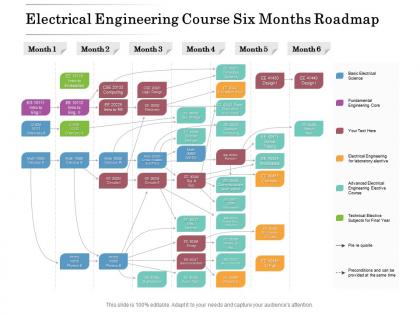
Electrical engineering course six months roadmap




Try Before you Buy Download Free Sample Product
 Impress Your
 Audience
 100%
100% Editable
 Save Hours
 of Time


A well thought out action plan makes execution easier and increases the possibility of success significantly. Ensure hitting all the milestones within the deadlines by introducing our fully customizable Electrical Engineering Course Six Months Roadmap. Streamline the work related information, budget, timeframe, key deliverable, landmarks, and major steps involved, all in one place to give an organized overview of the project by utilizing our PowerPoint theme. Minimize time lag and increase work efficiency by providing insight into the process with our comprehensively researched roadmap PowerPoint layout. Color coding helps in highlighting the process and grabs the attention of the audience. Download our handy Electrical Engineering Course Six Months Roadmap to identify the possible problem areas in a much shorter time and propose solutions. Have a productive brainstorming session with your workforce by utilizing our action plan visualization tool.
People who downloaded this PowerPoint presentation also viewed the following :
Electrical engineering course six months roadmap with all 2 slides:
Give your audience a fulfilling experience. They will find our Electrical Engineering Course Six Months Roadmap elevating.
FAQs for Electrical engineering course
Start with circuit analysis - Ohm's law, KVL, KCL, basic AC/DC stuff. That's your foundation. The math feels brutal at first but suddenly makes sense when you're working with actual circuits. Signals and systems comes next, then electromagnetics and digital logic. Definitely learn semiconductor physics too - how diodes and transistors actually function inside. Trust me, it'll save you from so many "why isn't this working??" moments later. Oh, and build simple circuits while you're studying theory. Hands-on practice beats just reading textbooks any day.
Dude, the job's changed SO much from just running coal plants. Now you're dealing with solar/wind integration, battery storage, all that smart grid stuff. Way more interesting though! Power electronics is huge - inverters, battery management systems, the whole deal. Everything's shifting toward distributed energy and microgrids instead of those massive centralized plants. Oh and renewable energy standards - definitely learn those if you haven't already. That's honestly where all the good opportunities are right now. Grid integration knowledge is basically required at this point.
Dude, electrical engineering is everywhere! Power systems if you want to work on the grid, electronics design, telecom stuff. Software's big too if you're into coding. Control systems in manufacturing pays really well from what I've heard. Project management and tech sales are solid options after you get some experience under your belt. The field's honestly so broad it can feel overwhelming - I had no clue what I wanted when I started. Definitely try different internships while you're in school though. You'll figure out what clicks.
Dude, the whole field is changing fast with AI and IoT everywhere. You'll definitely need to get into edge computing and sensor networks - that's where everything's heading. The hardware side is getting insane too, like designing circuits that barely use any power but still run machine learning stuff in real time. FPGA programming is super useful to learn right now. Oh and neuromorphic computing is pretty wild if you want to get ahead of everyone else. Honestly the data flow requirements alone are making chip design way more complex than it used to be. But it's actually fun once you get into it.
Dude, software is HUGE in EE now. Like, I spend half my time coding instead of just circuit stuff. Embedded systems, FPGAs, microcontrollers - they all need firmware. Python's everywhere for data analysis and test scripts. Even PCB tools want you to know some scripting, which honestly caught me off guard at first. Signal processing is basically all code too. You're gonna be writing automation scripts constantly. Get comfortable with C/C++ and Python early - trust me on this one. Oh, and learn Git or whatever version control your company uses. Makes you way more hireable.
Dude, EE is perfect for sustainability stuff. Solar inverters, wind turbine controllers, smart grids that actually make sense of power distribution - there's so much happening right now. EV charging infrastructure is blowing up too, which honestly seems like the easiest way to get your foot in the door. Energy-efficient electronics are huge as well. Pretty much any EE specialty has some green angle if you dig around a bit. My advice? Just pick whatever genuinely interests you first, then figure out how to make it sustainable. Way better than forcing yourself into something boring just because it's "green."
Math is huge - you'll want calculus and differential equations down solid. Python and C are basically required now, even for hardware stuff since everything connects. Circuit design is obvious, but don't sleep on communication skills. Trust me, you'll spend half your time explaining technical things to people who have no clue what you're talking about. Systems thinking helps a lot too. Oh, and pick up some project management basics along the way. My biggest tip? Start coding early - I wish someone told me that. Tech moves crazy fast so getting good at learning quickly is honestly more valuable than memorizing specific things.
Dude, seriously get on this ASAP. Sure, your degree teaches theory but internships show you how stuff actually breaks in real life lol. Most textbook examples are way cleaner than reality. You'll pick up the tools everyone actually uses, learn to debug properly, figure out team dynamics. Honestly the networking alone is worth it - like 60-70% of internships turn into job offers. Even side projects help tons. I started with basic LED circuits and felt silly but it paid off later. GitHub portfolio definitely makes you stand out from other candidates.
Dude, the chip shortage is still killing everyone - good luck finding components without waiting months. Power grids are ancient and can't handle all the solar/wind stuff being added, so that's creating a nightmare of engineering problems. Honestly the biggest issue might be that there just aren't enough EEs period. Like, companies are desperate for people. If you're thinking about where to focus, power systems and embedded stuff are huge right now. Oh and anything EV-related - that market's insane. Probably the best time ever to be getting into this field if you ask me.
Honestly, just make it part of your routine. I do like 30 mins every morning scanning new papers and industry stuff - adds up crazy fast. Subscribe to IEEE, follow researchers on LinkedIn, jump into communities like r/ECE or those Discord servers. Online courses help too (Coursera's pretty solid). But here's the thing - side projects are where it actually clicks. Mess around with new tools, try different approaches. That hands-on stuff beats reading theory all day. Start small though, maybe 15-20 minutes daily. I tried going hardcore at first and totally burned out lol. Consistency's way better than cramming.
Dude, safety has to be your top priority - you're literally dealing with people's lives here, whether it's keeping the power grid stable or making sure medical devices actually work. Privacy matters too, especially with all these IoT gadgets collecting everyone's data. Don't forget about environmental stuff either - energy efficiency, reducing e-waste, all that. The whole "move fast and break things" approach is honestly terrible when electricity's involved lol. Also think about accessibility so you're not just building for tech bros. My rule? Always ask yourself who might get screwed over before you launch anything.
Look, certs are basically your way of proving you actually know your stuff beyond just having a degree. The PE license is huge - lets you sign off on designs and take legal responsibility, which is where the real money is. Some companies won't even interview you without specific certs for certain roles, which honestly seems harsh but whatever. Power systems, automation, cybersecurity - those can easily boost your salary 10-20%. Plus you become way more competitive. I'd start figuring out which ones match where you want your career to go.
Dude, you've got so many options as an EE! Robotics is huge right now - you'd handle control systems and sensors while working with mechanical engineers and CS people. Telecommunications is another solid path where you'd team up with software devs on 5G, IoT stuff, satellite comms. Honestly the coolest innovation is happening at these crossover points. Oh and don't sleep on autonomous vehicles or medical devices - your electrical background becomes the backbone for way bigger systems. My advice? Just pick whatever sounds most interesting and dive into projects that mix different engineering fields together.
Honestly, AI-driven circuit design is changing everything right now. Machine learning is automating PCB layouts in ways that would've blown my mind a few years ago. GaN and SiC semiconductors are making power electronics way more efficient - think better EVs and data centers. Quantum computing keeps making crazy breakthroughs too. Edge computing is pushing us toward totally new architectures, which is pretty exciting if you ask me. For your career, I'd definitely get familiar with AI design tools. Power electronics is also huge right now - those skills will pay off big time. Oh, and solid-state batteries are worth watching too.
Dude, professional associations are seriously worth it for EE. IEEE's the obvious choice, but check out specialized ones too if you're into power systems or whatever. The real magic happens at events and forums - that's where you meet people who actually know what they're talking about. Job postings that never go public, mentors who've done the work, industry gossip that matters. Plus student memberships are crazy cheap right now. I wish someone had told me to start networking earlier instead of just grinding through classes. These connections will literally open doors you didn't even know existed.
No Reviews