


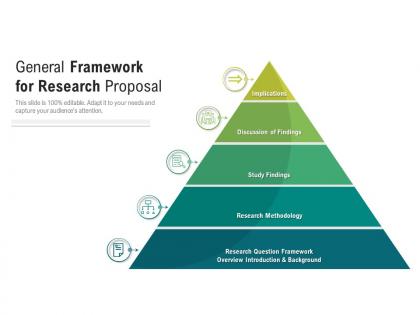
General framework for research proposal




Try Before you Buy Download Free Sample Product
 Impress Your
 Audience
 100%
100% Editable
 Save Hours
 of Time


Our General Framework For Research Proposal are explicit and effective. They combine clarity and concise expression.
People who downloaded this PowerPoint presentation also viewed the following :
General framework for research proposal with all 2 slides:
Give your audience a fulfilling experience. They will find our General Framework For Research Proposal elevating.

FAQs for General framework
Okay so you need a solid research question first - that's your foundation. Then do a lit review showing what others have found, plus your methodology section explaining your approach. Timeline and budget are huge - reviewers totally judge you on those, so don't half-ass them. Include why you're qualified for this specific project too. Depending on your field, you might need an ethics section (kinda annoying but whatever). Make sure everything connects logically - like, each part should flow into the next. Oh, and start with a killer one-page summary that grabs attention immediately. Expected outcomes matter too obviously.
Dude, structure is everything with funding proposals. Reviewers need to immediately get what you're doing and why it matters. I've watched amazing research get tossed because the proposal was a hot mess - like, genuinely groundbreaking stuff that just couldn't tell its story clearly. Make your timeline realistic, justify every budget line, and lay out your methodology so even your mom could follow it. Oh, and definitely call out potential problems before they do. Shows you're not just winging it. The whole thing should flow logically from "here's the problem" to "here's how I'll fix it."
Honestly, just nail down your research question first - everything else builds from there. Write like you're explaining it to your mom, not impressing some committee with fancy words. Nobody wants to wade through academic BS. Your methodology should actually answer what you're asking (shocking concept, right?). Do a lit review that shows you've done your homework without boring everyone to death. Oh, and get someone totally outside your field to read it - if your roommate gets it, you're probably good. Structure matters too, but clear thinking matters more.
Your lit review is honestly make-or-break for the whole thing. Without it, you can't prove there's actually a gap worth studying - and trust me, reviewers will tear apart weak background research immediately. It positions your question properly and shows you're not just randomly picking a topic. Plus it proves you get the field you're working in. I probably spent way too much time on mine, but whatever. Don't just summarize sources though - you've got to engage with them critically. Think of it as building your argument's foundation rather than checking boxes.
Honestly, your research question is everything - it's what drives your whole proposal. Once you nail that down, your methodology and lit review basically write themselves because they're all answering that same core question. I always think of it like... you wouldn't randomly start building a house from the roof, you know? If your question's too vague or all over the place, your entire proposal will feel scattered. But a really specific, focused question? That gives you a clear roadmap for every single section. Get that question solid first, then let it guide everything else you write.
Honestly, templates are a game-changer for proposals. They make everything way easier to scan through - reviewers don't want to dig through walls of text to find your budget or timeline. Clean formatting just looks more professional too, which matters when you're basically asking strangers for money. The structure also forces you to think through your argument logically instead of just rambling (guilty of that sometimes). I'd say grab a template that fits your field and tweak it so your best stuff hits them right away. Visual hierarchy is clutch - it guides people through without making their eyes glaze over.
So for your methodology section, you want three main things: clear steps, reasons for your choices, and timelines that actually make sense. Explain what you're doing first, then why those methods work for your research questions. Flowcharts are honestly a lifesaver here - reviewers eat that visual stuff up. Connect your methods to what you expect to find instead of just listing them. Also throw in what could go wrong and your backup plan, because let's be real, something always goes sideways. Make it detailed enough that someone could copy your approach from just reading it.
Honestly, the worst thing you can do is be super vague about your methods - reviewers hate that. Don't bite off more than you can chew timeline-wise either. I've seen so many proposals that sound amazing but completely fall apart when you actually look at them. Your lit review needs to hit the major studies (missing obvious ones is brutal), and for the love of god, don't lowball your budget. Time always costs more than you think. Oh, and make sure people understand why anyone outside academia should care about this stuff. Be upfront about limitations too - pretending they don't exist just makes you look naive. Start with solid research questions though. Everything else builds from there.
Honestly, who you're writing for changes everything about your proposal. Academic committees? They want all that methodology stuff right up front. But if you're pitching to industry people, they just care about results and when things will actually happen. Funding bodies are obsessed with budgets and proving impact - kind of annoying but whatever. Don't use fancy academic speak with regular stakeholders, but you can't be too casual with professors either. The sections are basically the same, just switch up what you emphasize. Figure out who's really reading it first, then write your whole thing around what'll grab them.
So you've gotta cover informed consent, privacy stuff, and data protection - the usual suspects. Vulnerable populations need extra paperwork if that applies to you. Honestly the ethics section is where people totally bomb because they half-ass it, but review boards are super picky about this part. Also map out your data storage plan and how you'll handle people dropping out. Don't forget conflicts of interest either. Which ethics board are you submitting to? Some funders won't even glance at proposals without that timeline nailed down first.
Okay so first thing - dig into your school's proposal guidelines like your life depends on it. Their website, grants office, whatever successful proposals you can get your hands on from your department. Every institution is weirdly picky about different stuff. Look for formatting rules, page limits, budget caps, required sections. Figure out how they actually review these things and what they care about strategically. Honestly, I'd make a literal checklist from all their requirements. Then just work through it methodically as you write. Sounds boring but it'll save you from scrambling later when you realize you missed something obvious.
Start with your strongest result or benefit - that grabs attention right away. Think of it like a mini version of your whole proposal: problem, solution, main benefits, what you're asking for. One page max (trust me, longer ones don't get read). Concrete numbers beat vague promises every time. I actually write mine last so I can steal the best parts from my full proposal. Close with exactly what you need and when. Oh, and test it on someone outside your field first - if they get it and seem interested, you're golden.
Yeah, your field totally changes how you write these things. STEM proposals need tons of methodology details and clear hypotheses - like, really get into the technical stuff. Humanities is more about your theoretical framework and diving deep into existing research. Social sciences kind of blend both approaches. Business proposals though? They just want to know the practical impact and money stuff. Honestly, I'd look up successful proposals in your exact area first - generic templates are pretty useless. Each discipline has its own weird expectations you won't catch otherwise.
Look, reviewers want to see you've actually mapped out how this thing will work in real life. Your timeline proves you can finish within their funding period and shows you're not just winging it. Breaking your huge project into chunks helps YOU stay sane too, honestly. It also justifies why you need that research assistant for 6 months instead of 3 - reviewers love specifics when it comes to budget stuff. Don't forget IRB approval can drag on forever, so factor that in. Make your milestones concrete, not some vague "data collection phase" nonsense.
Anecdotal stuff is actually pretty useful for lit reviews - just don't make it your main argument. I like using case studies to show gaps or add real-world context that makes people care about your research. The trick is being honest about what they can't do. They're perfect for highlighting patterns that need proper investigation, but terrible as "proof" of anything. Frame them carefully - say things like "early evidence suggests" or whatever fits. Honestly, they're more about storytelling than hard data. Use them to show why your question matters, then bring in the rigorous research to actually answer it.
No Reviews