


Research project proposal powerpoint presentation slides





Try Before you Buy Download Free Sample Product
 Impress Your
 Audience
 100%
100% Editable
 Save Hours
 of Time


Having a tough time scoring sponsors for your research project? It is highly likely that a lack of a professionally-designed dissertation proposal is holding you back. SlideTeam presents the all-new Research proposal presentation Slides. Leading industry experts decide the content, design, and the sequence of our research proposal PPT template deck. After collecting and polishing insightful content, it is passed on to the designers. It is then arranged in a visually-gripping manner keeping your audience in mind. There are no universal ingredients to a responsive PowerPoint proposal. SlideTeam developers have come up with this PPT format after years of trials and errors. Our team portfolio includes over a million slides like this research sponsorship proposal. This proficiency is what separates our PowerPoint proposal slides from others in the market. Elucidate the project to your sponsors by highlighting the study backdrop, key research questions, problems, and solutions. Demonstrate the aims and goals of your research project proposal through the cutting-edge graphics of this PPT slideshow. Elaborate on the primary hypothesis statement and the anticipated results. Portray the dissertation methodology you have selected for your research. You may explain key details like bibliography, types of data, data analysis methods, and approaches to data collection. Walk your potential sponsor through the project timeline from reading and research to other tasks and milestones. Elaborate on the various stages involved in the completion of the study through state-of-the-art data visualizations. Employ this PowerPoint theme to showcase a 30-60-90 days plan projection. Communicate the narrative or literature review. Discuss the theoretical and methodological contributions to the topic, strengths, and weaknesses of the study, and more. Widen the perspective by illustrating the research proposal for thesis constraints. Employ our PowerPoint slideshow to gain access to a variety of roadmap diagrams and make your proposal aesthetically-sound. Also, it will help you in the easy expression of sophisticated data. So, hit the download button, make final edits, and build an engaging presentation.
People who downloaded this PowerPoint presentation also viewed the following :
Content of this Powerpoint Presentation
Slide 1: This slide introduces Research Project Proposal. Mention Name of Person, Name of University, Name of Department, and Dissertion Title.
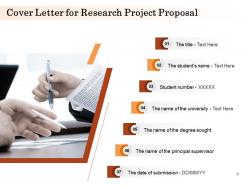
Slide 2: This slide displays Cover Letter for Research Project Proposal.
Slide 3: This slide shows Cover Letter for Research Project Proposal.
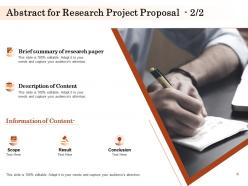
Slide 4: This slide describes Abstract for Research Project Proposal.
Slide 5: This slide presents Abstract for Research Project Proposal.
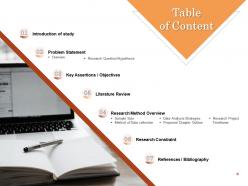
Slide 6: This slide shows Table of Content.
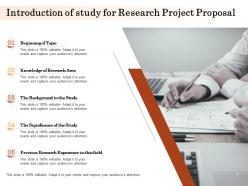
Slide 7: This slide showcases Introduction of study for Research Project Proposal.
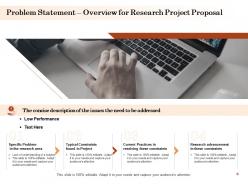
Slide 8: This slide depicts Problem Statement – Overview for Research Project Proposal
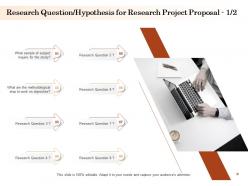
Slide 9: This slide showcases Research Question/Hypothesis for Research Project Proposal.
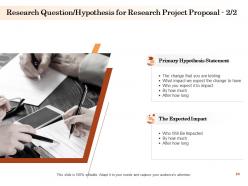
Slide 10: This slide depicts Research Question/Hypothesis.
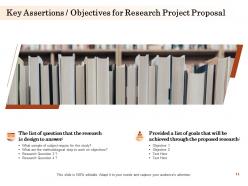
Slide 11: This slide depicts Key Assertions / Objectives for Research Project Proposal. Provided a list of goals that will be achieved through the proposed research:
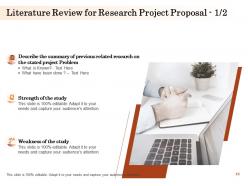
Slide 12: This slide showcases Literature Review for Research Project Proposal.
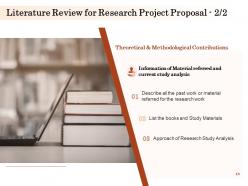
Slide 13: This slide represents Theoretical & Methodological Contributions.
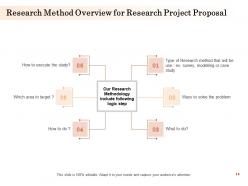
Slide 14: This slide presents Research Method Overview for Research Project Proposal.
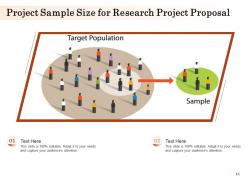
Slide 15: This slide shows Project Sample Size for Research Project Proposal
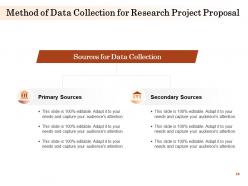
Slide 16: This slide depicts Method of Data Collection such as- Primary Sources, Secondary Sources.
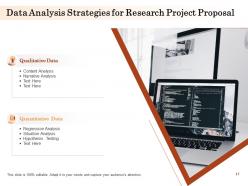
Slide 17: This slide shows Data Analysis Strategies for Research Project Proposal.
Slide 18: This slide depicts Research Project Timeframe.
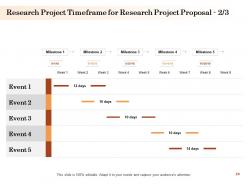
Slide 19: This slide showcases Research Project Timeframe for Research Project Proposal
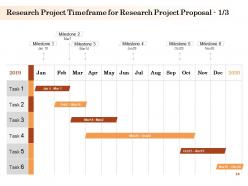
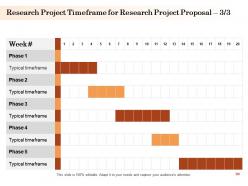
Slide 20: This slide showcases Research Project Timeframe for Research Project Proposal.
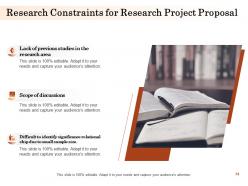
Slide 21: This slide showcases Research Constraints for Research Project Proposal.
Slide 22: This slide showcases References/ Bibliography for Research Project Proposal
Slide 23: This is Contact Us slide with Company address, Contact number and website.
Slide 24: This is Icons Slide for Research Project Proposal.
Slide 25: This slide is titled as Additional Slides for moving forward.
Slide 26: This is Our Mission slide with Vision, Mission and for Research Project Proposal
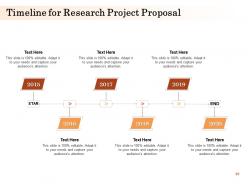
Slide 27: This slide showcases Timeline for Research Project Proposal.
Slide 28: This slide shows Roadmap process.
Slide 29: This slide 2 step Roadmap process.
Slide 30: This slide showcases 3 step Roadmap process.
Slide 31: This slide shows Roadmap process.
Slide 32: This slide showcases 5 step Roadmap process.
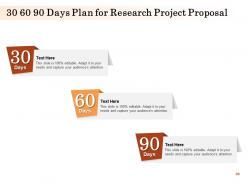
Slide 33: This is 30 60 90 Days Plan slide.
Research project proposal powerpoint presentation slides with all 33 slides:
Use our Research Project Proposal Powerpoint Presentation Slides to effectively help you save your valuable time. They are readymade to fit into any presentation structure.


FAQs for Research project proposal
Okay so for a solid research proposal, you need six main things. Start with your research question - that's honestly the most important part and everything else builds from there. Then do a literature review to show you actually know what's already been done. Your methodology section is huge - be super specific about how you're collecting data and your approach. Timeline and budget might seem boring but they prove your project is actually doable. Oh and don't forget expected outcomes at the end. The research question should grab people right away though, that's what I'd focus on first.
Here's the thing - you need to nail down exactly what's broken or missing, not just wave your hands around vaguely. Ask yourself "what specifically is the gap here?" Then figure out who actually cares about this problem and why it matters today. I like to imagine explaining it to someone who's gonna hit you with "okay, but so what?" Your research should connect to something bigger - maybe it advances theory, fixes real problems, or fills knowledge gaps that people are desperate to understand. Oh, and you better be ready to defend why your problem beats out all the other stuff competing for attention and funding.
So basically, if you're doing quantitative stuff, go with experiments or surveys - you'll need solid stats plans though. Qualitative is way more flexible honestly, like ethnography or interviews work great. Mixed methods is clutch when numbers can't tell the full story (which happens more than you'd think). Here's the thing - just match your method to what you actually need to find out. Don't pick something fancy just because it sounds smart. I'd start with your research question first, then figure out what kind of data answers it best. Way easier to work backwards from there.
First thing - get your search terms straight and hit up PubMed, Google Scholar, whatever databases work for your field. Cast a wide net at first. Then narrow it down to what's actually useful. Don't just hoard papers randomly (trust me, I once had 200+ useless ones). Group them by themes and look for gaps or contradictions your research might fill. Stick mostly to recent stuff from the last 5-7 years, but grab those classic foundational papers too. Oh, and use reference management software - your future self will thank you. Take notes on methods and findings as you go or you'll forget everything.
So you'll definitely need informed consent and privacy stuff covered - people gotta know what they're getting into. Risk assessment is big too. Data security is honestly where most people mess up, especially with sensitive information. Kids and elderly participants need extra protection, which is kind of a pain but makes sense. Oh and handle any conflicts of interest upfront. Make sure your research benefits actually outweigh the risks because IRBs will pick apart everything. Seriously, start these sections way earlier than you think - the approval process takes forever and they're super picky about details.
Break your budget into personnel, equipment, supplies, travel, and indirect costs. Personnel usually eats up most of it - salaries, benefits, plus what percentage of time everyone's spending on this. Equipment means stuff you're buying (not renting, that's supplies). Then add consumables, travel, whatever else you need. Indirect costs are honestly such a pain, but your grants office knows those rates. Oh, and make sure everything connects back to your methods section - reviewers need to see why you're asking for each thing. They're pretty good at spotting random line items that don't make sense.
Look, your research proposal is basically everything when it comes to getting funded. Committees read these to figure out if your project's worth their money and whether you can actually handle it. Honestly, it's more stressful than any job interview I've ever had. Without a solid proposal showing your methodology and why your research matters, you're not getting a dime. The budget breakdown needs to make sense too - reviewers can spot BS from miles away. Oh, and don't wait until the last minute because rushed proposals are painfully obvious.
Yeah, so definitely spell out your statistical plan in the methodology - like "I'll use ANOVA to compare group means" instead of just vague "statistical tests" nonsense. Mention your significance level (usually p<0.05) and how you'll deal with multiple comparisons if that applies. Power calculations for sample size are clutch too - reviewers eat that stuff up because it shows you actually thought about whether you'll have enough people to find real effects. Oh, and make sure whatever tests you pick actually match your research questions and data types. Sounds obvious but you'd be surprised how often people mess that up.
Think story first - problem, why it matters, then your solution. Skip the academic BS (seriously, reviewers hate that stuff). Concrete examples beat vague theory every time. Your methodology has to actually answer your research questions or you're dead in the water. Mix up your sentence lengths. Short ones work. Others can flow a bit longer when you need to explain something complex. Don't forget visuals - charts and timelines save you from wall-of-text syndrome. Oh, and get someone outside your field to read it. If they're lost, you need to simplify more.
Honestly, it's all about knowing who you're talking to. Academics want the nerdy stuff - show them your lit review, methodology, how you're filling research gaps. Industry people couldn't care less about that. They want to know: what problem does this solve and how much money will it make? I'd literally write two different intros. Academic version starts with theory and research contributions. Industry version? Jump straight into the business problem and market potential. Figure out maybe 2-3 things each group actually cares about, then structure everything around that. Way less painful than trying to make one version work for everyone.
Start with your problem and why anyone should care - that's your hook. Keep it under 250 words max. Problem, objectives, methods, expected outcomes. That's your flow. Honestly? Most reviewers are just skimming anyway, so don't get lost in technical weeds. Write it so someone from a totally different field could follow along. Skip the jargon where you can. Focus on the "so what" - what's actually going to change because of your work? End by spelling out exactly what new thing you're bringing to the table. It's basically your elevator pitch, just written down.
Look, you've gotta be real about three things: time, resources, and what you can actually pull off. Break everything into smaller tasks first - I swear everything takes way longer than you expect. Then figure out if you can actually get the data, people, or equipment you need. Are you skilled enough for what you're proposing? If not, maybe find someone to work with or simplify things. Honestly, reviewers just want to see you've thought about what could go wrong and have backup plans ready.
Honestly, just stick with what you know - PowerPoint or Canva work fine for most proposals. Prezi's cool if you want something more dynamic, but don't go crazy learning new software right before your deadline (been there, terrible idea). Charts make reviewers happy, so maybe try Tableau or Infogram for data stuff. I've seen people get way too carried away with animations though. Keep it simple. If it's a written proposal, Google Docs is clutch for getting feedback from your team in real-time. Notion's good too but might be overkill. Bottom line - pick something familiar and focus on your actual content instead.
Yeah, you definitely need a solid timeline - reviewers want proof you can actually finish this thing on time. Break it down into chunks: lit review, data collection, analysis, writing. Give each phase specific months or quarters. But here's the thing - don't just randomly assign dates! Factor in delays, how long equipment takes to arrive, seasonal stuff that might mess with your research. I learned this the hard way on my last project. Include milestones so people can see you're making progress. Oh, and work backwards from your deadline - you'll be surprised how tight things get.
Honestly, the biggest mistake is being way too vague about your methods - like, what are you actually *doing*? Also define your research question clearly from the start. Don't try to cure cancer in three months either (I've literally seen proposals like that). Your timeline needs to be real, and match your budget to what you're actually planning. Oh, and definitely mention the stuff that could go wrong. Reviewers hate when you pretend everything's gonna be perfect. Get someone to read it first and tear it apart - better them than the review committee!
-
Very unique and reliable designs.