


Student research proposal powerpoint presentation slides





Try Before you Buy Download Free Sample Product
 Impress Your
 Audience
 100%
100% Editable
 Save Hours
 of Time


Our Student Research Proposal Powerpoint Presentation Slides are topically designed to provide an attractive backdrop to any subject. Use them to look like a presentation pro.
People who downloaded this PowerPoint presentation also viewed the following :
Content of this Powerpoint Presentation
Slide 1: This slide introduces Student Research Proposal. Mention Dissertion title, Name of person, Name of University and Department.
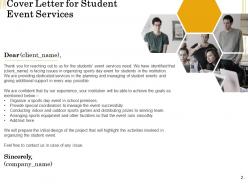
Slide 2: This slide displays Cover Letter for Student Event Services.
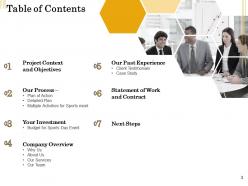
Slide 3: This slide displays Table of Contents.
Slide 4: This slide showcases Table of Contents with- Project Context and Objectives
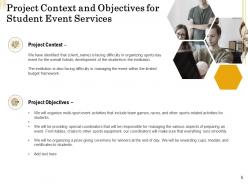
Slide 5: This slide describes Project Context and Objectives for Student Event Services
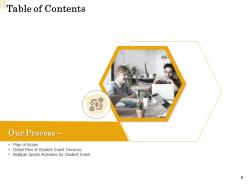
Slide 6: This slide shows Table of Contents containing- Our Process, Plan of Action, Detail Plan of Student Event Services, Multiple Sports Activities for Student Event.
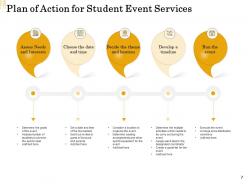
Slide 7: This slide displays Plan of Action for Student Event Services.
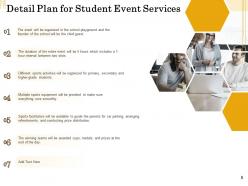
Slide 8: This slide showcases Detail Plan for Student Event Services
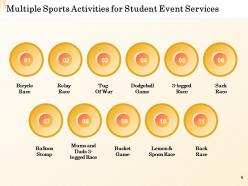
Slide 9: This slide shows Multiple Sports Activities for Student Event Services
Slide 10: This slide shows Table of Contents with- Budget for Student Event Services
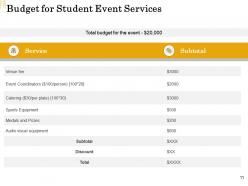
Slide 11: This slide showcases Budget for Student Event Services
Slide 12: This slide displays Table of Contents containing- Company Overview, Why Us, About Us, Our Services, Our Team.
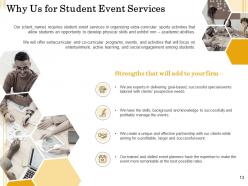
Slide 13: This slide showcases Why Us for Student Event Services
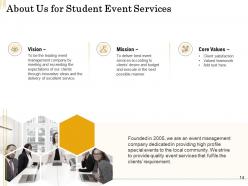
Slide 14: This is About Us slide to showcase Company specifications.
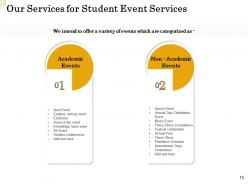
Slide 15: This slide depicts Our Services for Student Event Services.
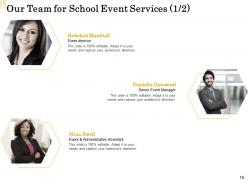
Slide 16: This is Our Team slide with Names and Designations.
Slide 17: This is Our Team slide with Names and Designations.
Slide 18: This slide displays Table of Contents
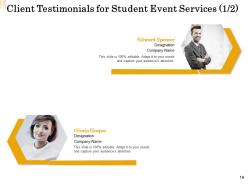
Slide 19: This slide depicts Client Testimonials for Student Event Services.
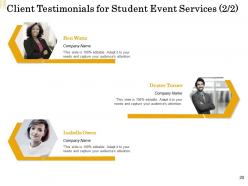
Slide 20: This slide depicts Client Testimonials for Student Event Services.
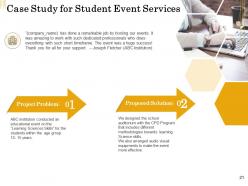
Slide 21: This slide showcases Case Study for Student Event Services
Slide 22: This slide displays Table of Contents with- Statement of Work and Contract.
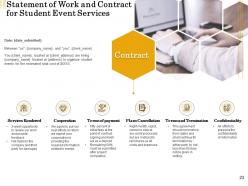
Slide 23: This slide describes Statement of Work and Contract for Student Event Services
Slide 24: This slide shows Table of Contents with- Next Step.
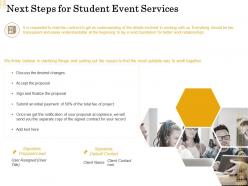
Slide 25: This slide showcases Next Steps for Student Event Services.
Slide 26: This is Contact Us slide with Address, Email address and Contact number.
Slide 27: This is Icons Slide for Student Research Proposal.
Slide 28: This slide is titled as Additional Slides.
Slide 29: This is About Us slide to Showcase Company specifications.
Slide 30: This slide displays Vision and Mission for Student Research Proposal
Slide 31: This is 30 60 90 Days slide.
Slide 32: This slide showcases Timeline process.
Slide 33: This slide displays Roadmap process.
Student research proposal powerpoint presentation slides with all 33 slides:
Use our Student Research Proposal Powerpoint Presentation Slides to effectively help you save your valuable time. They are readymade to fit into any presentation structure.


FAQs for Student research proposal
Your research question is everything - seriously, nail that first and the rest gets easier. Literature review shows you actually know what's been done already. Methodology section explains how you'll tackle the work. Don't forget timeline and budget if they want it. Oh, and the significance part? That's where you sell why anyone should give a damn about your project. So many people phone that section in and then act surprised when they get rejected. Make your question specific enough to actually answer but not so narrow that only three people care. Start with that question and build everything else around it.
Honestly, pick something you're actually curious about - not what sounds fancy on paper. List out topics that interest you, then get real about whether you can pull it off. Timeline, budget, resources - all that boring stuff matters. Can you get the data? Got the skills or time to learn them? I'd definitely bounce your top few ideas off your advisor early since they'll catch problems you totally missed. Oh and don't stress too much about it being groundbreaking. Better to do solid work on something you care about than struggle through a "prestigious" topic that makes you miserable.
Honestly, the biggest thing is making sure your hypothesis actually answers what you're researching - I know it sounds basic but people mess this up constantly. Write it out, then test it on someone who knows nothing about your topic. If they look confused, you need to simplify. Keep it specific and testable, not some vague statement that could mean anything. Your hypothesis should flow naturally from whatever research you've already done. Oh, and try this trick: add "because" to the end and see if you can explain why you think it'll happen. If you can't, you're probably not there yet.
Honestly, a good lit review is your way of proving you actually know the field and aren't just making stuff up. You're showing reviewers that you've read the important work, spotted the gaps, and figured out where your research fits in. Nobody wants to see you propose something that's been done a million times already - trust me on that one. It also proves you can think critically about sources and pull together different ideas, which is pretty much researcher 101. Focus on recent, solid sources and be super clear about how your study builds on what's already out there. Makes all the difference.
Methodology is honestly what makes or breaks your proposal. It's how you prove you can actually pull this research off, not just dream about it. Figure out what data you need first - then pick your methods. Surveys, interviews, experiments, whatever fits your question. Don't wing this part! I've watched solid research ideas get rejected because the methodology felt rushed. You're basically showing reviewers the step-by-step plan for getting answers. If you can't explain how you'll collect your data realistically, they'll assume you haven't thought it through properly.
Honestly, you've gotta figure out what each field actually wants before you start writing. STEM people love clear hypotheses and hard data - pretty straightforward. Humanities folks expect you to engage with theory and scholarly conversations, plus way more context usually. Social sciences are weird though - they're like this annoying middle ground that's hardest to pin down. Check out citation styles too since that stuff matters more than you'd think. My best tip? Find some recent proposals that got funded in your area and just copy their vibe. Structure, tone, all of it.
Honestly, the worst mistake is being vague about your research question - like, what are you actually studying? Be super specific there first. Don't give yourself impossible deadlines either (learned that one the hard way lol). Your lit review needs to connect to your actual project, not just be a random list of papers you found. Also explain why anyone should care about your research and how it's different from existing stuff. Oh, and this sounds obvious but check that your methods will actually answer your question - surprisingly easy to mess up. I always start with nailing down that research question since everything flows from there.
Honestly, the budget part matters way more than people think - reviewers want to see you've actually planned this out instead of just winging it. Include the obvious stuff like equipment and materials, but also weird little costs that pile up (printing, data storage, etc.). Travel and participant payments too if you need them. I always forget about software licenses until the last minute, so don't do that. Round numbers work fine for estimates - no need to calculate down to the penny. Just make sure your ask matches what you're actually trying to do. Nobody's impressed by unrealistic numbers.
Keep your data clean and focused on your research question. Charts and graphs work way better than boring tables full of numbers - trust me on this one. If you've got preliminary findings, include them but be upfront about what's real data vs. what you think you'll find. Every piece of data needs a reason for being there. Start with your strongest stuff first, then work down from there. The whole point is showing you can actually make sense of information, not just dump it all on the page. Oh, and don't overthink the organization part.
Look, you've got to show people why they should actually care about your research - not just that it's "interesting" (though honestly, passion does help sell it). Find the gap you're filling and make it matter. What's missing that people genuinely need to know? Be super specific about who benefits. Will it change how doctors treat patients? Help teachers in classrooms? I always get a bit annoyed when students just say "it advances knowledge" without getting concrete. Think policy changes, better practices, real impact. Then literally name who wins - parents, communities, whatever. That's what makes reviewers sit up and pay attention to your work.
Okay so first thing - hit up your university's library database for solid sources. Zotero will literally save your life with citations (I learned this the hard way). Your writing center does free proposal reviews too. Most schools have research guides with templates you can swipe ideas from. Honestly, your advisor has probably seen like a thousand of these things, so definitely bug them for feedback. Oh and look up successful proposals in your field online - gives you a good sense of what actually works. I'd start with the library guide then just build from there.
Your peers and advisor are like having extra sets of eyes on your work - they'll catch logic gaps and weird phrasing you've gone blind to. Advisors know what funding committees actually look for (which honestly can be pretty different from what you think matters). Meanwhile, peers aren't drowning in your research topic like you are, so they spot confusing parts easily. Don't just send drafts asking "what do you think?" Be specific - ask about your methodology or whether the research questions actually sound compelling. You're probably way too close to see the weak spots anymore.
Hey! So you're gonna need the big three: informed consent, confidentiality, and making sure nobody gets hurt. Privacy protection is absolutely critical right now - people are paranoid about data stuff for good reason. Even tiny risks need to be addressed upfront. Kids or vulnerable groups? That's a whole other level of paperwork, ugh. Don't forget IRB approval takes forever, so start way earlier than you think. Honestly, the ethics section always ends up being more work than expected. Draft it first!
Okay so visual aids are honestly a game-changer for research proposals. Most reviewers are drowning in text anyway, so charts and graphs let them actually see your data patterns without squinting through paragraphs. Timelines are clutch for showing you've got a realistic plan. I'd say focus on diagrams for your methodology section - that's where things get messy fast without visuals. You'll look way more organized too, which matters more than people admit. Just don't go overboard with fancy graphics. Clean and simple beats cluttered every time. Maybe 1-2 strong visuals per major point?
Just go with whatever style your department wants - APA for social sciences, MLA for humanities, Chicago for history stuff. Be consistent though. Cite recent, solid sources like peer-reviewed journals (skip the sketchy websites). I'm always paranoid about citing too much, but better safe than sorry in proposals since you're proving you know your field. Oh, and definitely keep a running bibliography while you write - learned that the hard way after spending hours trying to track down sources later. You'll need citations for any claims about existing research or gaps you're addressing.
-
Great designs, Easily Editable.