


Dissertation Proposal Outline Powerpoint Presentation Slides






Try Before you Buy Download Free Sample Product
 Impress Your
 Audience
 100%
100% Editable
 Save Hours
 of Time


Creating a proposal outline deck that is very professional and visually appealing is a tough task? To aid you with this big task, we have come up with 49 slides content-ready Dissertation Proposal Outline Powerpoint Presentation Slides. These sample templates files will help you with presenting the right outline for proposal. This sample PowerPoint deck has many slides like agenda, literature review, hypothesis, methods, statistical analysis, results, limitations of your study, conclusions, implications for future research, references, and many more. These templates will save to time and effort, that you must put in if you need to create a presentation from scratch. The slides in this PowerPoint sample file will not pixelate while you project your PPT on wide screens. There are additional slides too like vision, goals and objectives, comparison, financial, quote, dashboard, location, timeline, post it, mind map etc. This sample PPT deck will help you to present your topic in a very professional and impactful way. So, go ahead and download our Dissertation Proposal Outline Powerpoint Presentation Slides right now and leave your mark on the audience. Increase your credibility with our dissertation ppt Slides. Insist on highlighting facts.
People who downloaded this PowerPoint presentation also viewed the following :
Content of this Powerpoint Presentation
Slide 1: This slide presents Dissertation Proposal Outline. State your company name and get started.
Slide 2: This is an Agenda slide. Showcase your exclusive agendas here.
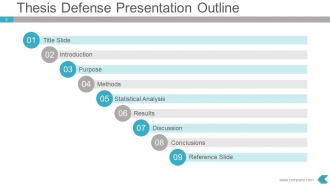
Slide 3: This slide presents Thesis Defense Presentation Outline with- Title Slide, Introduction, Purpose, Methods, Statistical Analysis, Results, Discussion, Conclusions, Reference Slide.
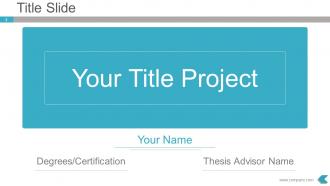
Slide 4: This is the Title Slide. State the following aspects- Your Title Project, Your Name, Degrees/Certification, Thesis Advisor Name.
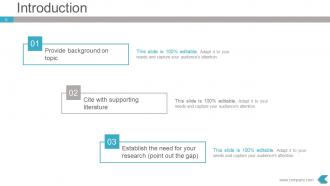
Slide 5: This is an Introduction slide with three main aspects to state- Provide background on topic, Cite with supporting literature, Establish the need for your research (point out the gap).
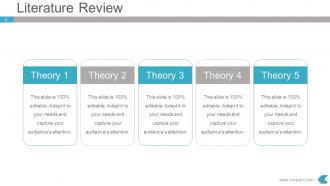
Slide 6: This is a Literature Review slide. Simply state relevant theories here.
Slide 7: This is PURPOSE STATEMENT slide. Use it accordingly.
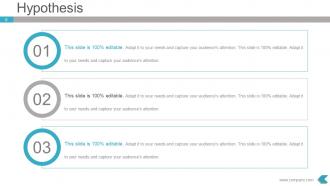
Slide 8: This is a Hypothesis slide. State it here.
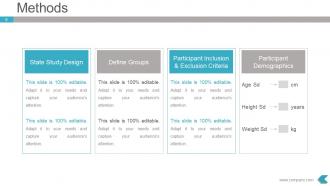
Slide 9: This slide showcases Methods such as- State Study Design, Define Groups, Participant Inclusion & Exclusion Criteria, Participant Demographics.
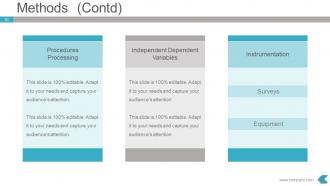
Slide 10: This slide also showcases Methods- Independent Dependent Variable, Instrumentation, Procedures Processing.
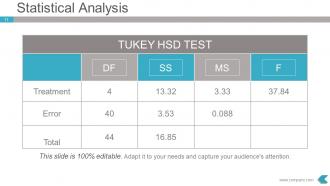
Slide 11: This is a Statistical Analysis slide. Present the same and use it accordingly.
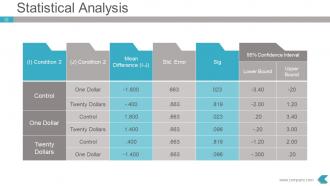
Slide 12: This slide also shows Statistical Analysis in a tabular form.
Slide 13: This slide showcases Results. State your results here.
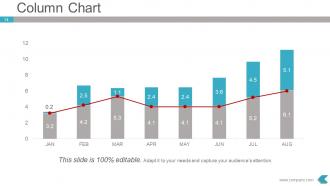
Slide 14: This slide presents a Column Chart for showcasing product/ company growth, comparison etc.
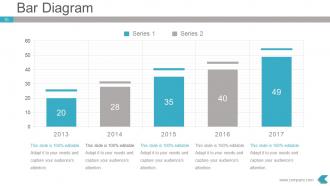
Slide 15: This slide presents a Bar Diagram for showcasing product/ company growth, comparison etc.
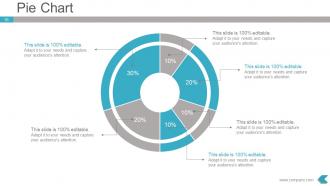
Slide 16: This is a Pie Chart slide to show product comparison etc.
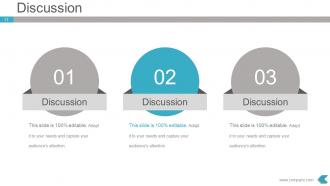
Slide 17: This is a Discussion slide. Discuss your important points, information etc. here.
Slide 18: This slide states the Limitations Of Your Study.
Slide 19: This is a Conclusions/ Findings slide. Simply state your project conclusions, findings etc. here.
Slide 20: This slide states various Implications For Future Research. Present them here and use accordingly.
Slide 21: This is a References slide with text boxes. State them here.
Slide 22: This is Any Questions slide. Ask any relevant and important questions here.
Slide 23: This slide is titled Additional Slides to continue further. Alter/ modify content as per your need.
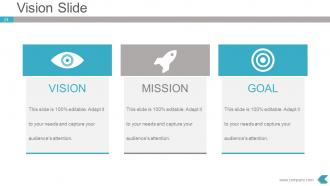
Slide 24: This is a Vision Slide. State your vision, mission and goals here.
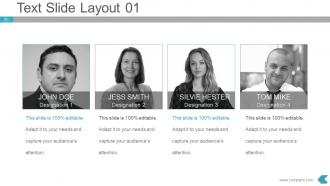
Slide 25: This is Text Slide Layout 01 with name, designation etc. to fill.
Slide 26: This is Text Slide Layout 02 with name, designation etc. to fill.
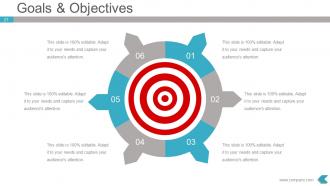
Slide 27: This is Goals & Objectives slide to state.
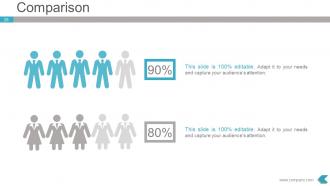
Slide 28: This is a Comparison slide to show comparison of two entities.
Slide 29: This is a Financial score slide to show financial aspects here.
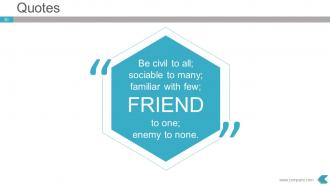
Slide 30: This is a Quotes slide to highlight, or state anything specific.
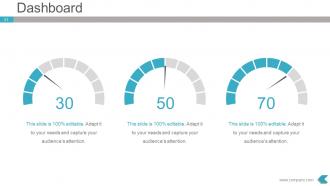
Slide 31: This is a Dashboard slide to state metrics, kpis etc.
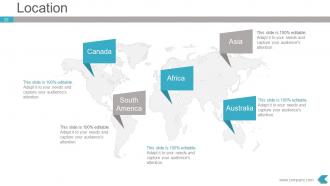
Slide 32: This is a Location slide on a world map image to show global presence, growth etc.
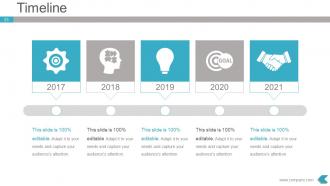
Slide 33: This is a Timeline slide to show evolution, growth, milestones etc.
Slide 34: This is a Post It slide to mark events, important information etc.
Slide 35: This is a Newspaper slide to show news, events etc. You can change the slide contents as per need.
Slide 36: This is a Puzzle slide to show information, specifications etc.
Slide 37: This is a Target slide. State your targets, goals etc. here.
Slide 38: This is a Circular image slide to show information, specifications etc.
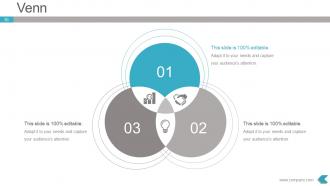
Slide 39: This is Venn diagram image slide to show information, specifications etc.
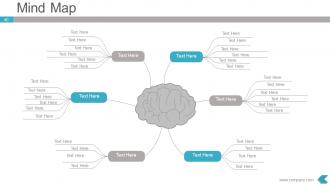
Slide 40: This is a Mind Map image slide to show information, specifications etc.
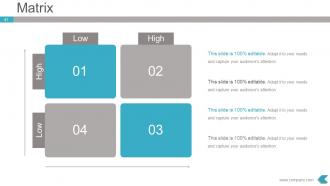
Slide 41: This is a Matrix slide ranging from High to Low.
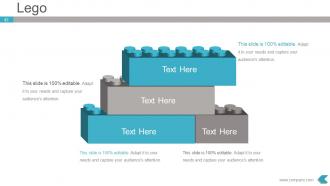
Slide 42: This is a Lego blocks image slide to present information, specifications etc.
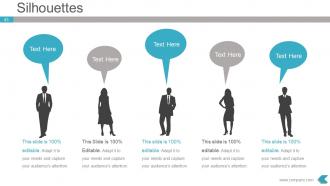
Slide 43: This is Silhouettes slide to present people specific information, specifications etc.
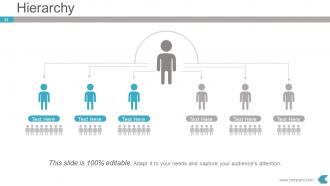
Slide 44: This is a Hierarchy slide to present team specifications etc.
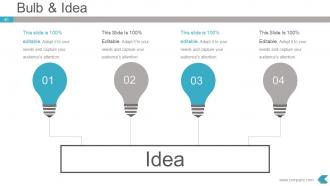
Slide 45: This is a Bulb & Idea image slide to present team, specifications etc.
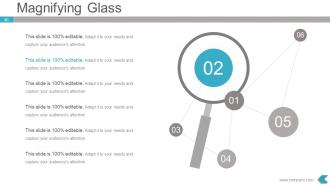
Slide 46: This is a Magnifying Glass slide with creative imagery to show specifications, information.
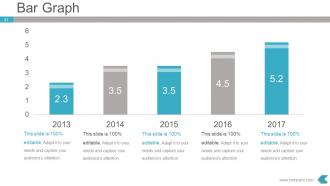
Slide 47: This is a Bar Graph image slide to show product comparison, growth etc.
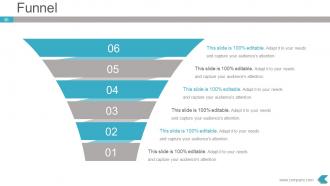
Slide 48: This slide displays a Funnel image. State information, funneling aspects etc. here.
Slide 49: This is a Thank You slide with Address# street number, city, state, Contact Numbers, Email Address.
Dissertation Proposal Outline Powerpoint Presentation Slides with all 49 slides:
Our Dissertation Proposal Outline Powerpoint Presentation Slides are like a warm breeze. Your thoughts will soar on the strength of their lift.



FAQs for Dissertation Proposal Outline
So you need six main things for your proposal. Start with your research question in the intro - that's honestly the hardest part. Then do a lit review showing what's been done already. Your methodology section explains how you'll actually do the research. Don't forget a timeline breaking everything into phases, plus expected outcomes. Bibliography is crucial too - profs always flip there first! Some programs want a budget if you're asking for money. Be specific enough to prove you've thought it through, but leave room to change direction later. Once you nail that research question though, the rest writes itself.
Think of your intro like an upside-down triangle - you're going from big picture stuff down to your exact focus. Hook them right away with why this research problem actually matters. Then zoom in on the specific gap you found (that's honestly the hardest part to nail). Don't forget to clearly state your research question and give a quick preview of how you'll tackle it. The trick is not making your work sound earth-shattering when it's not, but also don't downplay something genuinely important. Wrap up with a little roadmap so readers aren't wondering what comes next. Makes the whole thing feel more organized.
Okay so the lit review is basically proving you've done your homework and aren't just winging it. You're showing there's actually a gap worth studying, not rehashing stuff that's been beaten to death already. Committees eat this up because it proves you know the major theories and debates in your field. It also backs up why you chose your specific methods - like "hey, this approach worked for Smith but failed for Jones, so here's what I'm doing differently." Honestly, it's kind of tedious but think of it as your ticket to show you're ready for real research. Make yours tell a story about why your work matters now.
Put your research question right up front - intro and methodology sections both. Don't make the mistake I see constantly where students bite off way more than they can chew. Keep it narrow enough that you'll actually finish, but interesting enough to matter. Frame it like a real question that nobody's fully cracked yet. Then connect it directly to your lit review and methods - they should all talk to each other. Here's my test: explain it to your roommate or whoever. If they look lost, you need to simplify. Also, honestly? Starting too broad is dissertation death.
Think of methodology as your roadmap - committees will tear apart proposals with sketchy methods, no joke. You've gotta spell out your research design, how you'll collect data, and your analysis approach. Why did you pick these specific methods? That's what they really want to know. Honestly, I've seen great research ideas crash because the methodology was half-baked. Show them you actually understand the tools you're using and that your approach will genuinely answer your question. Don't just list methods - justify each choice you make.
Look for what's actually missing in the research first. What hasn't been studied yet? Then connect it to real-world problems - will this help actual practitioners or change policy? I learned this trick from my advisor: ask "so what?" after everything you write. Can't answer it? Keep digging. Honestly, academics sometimes get too caught up in theory and forget about practical impact. Link your work to current trends in the field too. Be specific about who benefits from your research and how they'll actually use it. That's what separates good research from just another paper collecting dust.
Vague research questions will kill you - committees see right through that nonsense. Don't try solving world hunger in your dissertation either (seriously, narrow it down). You've gotta connect your work to what's already out there, otherwise you're just floating in academic space. The "why should anyone care" part? Actually matters more than you'd think. I've watched people bomb their defense because they couldn't answer that basic question. Make your timeline realistic too - like, actually doable, not wishful thinking. Every chapter needs to earn its place in your argument or cut it.
Definitely start by checking what your department wants - they're all weirdly different about format and length. Your research question needs to be doable with your actual time/money situation. Literature review should hit recent peer-reviewed stuff. Methodology is where everyone screws up honestly, so really focus there. Timeline matters too. Show drafts to your advisor constantly - like, annoyingly often. Oh and try to find some successful proposals from recent grads in your program. They're usually happy to share and it's way more helpful than generic examples online. Don't stress too much about making it perfect on the first try.
Check your department's style guide first - probably APA, MLA, or Chicago. Standard stuff is 12-point Times New Roman (ugh, so dated but whatever), double-spaced, 1-inch margins. Page numbers are a must - profs get super annoyed without them. Keep your headings consistent and cite everything properly. You'll need a title page with your name, advisor, and date. Definitely ask your advisor about weird department rules early on. Some programs have random formatting quirks they don't post online anywhere, which is honestly pretty annoying when you're trying to get everything right.
Honestly, set up a Google Doc or something where your advisors can comment directly on sections instead of doing the whole email chain thing. Makes life so much easier. Don't just fix the surface stuff when you get feedback - really think about what they're actually worried about with your methods or theory. Oh, and keep a little log of who said what and how you handled it. Sounds nerdy but your committee will notice you're taking their input seriously. Plus it'll save you from that "wait, who wanted me to change this part again?" moment during revisions.
Make a simple timeline showing your research broken into phases - think months or semesters, not specific dates that'll definitely change. Include the big stuff: data collection, analysis, writing deadlines. Maybe 6-8 main activities tops. Honestly, everyone knows these timelines are basically educated guesses, but your committee still wants to see you've actually thought this through. Build in some buffer time because something always goes wrong (trust me on this). The whole point is just proving you can plan systematically, not impressing anyone with fancy project management skills.
Just be straight up about what you couldn't do - put it right in its own section. Don't try hiding anything because reviewers will catch it anyway. Sample size too small? Ran out of time? Couldn't access certain data? Just say it. Honestly, it's kind of a power move when you do this right. Shows you actually get research and can critique your own stuff. Here's the thing though - don't just list problems. Explain how you worked around each one or why it's still okay for what you're trying to prove. Makes you look way more legit than pretending everything was perfect.
Three things will make your proposal stand out. Start with the "so what" - why should anyone care about this research? Who actually benefits? Then show you've read everything relevant and explain exactly what gap you're filling. Your methodology needs to be super specific too - timeline, approach, all of it. Honestly, I think the biggest mistake people make is writing for experts when they should pretend they're explaining it to their mom. Oh, and definitely get multiple people to review it before you submit. You'll be way too close to it to catch obvious issues.
Clean slides with bullet points will save you here - nobody wants to read paragraphs on a screen. Charts and graphs are your best friend for showing methodology or expected results. Most committee members honestly tune out when there's too much text, so visuals keep their attention. A timeline graphic for your research phases is super helpful. Maybe throw in a conceptual framework diagram if it makes sense? Oh, and stick to simple colors and readable fonts - you don't want them squinting instead of listening to your brilliant ideas. Definitely practice beforehand so you're not fumbling with slides.
Definitely hit up your university's writing center website first - they've got solid style guides for APA, MLA, all that stuff. Most schools hook you up with citation tools like Zotero or Mendeley through the library too. Purdue OWL literally saved my life during proposal season (and it's free). Oh, and grab your school's dissertation handbook ASAP - trust me on this one, it'll prevent so much reformatting drama down the road. Also check with your advisor about their style preferences since some departments get weirdly specific about formatting details.
-
The Designed Graphic are very professional and classic.
-
Presentation Design is very nice, good work with the content as well.