


Business research plan proposal powerpoint presentation slides





Try Before you Buy Download Free Sample Product
 Impress Your
 Audience
 100%
100% Editable
 Save Hours
 of Time


Our Business Research Plan Proposal Powerpoint Presentation Slides are topically designed to provide an attractive backdrop to any subject. Use them to look like a presentation pro.
People who downloaded this PowerPoint presentation also viewed the following :
Content of this Powerpoint Presentation
Slide 1: This slide introduces Business Research Plan Proposal. State Client name, Submission date, and User assigned.
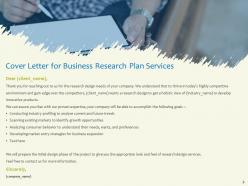
Slide 2: This slide displays Cover Letter for Business Research Plan.
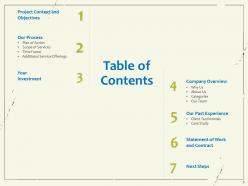
Slide 3: This slide displays Table of Contents.
Slide 4: This slide displays Table of Contents of the presentation.
Slide 5: This slide showcases Project Context and Objectives for Business Research Plan.
Slide 6: This slide contains Table of Contents.
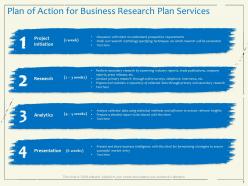
Slide 7: This slide depicts Plan of Action for Business Research Plan.
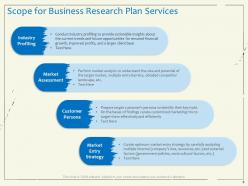
Slide 8: This slide depicts Scope for Research Design Services.
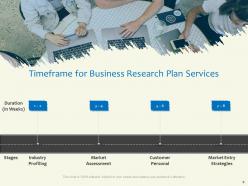
Slide 9: This slide shows Timeframe for Research Design Services.
Slide 10: This slide shows Additional Service Offerings for Research Design Proposal.
Slide 11: This slide displays Table of Contents.
Slide 12: This slide represents Investment details for Business Research Plan.
Slide 13: This slide represents Investment details for Business Research Plan. Following activities will be performed in different phases.
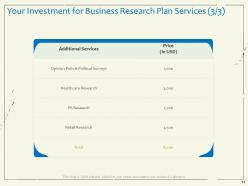
Slide 14: This slide represents Investment details for Research Design Services. Following activities will be performed in different phases.
Slide 15: This slide contains Table of Contents.
Slide 16: This slide describes Why Us for Business Research Plan.. List Out the Strengths that will add to your company
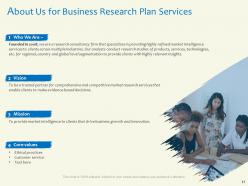
Slide 17: This is About Us slide with Company specifications, Vision, Mission and Core values for Business Research Plan.
Slide 18: This slide displays Categories for Research Design Services.
Slide 19: This is Our Team slide with Names and Designations.
Slide 20: This is Our Team slide with Names and Designations.
Slide 21: This slide displays Table of Contents.
Slide 22: This slide represents Client Testimonials for Research Design Services.
Slide 23: This slide represents Client Testimonials for Research Design Services.
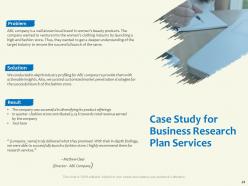
Slide 24: This slide shows Case Study for Business Research Plan.
Slide 25: This slide shows Table of Contents
Slide 26: This slide displays Statement of Work and Contract for Business Research Plan.
Slide 27: This slide contains Table of Contents.
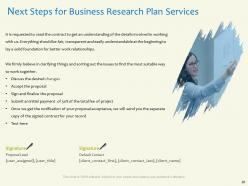
Slide 28: This slide depicts Next Steps for Business Research Plan.
Slide 29: This is Contact Us slide with Address, Contact number and Email address.
Slide 30: This slide is titled as Additional Slides for moving forward.
Slide 31: This is About Us slide to showcase Company specifications.
Slide 32: This slide displays Our Vision, Mission & Goal for Business Research Plan Proposal
Slide 33: This is 30 60 90 Days Plan slide.
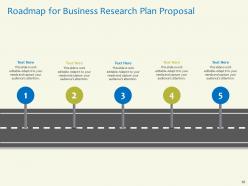
Slide 35: This slide depicts Roadmap process.
Business research plan proposal powerpoint presentation slides with all 35 slides:
Use our Business Research Plan Proposal Powerpoint Presentation Slides to effectively help you save your valuable time. They are readymade to fit into any presentation structure.











FAQs for Business research plan proposal
Look, you need to figure out three main things with your research plan. First - who's actually gonna buy this stuff and what problems they're dealing with. Second, scope out your competition to see where you can squeeze in. Third, test if your whole business idea even works before you blow through your savings. Honestly, I've seen too many people skip this part and regret it later. Write down all your big assumptions about the business first. Then figure out how to test each one - customer surveys, market sizing, pricing experiments, whatever. The whole point is avoiding those "well crap, nobody wants this" disasters that tank businesses.
Honestly, you'll want to mix a few different approaches here. Secondary research is your best friend to start - dig into industry reports, check out what competitors are doing, grab existing market data. It's cheap and gives you a solid foundation. Then add some primary stuff on top. Surveys are great for the numbers side of things. Focus groups though? Those can be absolute gold mines if you nail the questions (I've seen some terrible ones too, but whatever). Maybe throw in some observational research if that makes sense for your business. Pick like 2-3 methods that actually fit your budget and timeline. You don't want to rely on just one source anyway.
Honestly, start by figuring out who's actually signing the checks - it's rarely who you think it'll be. Company size and industry matter, sure, but dig deeper into their real problems and budget limits. How do they usually research stuff? I'd build maybe 2-3 detailed profiles using actual customer data if you've got it. Or just call up some existing clients for quick chats - people love talking about their challenges. The whole point is getting specific enough that you can actually track these people down and ask questions about what's really bugging them.
Really depends what you're after, honestly. Need to understand the "why" behind stuff? Go qualitative - interviews, focus groups, that kind of thing. Want hard numbers for market size or tracking trends? Quantitative's your best bet. Most good research uses both though, since they work well together. I'd say start with qualitative if you're exploring something totally new. But if you're just trying to validate ideas you already have with actual data, lean more quantitative. Oh, and don't overthink it - you can always pivot once you start getting results.
Budget for both your team's time and outside costs. People always lowball how much time they'll actually spend on this stuff - I've seen it happen a million times. You'll need survey platforms, maybe focus group spaces, participant incentives. If you're buying third-party data or outsourcing parts, factor that in too. Small things like travel and transcription add up fast. Tools and software subscriptions can get pricey. Honestly? Whatever number you come up with, tack on another 20% because there's always something unexpected that comes up.
Honestly, never trust just one source for anything that matters. Mix it up - do your own surveys or interviews, then back it up with solid industry reports from places people actually respect. Always peek at when stuff was published because old data will totally screw you over. When I find numbers that don't match up between sources, that's when things get interesting - dig into why. Document how you did everything so people can't pick apart your process later. Oh, and find maybe 3-5 go-to sources in your field first. Makes everything way easier down the road.
Honestly, just start with Excel or Google Sheets - they're way more powerful than most people realize and perfect for basic stats and charts. Got bigger datasets? Then look at SPSS or R, maybe Tableau if you want pretty visualizations. Interview transcripts and survey responses are different though - NVivo's solid for that stuff, or you can just do simple coding in Word (I've done this plenty of times). Don't overthink the tools part. Pick whatever your team already knows how to use and fits your budget. The fanciest software won't save you if nobody knows how to actually use it properly.
Yeah so basically you gotta match the format to who you're talking to. Executives want the quick version - just the key stuff and what they should do about it. Project teams need all the nitty gritty details and data backing everything up. Face-to-face presentations are honestly way better for complicated stuff because people actually ask good questions. Set up different sessions for each department, maybe throw together some dashboards for ongoing tracking. Oh and those short video summaries work pretty well for company-wide updates - way better than making everyone read another boring PDF that'll just sit in their inbox.
Okay so consent is obviously huge - be upfront about what you're doing with people's data. Anonymize everything and lock down any personal info you collect. Watch out for bias in your questions too, that can totally mess up your results. I know it sounds like bureaucratic nonsense but it actually protects your credibility later. Power dynamics are tricky - like if you're surveying your own employees, they might feel pressured to say yes. Oh and definitely avoid leading questions that push people toward certain answers. Just draft a quick ethics checklist for whatever you're researching.
So for planning and scoping, give yourself like 2-3 weeks. Data collection's where it gets tricky - surveys might take 4 weeks, but if you're doing interviews too, plan for 6. Analysis always drags on longer than expected because you'll spot cool patterns and want to explore them (happens every time). That's another 2-3 weeks right there. Writing up results and prepping presentations? 1-2 weeks should cover it. You're looking at 9-14 weeks total. Oh, and definitely pad your timeline with an extra week - stakeholders will 100% ask for changes once they see your preliminary stuff.
Set up your metrics before you even touch the data - both hard numbers and the fuzzy stuff. Revenue changes, cost savings, process improvements are obvious wins. But honestly? Survey people about whether they actually trust your findings enough to act on them. That's where most research dies - in someone's inbox. Do quarterly check-ins to see if anyone's making real decisions based on your work. Document everything now so you can prove the before/after difference later. Short-term adoption is cool, but long-term impact pays the bills.
Honestly, most research problems boil down to three things. Sample size kills you if money's tight - you end up with like 50 people trying to represent millions. Then there's timing, which people don't think about enough. Survey during Black Friday? Your data's gonna be wild compared to normal shopping habits. The worst part is response bias though - everyone lies a little, even when they don't mean to. They'll tell you what sounds "right" instead of what they actually do. My trick is being upfront about these issues from day one and mixing up where you get your data. Way more honest that way.
Honestly, the biggest thing is building in review points every month or so to check if you're still on track. COVID taught me that lesson the hard way - lost half my focus groups overnight and had to scramble! Now I just expect things to change. Watch your market indicators and customer feedback like a hawk. When stuff shifts (and it will), don't get married to your original plan. Sometimes you gotta switch up your data collection methods or pause studies entirely. Set up some alerts so you're not blindsided. Stay flexible but don't lose sight of what you're actually trying to accomplish.
Dude, you absolutely need to scope out your competition - it's like your sanity check for whether your idea actually makes sense. Look at what's working for them and what isn't. If three companies already crashed and burned trying your exact thing, that's pretty valuable intel right there. Plus it helps you figure out your unique angle and spot gaps they're missing. Don't just look at obvious competitors either - check out anyone who might poach your customers. I'd start with maybe 5-7 key players and just keep tabs on what they're up to. Trust me, you'll thank yourself later.
Think of your initial findings as a roadmap that might need some detours. Those "wait, that's weird" moments? Gold mine. They're usually where the real insights hide. Look for data gaps or unexpected patterns that make you go huh. Quick feedback loops with stakeholders are clutch - saves you from wandering down dead ends for weeks (been there). Don't be afraid to completely pivot your questions or methodology based on what you're seeing. Always pad your timeline for these pivots because they will happen.
-
Understandable and informative presentation.
-
Presentation Design is very nice, good work with the content as well.
-
Understandable and informative presentation.
-
Editable templates with innovative design and color combination.