

Thesis research paper proposal powerpoint presentation slides




Try Before you Buy Download Free Sample Product
 Impress Your
 Audience
 100%
100% Editable
 Save Hours
 of Time


The research thesis is a detailed paper on a focal topic picked by the students. Presenting a good working thesis is essential for the development of credibility and authenticity. It requires in-depth systematic inquiry, thoughtful editing, and writing to impress the superiors. You can make your proposition task easy with the help of our Thesis Research Paper Proposal PowerPoint Presentation Slides. These PPT templates allow you to incorporate a cover letter providing the crux of your research paper. Our expertly designed PPT slide gives you the opportunity to present a definite answer to your research question explicitly. Introduce the project to your superiors by outlining the study’s background, problem statement, hypothesis, objectives, literature review, and expected impact with the assistance of this dissertation PPT slideshow. Highlight the research method, target population, and methods of data collection for your thesis using our invigorating PowerPoint layout. Create a proper timeline for the completion of your paper to avoid any tardiness by taking the aid of this academic report PPT deck. This content-ready PPT visual proves to be highly useful to identify constraints to engaging paper, like lack of efficient research, wrong samples, etc. Employ this student thesis proposal PowerPoint presentation to showcase various phases involved in the completion of the study. Pitch your research proposal in an attractive yet informative way with this content-specific PPT graphic. Maintain the originality of your research by implementing this bibliography template in your survey work PowerPoint presentation. Our customizable additional slides given in the end allow you to edit it according to your study requirements. Utilize these slides to simplify the complex topic and make it more accessible. Take advantage of this visually-attractive PowerPoint template to exhibit the vision, mission, and goal of the proposed hypothesis. Download our thesis presentation ppt slides to clearly and concisely specify one measurable result.
People who downloaded this PowerPoint presentation also viewed the following :
Content of this Powerpoint Presentation
Slide 1: This slide introduces Thesis Research Paper Proposal. State Dissertion title, Name of University and Name of the department.
Slide 2: This slide displays Cover Letter for Thesis Research Paper Proposal
Slide 3: This slide shows Cover Letter for Thesis Research Paper Proposal
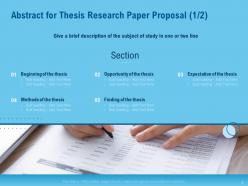
Slide 4: This slide showcases Abstract for Thesis Research Paper Proposal.
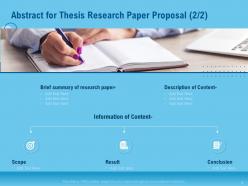
Slide 5: This slide displays Abstract for Thesis Research Paper Proposal with- Description of Content, Brief summary of research paper, Information of Content.
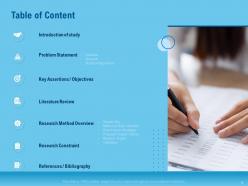
Slide 6: This slide displays Table of Content.
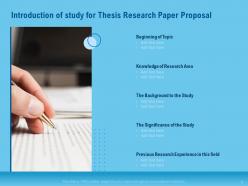
Slide 7: This slide showcases Introduction of study for Thesis Research Paper Proposal.
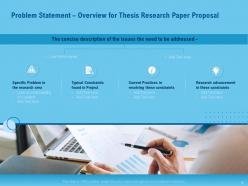
Slide 8: This slide showcases Problem Statement – Overview for Thesis Research Paper Proposal
Slide 9: This slide shows Research Question/Hypothesis for Thesis Research Paper Proposal.
Slide 10: This slide depicts Research Question/Hypothesis for Thesis Research Paper Proposal.
Slide 11: This slide represents Key Assertions / Objectives for Thesis Research Paper Proposal
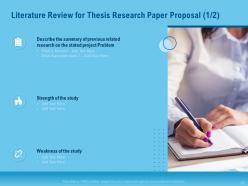
Slide 12: This slide shows Literature Review for Thesis Research Paper Proposal.
Slide 13: This slide showcases Literature Review for Thesis Research Paper Proposal.
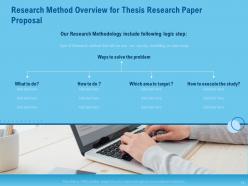
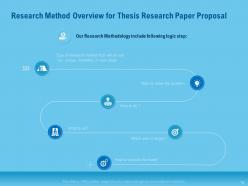
Slide 14: This slide shows Research Method Overview for Thesis Research Paper Proposal
Slide 15: This slide presents Research Method Overview for Thesis Research Paper Proposal
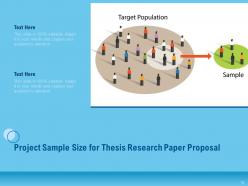
Slide 16: This slide showcases Project Sample Size for Thesis Research Paper Proposal
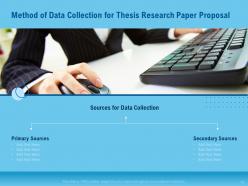
Slide 17: This slide represents Method of Data Collection for Thesis Research Paper Proposal.
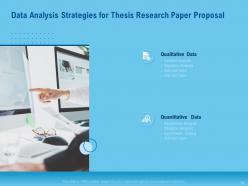
Slide 18: This slide showcases Data Analysis Strategies.
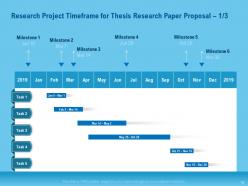
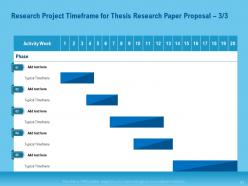
Slide 19: This slide showcases Research Project Timeframe for Thesis Research Paper Proposal.
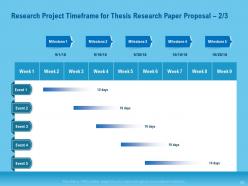
Slide 20: This slide showcases Research Project Timeframe.
Slide 21: This slide showcases Research Project Timeframe.
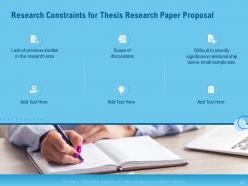
Slide 22: This slide describes Research Constraints for Thesis Research Paper Proposal
Slide 23: This slide displays References/ Bibliography for Thesis Research Paper Proposal
Slide 24: This is Contact Us slide with Website, Company Address and Website.
Slide 25: This is Icons Slide for Thesis Research Paper Proposal.
Slide 26: This slide is titled as Additional Slides for moving forward.
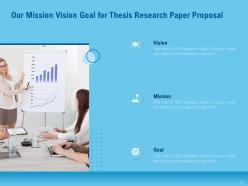
Slide 27: This slide displays Our Mission Vision Goal for Thesis Research Paper Proposal
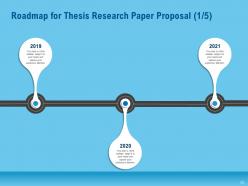
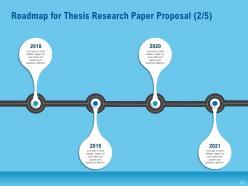
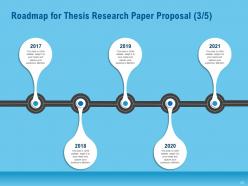
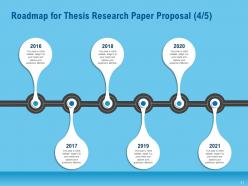
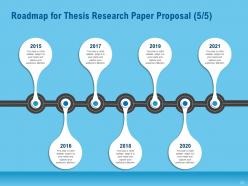
Slide 28: This slide depicts Roadmap process.
Slide 29: This slide depicts Roadmap process.
Slide 30: This slide displays Roadmap process.
Slide 31: This slide shows Roadmap process.
Slide 32: This slide shows Roadmap process.
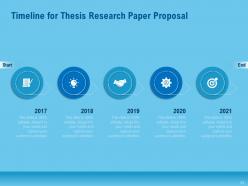
Slide 33: This slide displays Timeline process.
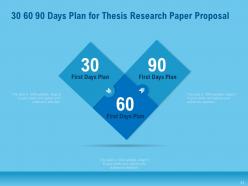
Slide 34: This is 30 60 90 Days Plan slide.
Thesis research paper proposal powerpoint presentation slides with all 34 slides:
Use our Thesis Research Paper Proposal Powerpoint Presentation Slides to effectively help you save your valuable time. They are readymade to fit into any presentation structure.

FAQs for Thesis research paper proposal
Okay so you need five main things: clear problem statement, lit review, methodology, timeline, and expected outcomes. Start by nailing what research gap you're actually filling - that's what grabs them. Your lit review shows you know your stuff, methodology proves you can pull this off. Timeline's where everyone screws up though - seriously, people are way too optimistic about how long things take! Build in extra time for when stuff inevitably goes wrong. End with why your work matters. Oh and practice beforehand because they'll definitely grill you on whether it's actually doable.
Dude, definitely use visuals for your thesis proposal. Your committee will actually stay awake when you turn dense data into charts they can understand. Flowcharts are clutch for explaining methodology - otherwise people get lost in your process halfway through. Most professors have endured countless boring presentations, so anything that breaks things up is gold. Plus when you're nervous, having slides to gesture at keeps you from just standing there awkwardly. Oh, and skip the crazy animations - they're distracting. Keep each visual clean and make sure it actually supports your point instead of just looking pretty.
Ugh, the worst thing you can do is go over time - professors hate that. Also cramming way too much onto slides makes everyone's eyes glaze over. Practice your transitions or you'll sound super choppy between sections. Never just read off your slides word for word, it's honestly painful to watch. Oh and know your methodology really well because that's where they'll grill you the most. State your research question right at the start and keep connecting back to it. Time yourself beforehand! Tech always crashes at the worst moments so have a backup ready.
Okay so basically you've gotta totally switch up your approach depending on who you're presenting to. Committee members want all the nerdy details - methodology, theoretical frameworks, the whole nine yards. They actually enjoy sitting through dense technical stuff. Conference audiences though? Completely different story. Start with your coolest findings right away because honestly, half of them are checking their phones after 10 minutes. Skip the lengthy lit review and focus on why anyone should care about your work. Also conference time slots are way stricter, so you can't ramble like you might with your committee. Just figure out what each group actually values before you dive into prep.
Dude, storytelling changes everything for committee meetings. Your research isn't just data - it's literally a mystery you solved. Walk them through how you found this problem, what made you curious, then your whole detective process. Way better than droning through methodology slides (trust me on this one). Short punchy moments work great. Then mix in longer explanations that actually flow together. Think friend conversation, not academic robot. Your research already has drama built in - conflict, discovery, the "aha!" moments. Committee members are way more likely to remember stories than bullet points anyway.
Ditch the spreadsheets - nobody wants to squint at rows of numbers during your presentation. Go with clean charts and infographics instead. Pick 2-3 main points that actually back up your thesis and build around those. One insight per slide works best, and keep your colors consistent so it doesn't look like a rainbow exploded. I'd practice explaining each visual in 30 seconds or less (seriously, time yourself). The biggest thing though? Connect everything back to your research question at the end of each section. Don't make your committee guess why you're showing them this stuff - spell it out clearly.
Honestly, just practice out loud like a crazy amount - way more than feels necessary. Your brain will autopilot through it when you're nervous. Think up the obvious questions they'll ask so you're not scrambling for answers. Show up early to mess around with the room setup and do those weird breathing exercises (I swear they actually help even though it feels dumb). Your committee isn't out to destroy you - they want this to go well too. Keep water nearby and don't speed through everything. Short breaks between slides are totally fine.
Definitely practice with a timer first - you'll figure out how long each part actually takes. I always aim to finish like 2-3 minutes early so there's room for questions. Trust me, I bombed this once by going over and had to rush through my methodology section like I was on speed or something lol. Speak way slower than what feels normal, and have a backup plan ready. Maybe identify some details you can skip if you're running behind? Short pauses between sections help too. Oh and do timed run-throughs every single practice - it's the only way you'll really know your pacing.
Honestly, repeat questions back if you're confused - gives you time to think anyway. Don't know something? Just say "good point, I'll have to look into that more" instead of rambling. I've watched so many people crash and burn trying to sound brilliant lol. Definitely take notes during feedback because you'll 100% forget the useful stuff later. Thank people for criticism (even when it hurts a little). Keep answers short and don't get all defensive. Oh, and always check if you actually answered what they asked - sometimes we think we did but totally missed the mark.
Honestly, just work those current trends right into your lit review and methods - shows you're not completely out of touch. Look for stuff published in the last 2-3 years especially. Older research is cool for background, but recent developments prove you know what's happening now. Point out how these trends create gaps that your thesis actually fills. I always end presentations by talking about how my work builds on these evolving areas - makes everything feel way more relevant. Oh, and definitely hit up recent policy changes or new tech that connects to your topic. Makes a huge difference in how current your research feels.
Don't cram everything onto one slide - drives me crazy when people do that. Pick one main point per slide and give it room to breathe. Stick with boring fonts that people can actually read from the back. I'd go with a simple color scheme too, nothing too flashy. Make your text big enough so grandma in row 20 doesn't need her glasses. Bullet points work great, but skip the spinning transitions - they're not impressing anyone in academia. Your slides should back up what you're saying, not be a teleprompter. Oh, and practice with the actual slides beforehand so you're not fumbling around during the real thing.
Put your hypothesis right at the front - no beating around the bush. Just say "I think X causes Y because of Z" in plain English. Seriously, I've sat through way too many defenses where people get lost in all the background stuff and you can't even figure out what they're testing. Don't do that to your committee! Reference it throughout your whole presentation so everything ties together. Your lit review? Connect it back. Methods section? Show how it tests your hypothesis. And yeah, definitely end with restating it one more time so it's the last thing they remember.
Walk them through your methodology like you're explaining it to your mom - no fancy academic words. Flowcharts are your best friend here, seriously. They help way more than you'd think. Show a real example of how you'll use each method, not just theory stuff. I always tell people to practice on someone totally outside your field first. If your roommate gets it, you're probably good to go. Don't just bulldoze through everything either - pause and check if they're following along. Ask "make sense so far?" Your committee actually wants to understand what you're doing, not catch you messing up.
Okay so basically you want to show how your research actually matters in the real world. What gap are you filling and why should anyone care? Think about who benefits - policymakers, practitioners, whoever. Your committee is definitely thinking "so what?" so beat them to it. Numbers help too, like "impacts 2 million people" or "overturns 20 years of theory." I always think the concrete examples work better than vague statements about advancing knowledge (which honestly sounds kinda boring). Wrap it up by showing what comes next - what can people actually do with your findings?
Honestly, just stick with PowerPoint - everyone has it and you won't run into compatibility issues. Google Slides is solid if you're working with your advisor online. Oh, and check out Canva's academic templates! They actually look professional unlike PowerPoint's boring defaults. If you've got heavy data, throw in some Excel charts or Tableau stuff. Prezi's cool but the spinning makes people dizzy lol. Here's the thing though - don't get caught up in fancy effects. Your research is what matters, not whether your bullet points fly in from the left. Pick one tool and stick with it.
-
Qualitative and comprehensive slides.
-
Good research work and creative work done on every template.
-
Innovative and Colorful designs.
-
Excellent work done on template design and graphics.
-
Easily Understandable slides.