

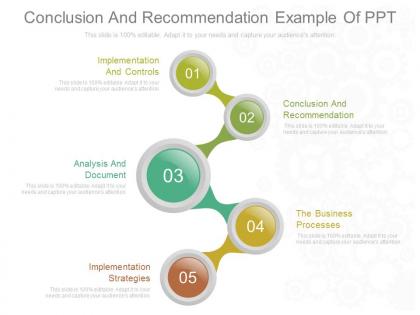
Conclusion and recommendation example of ppt




Try Before you Buy Download Free Sample Product
 Impress Your
 Audience
 100%
100% Editable
 Save Hours
 of Time


Demonstrate eagerness to accept any challenge with our Conclusion And Recommendation Example Of Ppt. You will display a daring approach.
People who downloaded this PowerPoint presentation also viewed the following :
Conclusion and recommendation example of ppt with all 7 slides:
Make them crave for your advice. Our Conclusion And Recommendation Example Of Ppt will drive their aspirations.






FAQs for Conclusion and recommendation
A strong presentation conclusion includes a clear summary of main points, actionable recommendations, compelling call-to-action, reinforcement of key benefits, and memorable closing statement. These elements work together by consolidating your message, providing clear next steps, and creating lasting impact, with many presenters finding that strategic conclusions significantly enhance audience engagement and decision-making outcomes.
Presenters can effectively summarize main points by restating key findings, highlighting critical insights, connecting back to their opening objectives, and emphasizing actionable outcomes. This strategic approach reinforces core messages through repetition and synthesis, with many executives finding that clear, structured summaries enhance audience retention, drive decision-making, and ultimately deliver stronger business results.
Strategic recommendations that align with business objectives, address specific pain points, and include clear implementation pathways are most impactful in presentations. These recommendations resonate because they connect directly to audience priorities, provide actionable solutions with defined timelines and resource requirements, and demonstrate measurable outcomes, with many executives finding that specific, prioritized recommendations with financial implications drive faster decision-making and organizational buy-in.
Visual aids enhance presentation conclusions by summarizing key findings, reinforcing critical recommendations, and creating memorable final impressions through charts, infographics, and call-to-action slides. These elements streamline complex information, guide audience focus toward next steps, and deliver lasting impact, with many presenters finding that well-designed visual conclusions significantly improve audience retention and decision-making outcomes.
Storytelling transforms presentation conclusions by creating emotional resonance, reinforcing key messages through memorable narratives, and inspiring audience action through relatable scenarios. A compelling closing story helps audiences connect abstract recommendations to real-world outcomes, with many presenters finding that narrative conclusions generate stronger engagement, clearer retention, and more decisive follow-through than traditional summary approaches.
Presenters should tailor conclusions by adjusting language complexity, emphasizing relevant outcomes, and aligning recommendations with audience priorities, whether technical teams need detailed implementation steps or executives require strategic insights. Financial services presentations might focus on ROI and compliance outcomes, while healthcare audiences prioritize patient impact, with successful presenters finding that audience-specific conclusions increase engagement and decision-making speed significantly.
Common pitfalls include introducing new information, ending abruptly without clear next steps, overwhelming audiences with too many recommendations, and failing to reinforce key messages from the presentation. These mistakes undermine decision-making by creating confusion, reducing message retention, and leaving stakeholders without actionable direction, with many organizations finding that structured conclusions significantly enhance meeting outcomes and strategic alignment.
Presenters can reinforce their call to action through clear timelines, specific resource requirements, defined ownership responsibilities, and measurable success metrics. By combining visual emphasis with compelling business rationale, organizations ensure stakeholders understand implementation steps, while addressing potential concerns proactively ultimately transforms recommendations from suggestions into strategic directives that drive immediate action.
Data and statistics strengthen conclusions through visual charts, comparative analysis, trend summaries, and key performance metrics that directly support recommendations. These quantitative elements enhance credibility by presenting measurable outcomes, benchmarking against industry standards, and demonstrating ROI projections, ultimately delivering compelling evidence that stakeholders can confidently use for strategic decision-making.
Presenters can ensure resonating conclusions through clear summary statements, actionable next steps, compelling calls-to-action, memorable closing stories, and direct audience engagement techniques. These approaches work by reinforcing key messages, creating emotional connections, and providing concrete pathways forward, with many business leaders finding that interactive conclusions and specific implementation timelines ultimately drive stronger audience commitment and follow-through.
Incorporating feedback from practice runs enhances conclusion sections by identifying unclear recommendations, weak call-to-action statements, timing issues, and audience engagement gaps. Through iterative refinement based on stakeholder input, presenters can strengthen their final messaging, ensure recommendations resonate with decision-makers, and deliver more compelling closures that drive actionable outcomes and strategic buy-in.
A memorable closing statement reinforces key messages, creates lasting impact, and motivates audience action by summarizing critical points, delivering emotional resonance, and providing clear next steps. These powerful conclusions enhance audience retention, strengthen credibility, and drive decision-making, with many presenters finding that strategic closing statements ultimately transform presentations from informative sessions into catalysts for business outcomes and stakeholder engagement.
Presenters can balance professionalism with relatability by using structured frameworks while incorporating conversational language, sharing relevant personal insights without compromising credibility, and connecting recommendations to audience-specific challenges. This approach enables executives, consultants, and team leaders to deliver authoritative conclusions that resonate personally, with many organizations finding that authentic yet polished delivery styles ultimately enhance stakeholder buy-in and decision-making outcomes.
Post-conclusion Q&A strategies include anticipating common questions, acknowledging uncertainty when needed, redirecting irrelevant queries, and reinforcing key messages through responses. Effective presenters prepare concise answers for likely concerns, use bridging techniques to connect questions back to recommendations, and maintain confident body language, with many finding that structured response frameworks and brief recap statements ultimately strengthen audience buy-in and decision-making momentum.
Presenters can ensure actionable recommendations by providing specific implementation steps, realistic timelines, required resources, and clear ownership assignments for each proposed action. Successful recommendations include measurable outcomes, address potential obstacles upfront, and align with organizational capabilities, with many executives finding that presentations linking recommendations to strategic priorities and budget realities achieve significantly higher adoption rates.
-
Use of different colors is good. It's simple and attractive.
-
Easily Understandable slides.