


Conclusions findings ppt slides rules




Try Before you Buy Download Free Sample Product
 Impress Your
 Audience
 100%
100% Editable
 Save Hours
 of Time


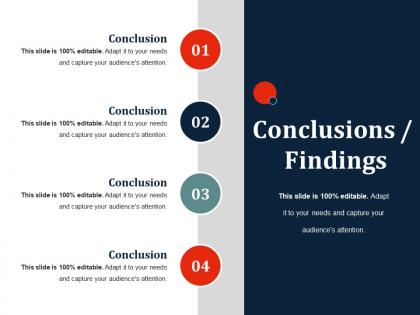
Bring about changes that go in your favor with our Conclusions Findings Ppt Slides Rules. It helps convert drawbacks to an advantage.
People who downloaded this PowerPoint presentation also viewed the following :
Conclusions findings ppt slides rules with all 5 slides:
Our Conclusions Findings Ppt Slides Rules have a dramatic effect. The audience will enjoy the extra flourish.

FAQs for Conclusions findings
Okay so the big three things: recap your main points, hammer home why it matters to them, and give them something concrete to do next. Don't just trail off - I've sat through way too many presentations that just... died at the end, you know? If you opened with a story or statistic, try circling back to it. Makes everything feel complete. Your closing lines need to sound final and confident, not like you forgot what comes next. Oh, and definitely practice those last few sentences out loud until they don't sound rehearsed. Then pause after you're done - let it sink in.
Ugh, I used to make this mistake too - trying to cram every single detail in there. Pick your 2-3 biggest findings and focus on those. Think highlight reel, not director's cut. Say "the data suggests" instead of acting like you've solved everything definitively. Be upfront about what you're not covering - readers actually respect that honesty. Your conclusion should wrap things up without pretending complex stuff is simple. Oh, and definitely point people toward where they can find more details if they're curious. Way cleaner approach.
Okay so basically you want to say your main point again but switch up the wording - don't just copy-paste from your intro. If you opened with a story or hook, bring that back around. Makes it feel complete, you know? I'm a sucker for dropping in a solid statistic or quote right at the end too. You could also describe what'll happen if people actually listen to you (or what happens if they ignore you completely). Keep it short but punchy. Oh, and definitely end with telling them exactly what to do next - people need that push.
Dude, you HAVE to end with a call to action - otherwise your whole presentation just dies this weird death where everyone's like "...so?" Think about it: you just spent 20 minutes convincing them of something, then you're gonna leave them hanging? Tell them exactly what to do next. "Email me your thoughts by Wednesday" or "test this with your team this month." Something concrete they can actually act on. Don't just ask "any questions?" - that's not helpful. Give them one specific step so they don't walk away wondering what the point was.
Stories are pure gold for conclusions because our brains are literally wired for narrative. Instead of just repeating your main points (boring!), wrap up with a quick anecdote or paint a picture of success. People will actually remember it. I always go with something like "imagine if..." or share a relevant example - way better than bullet points. The trick? Keep it short and tied to your message. Trust me, you'll see people leaning in instead of scrolling Instagram. Works every time.
Honestly, visuals in your conclusion are game-changers. People retain images way longer than whatever you just said to them. A solid chart backing up your data works great, or before/after shots if that fits. Even just your main point in big bold letters on a slide - that becomes what they walk away remembering. I've seen people go nuts with animations though and it totally backfires. You want clean and simple, tied directly to what you're trying to get across. The visual basically becomes the hook for everything else you covered.
Ugh, people always tune out during conclusions! Here's what actually works though - make it interactive instead of just rehashing your points. Ask them a question that gets their brain going, or do a quick poll if you're on Zoom. Stories work too - find one that wraps everything up nicely. Honestly, I've had good luck with surprising stats or making some bold prediction about the future. The whole point is getting them involved rather than just sitting there. Pick whatever feels natural to you and practice it a few times beforehand.
The worst thing you can do? Drop brand new info in your conclusion - seriously, don't do it. Also, don't make it super long or use boring transitions like "in conclusion." Ugh, so stiff. Instead of just copy-pasting your main points, weave them together differently. Your ending needs punch, not some wishy-washy trailing off that makes readers forget what they just read. Think of it like this: you want your conclusion to feel like a mic drop, not awkwardly shuffling offstage. I always read my last sentence out loud a few times - if it doesn't sound confident when I say it, it won't hit right on paper either.
Honestly, you've gotta read the room and tailor your ending to whoever's there. Executives? Keep it short, hit the ROI stuff. Academic crowd wants methodology and research next steps. Sales presentations need that clear call-to-action, but training sessions are different - people need takeaways they can actually remember and use later. Setting changes everything too. Formal conference = polished wrap-up. Team meeting? Way more relaxed. I always screw this up in all-hands meetings and get too casual lol. Just match your tone and focus to what that specific group actually cares about most.
Okay so for wrapping up essays, I usually go with stuff like "In conclusion" or "To summarize" - basic but works. "What this all means is..." is actually my favorite though, way less formal than the typical options. You can also circle back to whatever you opened with. Creates this nice full-circle thing that feels really satisfying when you nail it. Or try "Taken together, these findings suggest..." if you're synthesizing points. Honestly just pick whatever matches your vibe and audience. I'd start with like two favorites and practice until they don't feel weird coming out of your brain.
Honestly, the biggest thing is to actually listen instead of just waiting for your turn to talk again. Once you finish presenting, take a second to mentally switch gears - you're not performing anymore, you're just having a conversation. I always say something like "great question" when someone asks stuff because it buys me time to think. Don't know something? Just admit it instead of making something up on the spot. Oh, and keep a notepad nearby to write down things you can't answer right away. Trust me on this one - you'll forget otherwise and look unprepared later.
Grab your best stats and case studies - whatever convinced you in the first place is probably your strongest stuff. Recent research helps (like past 2-3 years), but don't just throw numbers around that sound impressive if they don't actually prove your point. I learned that the hard way once. Pick 2-3 really solid pieces of evidence instead of dumping everything on them. Make sure your sources aren't sketchy and actually relate to who you're talking to. Then connect it all back to what you want them to do about it.
Your conclusion's tone is honestly what people remember most. End confidently and energetic? They'll leave motivated. But if you sound unsure or rush through it because you're running out of time, everyone walks away confused. I always match my closing tone to what I'm trying to do - sound authoritative for recommendations, inspiring for big-picture stuff. The weirdest thing is how much that last 30 seconds matters. Practice it specifically because that's literally what sticks in their heads afterward.
So for business stuff, just be super direct - "here's what we're doing next" with actual dates. Academic conclusions are way more boring tbh, just summarizing what you found and throwing in "future research could explore..." Creative presentations? Go big or go home with something that'll stick. The thing is, each audience wants something totally different. Executives need decisions they can act on. Academics want you to prove you analyzed everything properly. Creative crowds are there for that "wow" moment that makes them feel something. Just figure out what your specific audience showed up expecting and give them exactly that.
Think of your conclusion as setting up the next conversation, not wrapping everything up. Don't just recap what you talked about - spell out what happens next. Maybe it's scheduling another meeting or figuring out who's doing what. I usually end with something like "Here are the three things we still need to figure out..." or "Let's tackle this over the next two weeks." Honestly, people forget half of what you said anyway, but they'll remember clear next steps. Give them specific ways to keep talking about your ideas after everyone leaves the room. Makes a huge difference.
-
Nice and innovative design.
-
Unique and attractive product design.