

Project conclusion and proposal ppt presentation examples




Try Before you Buy Download Free Sample Product
 Impress Your
 Audience
 100%
100% Editable
 Save Hours
 of Time


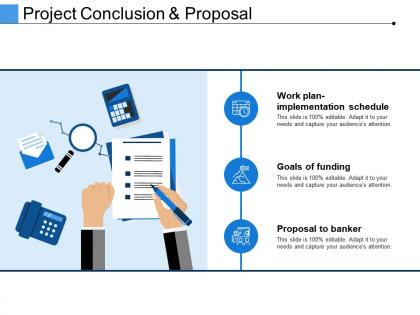
Your quest for an ideal presentation design for project conclusion and proposal to the banker ends here. The slide creates a perfect balance of vector graphics and data representation. Hence, it is not only informative but eye – catching also. Our team has conducted extensive research to include all the parameters of a project conclusion and proposal report, namely – work plan, implementation schedule, goals of funding and final proposal to the banker. As getting the required funds is crucial for a successful business, choosing this well – laid out PPT template is a beneficial idea for you. The design of an office desk with intricate detailing reflects your meticulous approach and leaves a good impression on the banker. The icons drawn along the stages involved in the report make it realistic and make the audience believe in it. So, download this exceptional presentation slide at the click of a button! Eradicate discrimination with our Project Conclusion And Proposal Ppt Presentation Examples. Extol the benefits of equal access.
People who downloaded this PowerPoint presentation also viewed the following :
Project conclusion and proposal ppt presentation examples with all 5 slides:
Our Project Conclusion And Proposal Ppt Presentation Examples give any gala a facelift. The festive fervour gets a boost.
FAQs for Project conclusion and proposal
So basically you want to tell the whole story - what you planned vs what actually happened. Be real about the messy parts too, people respect that honesty way more than fake perfection. Throw in your key wins and biggest challenges. Numbers help a ton if you've got them. Oh and definitely include what you learned along the way - that's often the most valuable stuff anyway. End with solid next steps or recommendations. Think of it like updating someone who's been out of the loop on how everything went down.
Look, people remember stories way better than boring bullet points - that's just how we're wired. Don't just dump features and benefits on them. Paint the whole picture: what's broken, how you'll fix it, what amazing thing happens after. Think of it like a movie plot honestly. Start with the problem (that's your conflict), then your solution becomes the hero swooping in to save the day. End with the happy transformation everyone wants to see. When stakeholders can actually visualize success, they're way more likely to get excited about your project and say yes.
Pick the metrics that actually matter to your original goals - completion rate, budget stuff, timeline, those KPIs you set up front. Quality numbers are super important too (defect rates, user satisfaction if that applies). Stakeholders eat up those good numbers that prove you delivered what you said you would. Oh, and definitely throw in any surprise wins or lessons that added extra value. I'd honestly stick to your 3-5 strongest metrics instead of dumping everything on them. Tell a clear story with your data that shows real impact and ROI.
Honestly, visuals are a game-changer for proposals. Complex data becomes way clearer when you throw it into charts and graphs instead of drowning people in paragraphs. Nobody's reading 20 pages of dense text anyway. Simple timeline graphics and budget bar charts work great - you don't need anything fancy. Screenshots and mockups are perfect for showing what you'll actually deliver rather than just describing it. I always think flowcharts make everything look more professional too. Your presentations will be way more engaging, and people remember visual stuff better. Even basic charts instantly make your whole proposal more persuasive and easier to follow.
Okay so here's what I do - pull up your original proposal and literally check off each goal against your conclusions. I'm terrible at staying focused during long projects, so I always keep mine open in another tab. Write a sentence or two for each goal explaining how your results actually answer it. Can't connect something? Just be honest about it or fix the conclusion. I usually make a quick table - goals on one side, results on the other. Sounds super basic but it works way better than trying to remember everything you promised to figure out.
Your biggest mistake? Just rehashing everything you already covered - that's not concluding, that's repeating yourself. Also don't throw in brand new ideas at the end (seriously, I've seen this mess up so many reports). Skip the vague stuff like "this was successful" without backing it up with real evidence. And honestly, cut the whole "more research is needed" line unless you can actually specify what research. Focus on concrete results instead. What did you learn? What's happening next? Be specific about outcomes. Here's the thing - executives often only read conclusions thoroughly, so make yours actually worth their time. Don't waste it on fluff.
Get stakeholder feedback early - seriously, don't wait until you've written the whole thing. Send rough outlines or concepts to key people first. Way easier to change direction early than rebuild everything later (learned this the hard way). Make a simple spreadsheet to track who said what and how you'll fix it. Quick check-ins throughout the process work better than one massive review at the end. People actually feel heard this way, plus you'll catch big problems before they tank your proposal. Oh, and start reaching out this week if you can.
Honestly, risk assessment is like your project insurance policy. At the start, you're flagging potential disasters so nobody can say "why didn't you warn us?" later. Most people skip this part - big mistake. Then at the end, you're basically doing a post-mortem: what actually blew up versus what you thought would? I swear this feedback loop is what separates decent project managers from great ones. Creates this database of "oh yeah, vendors always do X" that makes you look psychic on future projects. Just build yourself a basic risk template and tweak it as you go.
Don't just write generic BS about "lessons learned." Get specific about what actually broke - like when our integration testing took three weeks longer than expected (been there). Break it into real categories: tech decisions, resources, timeline screw-ups, team stuff. Skip the vague "we should communicate better" nonsense. Write it like you're warning the next PM about the landmines they'll step on. Honestly, pretend you're handing over a project to someone who'll curse your name if you don't tell them where the real problems are hiding. Make it actionable, not corporate speak.
You gotta lead with the problem you're solving and throw in real numbers whenever you can. Seriously, nobody cares about vague "benefits" - they want to see actual impact. Put your strongest stuff right at the beginning because that's what grabs them. Case studies work great for this. Oh, and figure out what they'll probably object to before they even bring it up. Your timeline needs to be realistic too - overpromising just makes you look amateur. End with something super easy for them to agree to, like a quick call or demo.
Dude, budget stuff can totally make or break your whole thing. Don't just think about the obvious costs - materials, labor, whatever. There's always random expenses that pop up, overhead, projects that spiral out of control. I've watched some really solid ideas get completely rejected because the money part seemed sketchy or half-baked. Breaking down your costs clearly shows you actually know what you're doing. Decision-makers need to see exactly what they're signing up for. Oh, and definitely build in some extra cushion for unexpected crap - trust me on this one, you'll be so glad you did later.
Go with an executive summary format - start with the big outcomes first, then get into what worked and what bombed. I'd add sections comparing your original goals to actual results, plus budget/timeline stuff and what stakeholders thought. Honestly, don't overthink it like some people do and create these massive 20-page reports that sit unread forever. Bullet points and charts are your friend here. Even though the project's done, throw in a recommendations section - it shows you're thinking ahead. PMI has decent templates, or just grab a Google Doc structure. Trust me, it'll save you from formatting hell later.
Okay so case studies are basically proof that your idea isn't just wishful thinking. Pick 2-3 examples that actually relate to your project - similar budget, scope, whatever. Stakeholders hate theoretical BS (trust me on this one). You want recent examples where you can point to real outcomes and timelines. The trick is connecting each case directly to your approach. Like, show them how Company X solved the exact problem you're tackling. Also smart to pick cases that squash any obvious objections before they even come up. Makes you look like you've thought this through.
Definitely ask questions throughout to keep people engaged - polls are gold if it's virtual. Stories hit different though, especially when you can show how your project actually helped real users. Before/after visuals? *Chef's kiss.* Don't just stand there reading slides word for word - move around, make eye contact. I always throw in quick discussion breaks or demos to break up heavy content. Oh, and practice those transitions between sections! Nothing kills momentum like awkward pauses while you figure out what comes next. The flow should feel smooth, not like you're jumping between random topics.
So first thing - tie your results back to whatever problem you were actually trying to solve. Don't just say "we saw significant improvement" because that's meaningless. Give real numbers! How much time did you save? What did it cost? I hate when people just rehash what they already said in the intro. Your stakeholders want to know the actual impact on their world. Maybe you cut processing time by 30% or saved the department $50K - that's what matters. Oh, and always end with what they should do next. Otherwise people just read it and... nothing happens.
-
Amazing product with appealing content and design.
-
Colors used are bright and distinctive.