

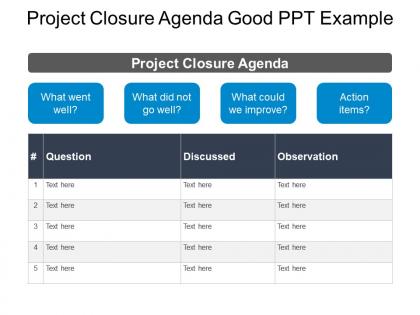
Project closure agenda good ppt example




Try Before you Buy Download Free Sample Product
 Impress Your
 Audience
 100%
100% Editable
 Save Hours
 of Time


You will be happy with the facilities included in our Project Closure Agenda Good Ppt Example. Get to feel a lot of joy.
People who downloaded this PowerPoint presentation also viewed the following :
Project closure agenda good ppt example with all 5 slides:
Give cleat cut instructions on how to do it with our Project Closure Agenda Good Ppt Example. Direct folks on the job.



FAQs for Project closure agenda
A project closure agenda should include project deliverables review, stakeholder feedback collection, lessons learned documentation, resource deallocation planning, and final financial reconciliation. These components streamline the closure process by ensuring comprehensive evaluation, capturing valuable insights for future projects, and facilitating smooth resource transitions, ultimately delivering organizational learning and enhanced project management capabilities.
A project closure agenda ensures stakeholder satisfaction by systematically addressing deliverable acceptance, performance evaluation, lessons learned documentation, and feedback collection. Through structured final reviews and formal sign-offs, organizations can resolve outstanding concerns, demonstrate value delivered against original objectives, and maintain positive relationships, ultimately enhancing their reputation and securing future project opportunities with satisfied stakeholders.
Project success assessment methods during closure include performance metrics analysis, stakeholder satisfaction surveys, budget variance analysis, timeline adherence evaluation, and deliverables quality review. These comprehensive evaluations enable organizations to measure ROI, identify lessons learned, and benchmark future project performance, with many companies finding that systematic closure assessments ultimately streamline resource allocation and enhance competitive advantage in project delivery.
Documenting lessons learned is crucial for organizational growth and future project success, as it captures valuable insights about what worked well, challenges encountered, and process improvements needed. These documented experiences enable teams to avoid repeating mistakes, replicate successful strategies, and continuously enhance project management capabilities, ultimately delivering improved efficiency and competitive advantage across future initiatives.
**INPUT**: What are the common challenges faced during project closure, and how can they be addressed in the agenda? **OUTPUT**: Common project closure challenges include incomplete deliverable documentation, unresolved stakeholder concerns, resource reallocation delays, knowledge transfer gaps, and final budget reconciliation issues. A comprehensive closure agenda addresses these by incorporating structured handover sessions, stakeholder sign-off checkpoints, and detailed documentation reviews, with many organizations finding that systematic closure processes ultimately enhance future project efficiency and reduce operational risks.
A project closure agenda facilitates deliverable transition by establishing clear handover protocols, documentation requirements, operational training schedules, and responsibility transfers between project and operations teams. Through structured knowledge transfer sessions, asset inventories, and support agreements, organizations ensure seamless operational integration while minimizing disruptions, ultimately delivering sustained business value and operational efficiency.
Team recognition serves as a critical component in project closure agendas, boosting morale, reinforcing successful behaviors, celebrating achievements, and maintaining team cohesion for future initiatives. Through formal acknowledgments, performance highlights, and contribution celebrations, organizations enhance employee engagement, improve retention rates, and build stronger project cultures, with many companies finding that recognized teams demonstrate significantly higher performance in subsequent projects.
Team member feedback can be effectively incorporated through structured retrospectives, anonymous surveys, individual exit interviews, and collaborative lessons learned sessions that capture both successes and improvement areas. These approaches enable organizations to document actionable insights, refine future project methodologies, and enhance team satisfaction, with many companies finding that systematic feedback collection ultimately delivers improved project outcomes and stronger team retention.
**INPUT**: What specific templates or tools are recommended for creating a project closure agenda? **OUTPUT**: Recommended tools include project management platforms like Microsoft Project, Asana, and Trello, along with standardized closure checklists, stakeholder feedback templates, and lessons learned documentation frameworks. These resources streamline the closure process by ensuring comprehensive deliverable reviews, stakeholder sign-offs, and knowledge transfer activities, ultimately delivering structured project completion and valuable insights for future initiatives.
A project closure agenda facilitates final project report creation by systematically organizing deliverable reviews, performance evaluations, stakeholder feedback collection, and lessons learned documentation. Through structured sessions covering budget analysis, timeline assessments, and outcome measurements, project managers can efficiently compile comprehensive reports that capture key insights, with many organizations finding this approach streamlines post-project analysis and knowledge transfer processes.
**INPUT**: What strategies can be implemented to ensure all project resources are properly accounted for at closure? **OUTPUT**: Resource accountability strategies include comprehensive asset inventories, financial reconciliation audits, equipment return protocols, personnel reassignment planning, and vendor contract closure reviews. These methodical approaches streamline organizational transitions by recovering physical assets, finalizing budget allocations, and redistributing human capital, with many companies finding that structured closure processes reduce resource losses and enhance future project efficiency. *[Word count: 54]*
A project closure agenda facilitates knowledge transfer through lessons learned documentation, process improvement identification, and resource allocation insights that directly inform future project planning. By systematically capturing what worked, what didn't, and why, organizations can streamline initiation processes, enhance risk management protocols, and optimize team structures, ultimately delivering faster project launches and improved success rates across their project portfolio.
Effective stakeholder communication during project closure involves regular status updates, clear documentation of deliverables, formal handover procedures, and structured feedback sessions. Through comprehensive closure reports and stakeholder meetings, project managers ensure transparency regarding final outcomes, lessons learned, and transition processes, while maintaining stakeholder confidence and securing support for future initiatives.
Project closure metrics should include budget variance analysis, timeline adherence, deliverable quality assessments, stakeholder satisfaction scores, and ROI calculations. These performance indicators enable organizations to measure project success comprehensively, identify improvement opportunities for future initiatives, and demonstrate tangible value to leadership, ultimately enhancing project management capabilities and strategic decision-making processes.
A formal project closure agenda supports compliance and governance by ensuring systematic documentation, stakeholder sign-offs, deliverable verification, regulatory requirement confirmation, and audit trail completion. Through structured closure processes, organizations maintain accountability standards, demonstrate regulatory adherence, and establish comprehensive project records, ultimately delivering transparency and risk mitigation while enabling future audits and organizational learning initiatives.
-
Topic best represented with attractive design.
-
The content is very helpful from business point of view.