

Continuous Improvement Strategy Powerpoint Ppt Template Bundles




Try Before you Buy Download Free Sample Product
 Impress Your
 Audience
 100%
100% Editable
 Save Hours
 of Time


Elevate your business and empower your team with our Continuous Improvement Strategy PowerPoint template. Designed for professionals seeking to optimize their processes and foster a culture of growth, this presentation offers a dynamic roadmap to success. Unlock the full potential of your employees by implementing effective improvement strategies. With a focus on essential keywords like strategy, process, employee, and business, our slides enable you to articulate your vision with clarity. From identifying opportunities for enhancement to implementing sustainable changes, this versatile PPT equips you with the tools to stay ahead of the competition. Embrace continuous improvement and drive lasting success in your organization. Elevate your professional journey with our Continuous Improvement Strategy template today.
People who downloaded this PowerPoint presentation also viewed the following :
Continuous Improvement Strategy Powerpoint Ppt Template Bundles with all 24 slides:
Use our Continuous Improvement Strategy Powerpoint Ppt Template Bundles to effectively help you save your valuable time. They are readymade to fit into any presentation structure.












FAQs for Continuous Improvement Strategy Powerpoint
Honestly, start super small - like embarrassingly small changes. Don't try fixing everything because you'll burn out your team (learned that one the hard way). Get everyone involved in spotting problems, especially the people actually doing the work daily. They know where the real mess is. Measure what you can so you're not just guessing if stuff's working. Here's the tricky part though - you've got to make it okay for people to fail and talk about it openly. Most places totally bomb this because managers freak out about looking bad. Pick one thing, fix it, see what happens, then move on. Build some wins first.
First thing - figure out what you actually want to measure before diving in. Cycle time, defect rates, customer satisfaction, cost savings, whatever matters for your situation. I like using simple dashboards or even just spreadsheets honestly. You'll want both the process stuff (leading indicators) and the results (lagging indicators). Don't forget to talk to people too - employees and customers give you insights numbers can't. Too many teams waste time tracking metrics that look impressive but don't mean anything. Monthly check-ins work well for seeing what's working. And definitely celebrate the real wins when they happen!
Honestly, your team sees stuff you don't - they're the ones dealing with problems daily. Engaged people actually speak up about what's broken or could work better. Makes sense, right? They know their jobs inside and out. Plus when employees stick around longer (which engaged ones do), you're not constantly restarting improvement projects from scratch every time someone quits. The biggest thing is making people feel safe to share ideas without getting shut down or blamed for pointing out issues.
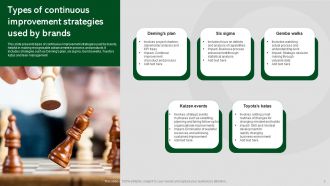
PDCA cycles are honestly your best friend here - Plan-Do-Check-Act keeps everything systematic. Kaizen events give you those quick wins that make everyone happy. For the bigger picture stuff, value stream mapping shows you exactly where you're bleeding time and resources. When things go sideways (and they will), 5 Whys or fishbone diagrams help you actually figure out what's broken instead of just putting band-aids on symptoms. The real trick is getting your team to question everything - like why we've always done X when Y might work better. Six Sigma's DMAIC adds structure if that's your thing. Just don't go crazy with tools though. Pick maybe 2-3 to start or you'll overwhelm everyone.
First thing? Map out what you're doing now and find where stuff gets stuck or goes wrong. Your frontline people are gold for this - they see the mess every day and honestly have way better solutions than management thinks. Pull your data too: complaints, quality numbers, how long things take, budget overruns. That stuff tells the real story. Oh, and check what competitors are doing so you don't miss obvious gaps. I'd tackle whatever's hitting customers hardest first, or bleeding the most money.
Honestly, the hardest part is dealing with people who hate change - they're so stuck in their old ways. Leadership usually doesn't get it either, which makes everything harder. Measuring success is tricky too because you'll end up tracking stuff that looks good on paper but doesn't actually matter. Oh, and finding time/budget? Good luck with that. My take: grab some easy wins first to show it works. Get your boss visibly backing you (this is huge). Focus on changes that actually solve problems your team complains about. Start small and build from there.
Honestly, data analytics just shows you what's actually happening instead of you guessing all the time. Like, you'll see exactly where things get stuck or which steps are taking way too long. The error patterns become super obvious too. I was skeptical at first, but the numbers don't lie - you can actually track if your changes are working or if you're wasting time. My advice? Start simple with one process. Just measure basic stuff like how long things take and error rates. The bottlenecks will jump out at you pretty fast, and then you can actually fix the right problems instead of random stuff.
Honestly, leadership makes or breaks this stuff. When things go sideways, your team's watching how you react - that's what tells them if you actually want continuous improvement or if it's just buzzword nonsense. I've seen managers who ask "how can we do this better?" all the time, and their teams aren't afraid to try weird experiments. The good ones also clear out roadblocks so people can actually test ideas. Oh, and here's something that works: share a mistake you made recently and what you learned. Sounds cheesy but it gives everyone permission to mess up and learn too.
Honestly, lean is probably your best bet for getting continuous improvement to actually work. It gives you solid tools - value stream mapping, 5S, kaizen events - that help you spot waste and fix processes step by step. What I love about it is how it gets people thinking differently. Once your team learns the basics, they start noticing inefficiencies everywhere (sometimes annoyingly so, but whatever). Pick one process that's driving everyone crazy and try some basic lean stuff on it first. Those quick wins really help build momentum. Training everyone upfront is key though - can't skip that part if you want it to stick long-term.
Cross-functional teams are honestly amazing for continuous improvement. You pull people from different departments and suddenly everyone's seeing problems from completely new angles. No more of that annoying ping-pong between teams that drags projects out forever. Each person catches issues in their own area before they become huge headaches later. The solutions actually work because - and this might sound obvious but - people who have to implement them helped create them. My advice? Pick one improvement project and grab someone from every department it'll touch. You'll move way faster than you expect.
Honestly, just celebrate the little wins way more than you think you should. Mix up what you're working on so people don't get bored. I've watched so many companies go all-in on some massive program, then leadership gets distracted by whatever's next and it dies. Make sure your leaders actually stick around and stay involved - that's huge. Share stories between teams about what's working. Give people real time to make changes, not just another thing piled on their normal workload. Oh, and track stuff that actually matters to them day-to-day, not metrics that just sound impressive upstairs.
Honestly, you need both the quick wins and the long-term stuff. Process metrics first - cycle time, defect rates, customer satisfaction. Those show results fast. Financial stuff like cost savings and ROI comes later but that's what the bosses actually care about. Don't sleep on employee engagement either - I've watched so many good initiatives crash because people weren't bought in. Track who's participating in training and suggestion programs. Pick maybe 5-7 metrics max that actually matter to your goals. Otherwise you'll drown in data. Simple dashboard, monthly reviews with the team, done.
Technology's like having a really good assistant - it does the boring stuff so you can actually think. Set up automation to track your processes and catch problems early. AI is surprisingly good at spotting patterns you'd never notice (honestly better than most people want to admit). Digital dashboards are clutch for keeping everyone on the same page about what's broken and what's not. Just don't go crazy at first - pick one thing to automate, see how it works, then expand from there. Way easier than trying to digitize everything at once.
Look, customer feedback is literally your roadmap for fixing stuff that's actually broken. Why guess when people will straight-up tell you what sucks? I mean, beats those endless meetings where everyone's just throwing around theories. Set up a simple system to collect it regularly - not just when everything's on fire. Pick whatever channel you're already using and check it weekly. That's it. The feedback shows you what's working too, which is honestly just as valuable. You'll get real data instead of operating blind, and your improvements will actually matter to customers.
Honestly, the trick is making improvement feel routine instead of some big corporate thing. Celebrate wins publicly - even small ones matter. Give people actual time to work on stuff, don't just dump it on their already crazy workload. Your managers should be asking "how do we make this better?" in regular meetings, not just putting out fires all the time. Here's the key though: when someone has a good idea, act on it fast. Nothing kills motivation like suggestions that disappear into the void. Focus on getting better bit by bit rather than expecting everything to be perfect right away.
-
Editable, diversified, compatible with MS PPT and Google Slides, and on top of that finest graphics!! I mean in the words of the famous Ross Geller, “What more do you want!”
-
I was mind-blown by the services that SlideTeam provided me. Thanks a ton!