


Continuous improvement powerpoint template slide





Try Before you Buy Download Free Sample Product
 Impress Your
 Audience
 100%
100% Editable
 Save Hours
 of Time


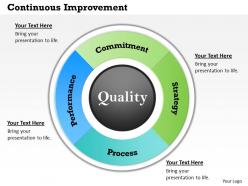
Don't wait for too long .Your wait is over. We present to you the unique and best Continuous Improvement PowerPoint Slide using smart arts and colored circular shapes. 4 sections of circular improvement cycle in the form of wheel helps establish the objective pillars of your PPT diagram services. It offers ready to go options to freely edit the color, theme, size and orientation according to one's taste and requirements. Hence, can be customized. Presentation Template Slide offers smart work features for quality management and quality assurance. Wheel diagram with sections helps people or clients rate the performance, the process, commitment and strategy through the PowerPoint show. Work progress can be easily related to feedback, efficiency and evolution. Continuous Improvement PowerPoint presentation helps to assess, analyze and act smarty by organizing the facts in a smart manner which suits the requirements and agenda of meetings. We all sometimes have the presentation nerves especially if we are not sure of what we have for our audience. However when you use Continuous Improvement PowerPoint Template Slide that are created by professionals your confidence level is sure to increase.
People who downloaded this PowerPoint presentation also viewed the following :
Continuous improvement powerpoint template slide with all 5 slides:
Time is precious. Save more of yours by using our ready made Continuous Improvement PowerPoint Template Slide in your next presentation.
FAQs for Continuous improvement
Honestly, start small - don't try to revolutionize everything at once. Get your frontline people involved because they're the ones dealing with the actual problems daily. Measure stuff so you know if changes actually help (seems obvious but you'd be surprised). Oh, and make sure your process is consistent first - can't improve something that's all over the place. People need to feel safe suggesting ideas without getting thrown under the bus. The Japanese have this whole "kaizen" thing that works everywhere. Pick one annoying process everyone complains about and brainstorm solutions together. Data beats gut feelings every time.
Honestly, leadership has to actually walk the walk first - not just say they care about improvement. Make it safe for people to call out problems without getting thrown under the bus. I've watched so many suggestion boxes turn into black holes where ideas go to die lol. Start small to build some momentum. Give your team real training, not just a PowerPoint deck. Celebrate wins even if they're tiny - people need to see their efforts matter. Pick one process that's obviously broken and let a mixed team fix it together. That's your proof of concept right there.
Dude, you absolutely need employee feedback - it's like having eyes everywhere. Your team sees the daily grind stuff that totally flies under management's radar. Bottlenecks, weird inefficiencies, all that. When people feel heard, they'll actually get on board with changes instead of fighting them (trust me on this one). Set up different ways for feedback - surveys work, suggestion boxes, regular chats, whatever clicks with your crew. Oh and here's the thing - you've gotta act on what they tell you. Otherwise they'll just stop bothering to share anything useful.
Look, data analytics is basically your proof when you want to improve stuff instead of just winging it. Track your key metrics and you'll actually see what's working. Honestly, it stops those endless debates in meetings where everyone's just guessing. Set up some dashboards so you can catch problems early - super helpful. The predictive stuff is cool too, lets you see issues coming. Oh, and don't go crazy at first. Pick like 2-3 metrics you actually care about and expand later. Way less overwhelming that way.
PDCA (Plan-Do-Check-Act) is probably the most common one you'll run into. For small improvements, there's Kaizen - honestly love how straightforward it is. A3 problem solving is huge too, but fair warning, it can be pretty intense when you're starting out. Root cause stuff like 5 Whys and fishbone diagrams? Super useful for actually figuring out what's going wrong. Value stream mapping helps with processes, and DMAIC if your company's into Six Sigma. I'd definitely start with PDCA and 5 Whys though. They're simple enough that you can try them on literally anything you're dealing with right now.
Think of it like this - one-time optimization is a band-aid fix. You solve the problem once and move on. Continuous improvement is totally different. You're constantly tweaking things based on what you learn. It's honestly way more effective long-term, even though it requires more commitment. Like, you could crash diet once or actually change how you eat forever. The continuous approach builds this mindset where your team naturally looks for better ways to do stuff. Pick one process and review it every month instead of just fixing it once and forgetting about it.
Honestly, the toughest part is getting people to actually care - leadership especially. Everyone's so stuck in their routines that any change feels like extra work. Your team will probably push back at first because CI isn't some quick fix you implement once and forget about. It requires constant attention, which is exhausting when you're already juggling daily fires. Plus measuring success is super frustrating since improvements take forever to show up in the numbers. Resource-wise, you're basically trying to run operations while simultaneously fixing them. Start with small pilot projects though - way easier to prove value that way before rolling it out everywhere.
Be curious yourself first - that sets the tone. Your team needs to feel safe sharing wild ideas or admitting when stuff goes wrong. Actually ask "how can we improve this?" and don't just nod along like most managers do (ugh, hate that). Celebrate the small experiments, even failures. Block out real time for these conversations - cramming it into regular meetings never works. Oh, and start simple. Pick one process this week and ask your team how to make it just 10% better. Small steps actually stick.
Look, when you're constantly tweaking things based on what customers tell you, they notice. They love when companies actually listen instead of just taking their money and running. You'll catch problems early before they turn into major disasters. Response times get better, complaints drop, and stuff actually works like it should. Honestly, most businesses are terrible at this - so even small improvements make you stand out. Track one customer metric this week and find something you can fix quickly. It's those little wins that add up to happier customers who stick around.
Okay so Lean is basically your blueprint for getting rid of waste and making processes flow better. Then continuous improvement gives you the actual tools - like PDCA cycles, kaizen events, those gemba walks where you actually go see what's happening. They work together really well because Lean shows you the big picture value streams, which honestly makes it way easier to spot where things are getting stuck. I'd start simple though - just map out one process you deal with all the time and look for the obvious waste. That's your first improvement project right there.
Dude, Toyota's the gold standard here - they've spent decades perfecting their system where workers can literally stop production if something's off. Pretty bold move if you ask me. Amazon obsesses over customer experience through endless testing and tweaking. Then there's 3M letting employees spend 15% of their time on random passion projects (hello, Post-it Notes!). The cool thing is none of these companies just fix problems. They've built cultures where everyone's constantly thinking "what if we tried this differently?" Just start small with your team and see what happens.
You'll want to track the obvious stuff first - cost savings, defect rates, cycle times, customer satisfaction. Those give you real proof it's working. But honestly? The culture piece matters just as much. Are people actually submitting ideas? How fast are you implementing changes? Teams solving their own problems quicker? I'd set up a basic dashboard with maybe 3-4 key metrics you check monthly. Throw in some employee pulse surveys too - you need to know if people are actually bought into this whole thing. Oh, and start measuring now even if it's super basic. You can always get fancier later.
Honestly, they're not competing against each other at all - continuous improvement and innovation actually work together pretty well. Your CI efforts give you the groundwork for bigger breakthroughs. When you're constantly looking at processes and collecting feedback, you'll naturally spot those larger opportunities that need creative solutions. The data from continuous improvement often shows you patterns you wouldn't have noticed otherwise. It's kind of like... CI keeps you in shape for when innovation opportunities come along. I'd say keep doing both - let your improvement work create the right conditions where innovation can actually take root and grow.
Honestly, service industries are trickier than manufacturing because you can't just count defective widgets. You're still using the same approach though - find problems with data, test fixes, measure what works. Instead of tracking production defects, you'll be looking at customer satisfaction scores, how long responses take, that kind of stuff. Manufacturing definitely has it easier! Start by mapping out your customer's whole experience and spot where people get most frustrated. Those friction points are gold mines for improvements. You're basically streamlining workflows and making interactions smoother, but the core process is identical to any other improvement work.
Honestly, you don't need some fancy certification or anything. Most people who are good at this stuff are just naturally curious - they notice when something's broken or inefficient. Companies usually train you on the actual tools (lean methodology, root cause analysis, whatever) once you're there. The main thing is being comfortable asking "wait, why do we even do it this way?" Basic problem-solving helps, plus understanding simple data analysis. Oh, and being able to map out processes step by step. My advice? Find one tiny thing that's bugging you at work and suggest a fix. Collaboration's huge too - nobody likes the person who thinks they can solve everything alone.
-
The Designed Graphic are very professional and classic.
-
Excellent products for quick understanding.