

Quality improvement powerpoint presentation slide template





Try Before you Buy Download Free Sample Product
 Impress Your
 Audience
 100%
100% Editable
 Save Hours
 of Time


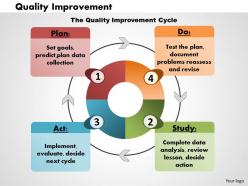
Companies need constant feedback to Improve their business processes. That is one way to generate PPT inspiration. Different organizations have different methods to achieve objectives; But most of them rely on constant feedback and acting on it to for better results. Most of them are divided into equal phases which are dependent upon each other; I.e., no task can be achieved if the previous one is left incomplete. Are you a businessman and looking for a quality presentation tool to aware your target audience? Then look no further and browse thousands of efficient PowerPoint slide background designs on our website. These apt and to the point PPT slides are made for different subjects. One such example of PPT is our quality improvement PowerPoint slide background image. Feel the difference with a robust and powerful PowerPoint layout. Our designers have worked hard to present to you a state of the art PowerPoint slide introduction. Apply this slide for maximum presentation benefit. Acquire aplomb with our Quality Improvement powerpoint presentation slide template. They exemplify a cool approach.
People who downloaded this PowerPoint presentation also viewed the following :
Quality improvement powerpoint presentation slide template with all 5 slides:
Capture hearts with your views. Set pulses racing with our Quality Improvement powerpoint presentation slide template.


FAQs for Quality improvement powerpoint
Track both outcome and process stuff - defect rates, customer satisfaction, cycle time, first-pass yield. Don't sleep on employee engagement either since your team has to actually care for this to work. Process metrics like time-to-resolution help catch problems early. Honestly, rework rates are huge red flags most people ignore. Pick maybe 3-5 metrics that actually relate to your goals instead of measuring everything. I'd start with whatever's driving you crazy right now and build from there.
Honestly, engagement is everything for quality improvement. Your team will catch problems way earlier when they actually care. They'll come up with solid solutions and follow through instead of half-assing it. But disengaged people? Total opposite - they resist changes, miss obvious issues, and do the absolute minimum. I've seen it happen so many times. Engaged teams take ownership and keep improving stuff on their own. Short, punchy point: if your quality programs keep failing, maybe check if people are actually bought in first. Sometimes you gotta fix that before rolling out new standards.
Think of data analytics like being a detective for quality problems. You'll spot issues way before they blow up into disasters. Look for patterns - maybe one production line keeps screwing up, or customers always complain about the same feature. Honestly, the numbers don't lie and they're usually more reliable than hunches. I've seen too many people waste time fixing the wrong things because they went with their gut instead. Pull whatever quality metrics you've got and hunt for weird trends or outliers. That's where you'll find your real problems hiding.
Make everyone feel like they own quality improvement, not just the QA folks. Celebrate when people catch problems or pitch ideas - honestly, free pizza goes way further than you'd think. Give your team actual time for this stuff instead of cramming it between everything else. Train them on root cause analysis and basic improvement tools. Here's the thing though - if leadership ignores their suggestions, people will stop trying real fast. So actually implement the good ideas. Create space where it's okay to mess up and try new things. Small wins add up.
Honestly, people hate change - even when their current process sucks. That's your biggest headache right there. Leadership not backing you up is brutal too. Plus you'll never have enough time or budget, obviously. Communication gets messy fast when nobody understands why you're changing things in the first place. Don't even get me started on crappy data - can't fix what you can't properly measure. Success metrics? Half the time they're so vague they're useless. Start with small pilot tests though. Quick wins make everything else way easier to push through later.
Honestly, customer feedback is your best shot at catching stuff you'd never notice from the inside. People will straight-up tell you what's broken through reviews, support calls, surveys - whatever. The real trick isn't collecting it (that's the easy part), it's actually doing something with all that info instead of just letting it pile up somewhere. Look for patterns in what people complain about most. That'll show you where to focus first. I've seen companies miss huge issues because they weren't really listening to their customers - don't be one of them. Set up some kind of regular review process so feedback doesn't just disappear into the void.
Leadership buy-in is everything, honestly. Without it, your quality projects will die a slow death when the next crisis hits. I've seen it happen so many times - you'll get initial momentum, then suddenly there's no budget or time because leaders moved on to other priorities. The good ones actually model the behaviors they want to see. They clear roadblocks and celebrate when teams hit milestones. If you're struggling to get them on board, show them quick wins first. Connect your improvements to stuff they actually care about - usually money or customer satisfaction. That's what gets their attention.
Honestly, the biggest mistake people make is treating quality improvement like some separate thing. Bake it right into job descriptions and team meetings instead - that way it's just part of the job, not extra work piled on top. Your leadership has to actually care though, or it'll die within months (seen this happen way too many times). Pick one process to start with and make QI part of your weekly routine there. Don't forget to celebrate the wins! People need to see it's working or they'll lose interest fast.
Honestly, start with the 5 Whys thing - just keep asking "why" until you get past the surface stuff to what's actually broken. Fishbone diagrams work great because you can map out causes across different areas like people, processes, materials, whatever. For complex systems, failure mode analysis is where it's at (yeah it's kinda nerdy but super effective). Oh, and Pareto analysis helps you tackle the biggest problems first - classic 80/20 rule. Don't just pick one method though. Mix a few techniques together and double-check your findings with actual data before you start fixing anything.
Think of regulations as the rules you have to play by when rolling out quality improvements. Yeah, the documentation stuff is annoying as hell, but at least it gives you a roadmap. You'll need to hit certain patient safety marks and reporting deadlines anyway. My advice? Figure out which regs apply to your department first - don't wait until you're halfway through a project to realize you missed something obvious. Build those compliance checks right into your timeline from the start. It's way easier than backtracking later when leadership starts asking questions.
So Six Sigma and Lean are both solid options, but honestly they work way better together. Six Sigma is all about cutting defects using data (the DMAIC process), while Lean just gets rid of waste and makes everything flow smoother. Most companies that actually succeed use "Lean Six Sigma" - there's a reason they named it that. You could also look into Kaizen for those small daily improvements, plus statistical process control to keep tracking things. Oh, and definitely map out what you're doing now first. Then just tackle whatever's causing you the biggest headache. Don't go crazy trying to do it all.
Dude, you absolutely need other departments involved - it's like the make-or-break thing for quality stuff. Most problems don't just live in one silo, they're spread across marketing, ops, customer service, wherever. Each team only sees their piece of what's broken. Get them talking and suddenly you're fixing actual root causes instead of just slapping band-aids on symptoms. I'd start by figuring out which departments actually touch your problem (probably more than you think), then literally get everyone in a room together. It sounds obvious but most companies suck at this.
Focus on training your people first - that's where you'll see the biggest bang for your buck. Most screw-ups happen because processes aren't consistent, not because you need fancy equipment. Map out your main workflows and spot where things go wrong most often. Create simple checklists your team can actually follow (nobody reads 20-page manuals, let's be real). Customer feedback is basically free research, so collect it and fix issues fast. Track basic stuff weekly like error rates. Oh, and don't try fixing everything at once - pick one process monthly. You'll burn out otherwise.
Stop treating quality like some afterthought! Build it right into your review process from day one. Set actual targets - cut defects by X%, boost customer scores, whatever matters. Most companies totally whiff on this part honestly. Track progress monthly, not just when reviews roll around. Give props to people who spot issues and pitch fixes, even if implementation drags on forever. I've watched too many good employees get overlooked because their quality work doesn't show up anywhere official. Quality should count as much as hitting your sales numbers.
Honestly, you can't just throw people into quality improvement and hope they figure it out. Your team needs actual training on stuff like root cause analysis and methodologies - Lean, Six Sigma, whatever fits your situation. Even naturally good problem-solvers need frameworks to work with. Figure out what skills your people are missing first. Then build training around those gaps. Good programs teach critical thinking about processes and how to use data properly. Plus they learn to collaborate on real solutions instead of constantly firefighting. (Which gets exhausting, trust me.) The whole point is giving them tools to spot problems systematically and actually fix them long-term.
-
Great experience, I would definitely use your services further.
-
Content of slide is easy to understand and edit.