

Process improvement ppt infographic template





Try Before you Buy Download Free Sample Product
 Impress Your
 Audience
 100%
100% Editable
 Save Hours
 of Time


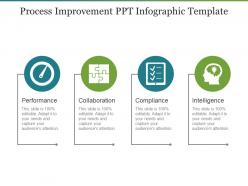
Process improvement or business process improvement occupies a major place in business presentations. So, in order to help you in presenting it in the best possible manner, we have come up with this process improvement PPT infographics template. Crafted professionally under the guidance of field experts, we come up with this hassle-free and easily customizable business process improvement Powerpoint presentation model. The BPI PPT infographic is a balanced blend of graphics, images, and text. The slide comprises a well-curated content that will let you present the topic without much hassle. Save your time and other resources while you take the assistance of this thoroughly editable template to draft a remarkable presentation. Overall it is a highly informative and aesthetically pleasing PPT PowerPoint presentation. Performance, collaboration, compliance, and intelligence are the components of the BPI as mentioned by our experts along with their respective PPT icons. Generate the desired inputs with our Process Improvement Ppt Infographic Template. Ensure important information is available to all.
People who downloaded this PowerPoint presentation also viewed the following :
Process improvement ppt infographic template with all 5 slides:
Inform folks about the facts of the case with our Process Improvement Ppt Infographic Template. Address attempts to confuse the issue.



FAQs for Process improvement
So there's three big ones: Lean, Six Sigma, and Kaizen. Lean's about cutting waste and making workflows smoother. Six Sigma gets deep into data and stats to reduce defects - honestly, the math can be brutal. Kaizen is different though, more focused on getting everyone involved in small, ongoing improvements. The way I see it, Lean targets efficiency, Six Sigma goes after quality, and Kaizen's really trying to shift your whole team culture. I'd probably start with Lean since it's way more straightforward and you can actually see results pretty fast.
Map out your process first - visually if you can. Check your data for wait times and error rates, but honestly? Talk to the people doing the actual work. They'll catch stuff numbers miss. Bottlenecks love hiding in handoffs between teams (org charts are the worst for this). Time things manually or use value stream mapping - whatever works. Here's the thing though: find your biggest constraint first. That's what's choking your whole system. Fix that before you mess with smaller stuff, otherwise you're just rearranging deck chairs.
Honestly, you can't improve processes without getting your team's input first. They're in the trenches daily - they know where things get stuck or fall apart way better than management does. Skip this step and you'll end up fixing stuff that isn't broken while the real problems keep causing headaches. I've seen it happen so many times. People also buy into changes more when they feel heard. Create ways for them to speak up safely (anonymous surveys work great), then actually do something with what they tell you. Otherwise you're just wasting everyone's time.
Honestly, data analytics is like having x-ray vision for your business processes. You'll spot bottlenecks you never knew existed and see patterns in failures that weren't obvious before. The predictive stuff is pretty wild too - you can actually catch problems before they blow up if you've got decent historical data. My advice? Pick one process and really dig into those numbers. Set up some basic dashboards so issues smack you in the face instead of hiding. Don't just look at what happened though - always ask why it happened. I started doing this last year and man, some of the stuff that came up was eye-opening.
Dude, you absolutely need measurable goals or you're just guessing if anything's actually getting better. Like, you might *think* the process is running smoother, but how do you prove that to your boss? Concrete metrics show you what's working and what still sucks. Everyone stays on the same page about what you're trying to fix too - no more confused meetings where people are like "wait, what was the point of this whole thing again?" Pick maybe 2-3 key numbers that actually matter to your process. More than that and you'll drown in data.
Honestly, process mapping is like getting X-ray vision for your workflows. You'll see exactly where things get stuck - like when there's five different people who need to approve one simple request (corporate bureaucracy at its finest). Map out one messy process on a whiteboard with sticky notes. The bottlenecks become super obvious when you visualize everything. Plus you can figure out which steps actually matter vs pure busy work. Once you see your current mess laid out, designing something better is way easier. Trust me, do this once and you'll wonder why you waited so long.
Don't try fixing everything at once - that's a recipe for disaster. Talk to the people actually doing the work first, not just management. I can't stress this enough: get real data before assuming what's broken. Teams constantly jump to solutions without understanding the actual problem, then wonder why nothing improves. Also? Ditch the perfectionism. Good enough beats waiting forever for some flawless process. Pick one specific thing that's driving everyone crazy, test small changes, then scale up what works. Oh and definitely don't skip the frontline conversations - they know where the real problems are.
Honestly, automation is a total game-changer because you get actual data instead of just guessing. Real-time tracking shows you bottlenecks and patterns you'd miss otherwise. Your team stops wasting time on documentation and starts fixing actual problems - which feels way better, trust me. Start small though. Pick whatever process is making everyone miserable, automate how you collect data on it, then use those insights to make specific improvements. I always tell people workflow software is clutch for this stuff. Way more effective than the old "let's have a meeting about it" approach.
Culture basically determines if your process improvements will work or die a slow death. You'll slam into resistance if people think "we've always done it this way" or hate trying new things. They might nod along in meetings but go right back to old habits afterward. But when your team actually wants to learn and improve? Those changes stick. People get excited about small wins and throw out good ideas. Honestly, I've seen too many companies jump straight into new processes without checking if anyone will actually embrace them first. That's backwards - fix the culture piece or you're just wasting time.
Get people involved from day one - trust me on this. Map out who's actually affected and figure out their concerns first. Don't just tell them what you're changing, explain why it matters to them specifically. Quick wins are your friend here - share those progress updates so they see stuff is actually happening. Here's what really works though: ask stakeholders to help design the solution. When they've got skin in the game, they'll fight for it instead of against it. Oh, and do regular check-ins before problems blow up into drama.
So basically, continuous improvement is like... you're always tweaking stuff vs just fixing something once and calling it done. One-time fixes are more "this is broken, let's have a meeting and solve it." But with continuous improvement, your whole team gets into this habit of spotting tiny things to make better. It becomes second nature, you know? Honestly, I'm way more into the continuous approach because those small changes actually stick around. Quick fixes feel good in the moment but don't really change how people work. Try this - pick something your team does every week and just ask what's bugging everyone about it. Start there.
Focus on efficiency, quality, and customer stuff. Cycle time and throughput show if things are actually moving faster. Error rates are huge - honestly they tell you more than most other metrics combined. Customer satisfaction scores matter too, obviously. Here's the thing though - don't go crazy measuring everything. Pick like 3-4 max that actually connect to what you're trying to fix. Get your baseline numbers first before changing anything, then track consistently. I learned this the hard way when I tried tracking 12 different things and it was just noise.
So here's what I'd do - start with Lean to knock out the obvious waste first. Value stream mapping is clutch for spotting inefficiencies, and trust me, there's always more than you think. After you clean up the workflow basics, that's when Six Sigma comes in handy for the gnarly problems that actually need data analysis. DMAIC works great for those quality issues that aren't immediately obvious. The trick is getting the order right though - Lean gives you quick wins, then Six Sigma handles the precision stuff. I'd definitely test it on just one process before going crazy with it everywhere.
Honestly, there's so much out there it can be overwhelming. Free stuff works great to start - YouTube has some solid continuous improvement tutorials, and you can grab process mapping templates online. ASQ does certification programs if you want something more formal. But here's the thing - sometimes you learn more by just picking your most annoying process and messing around with it as a team. I'd probably start everyone with one free online course so you're all speaking the same language, then figure out what specific stuff your team actually wants to get better at. Oh, and lots of consulting firms do industry-specific workshops too.
You gotta make it stick in your daily routine, not just some fancy project that dies after two weeks. Train a few people so you're not screwed when Sarah leaves for another job. Have your team do regular check-ins about what's working and what sucks. Pick clear metrics that people actually look at - none of that dashboard nonsense nobody opens. Honestly, celebrating the small stuff makes a huge difference in keeping momentum going. Let teams own their processes instead of micromanaging everything. Start simple this month. Just ask your team what's driving them crazy about one specific process and fix that first.
-
Best way of representation of the topic.
-
Very unique and reliable designs.
-
Excellent Designs.
-
Easily Understandable slides.