


Process documentation and improvement powerpoint slides




Try Before you Buy Download Free Sample Product
 Impress Your
 Audience
 100%
100% Editable
 Save Hours
 of Time


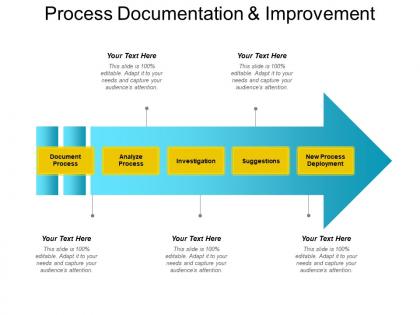
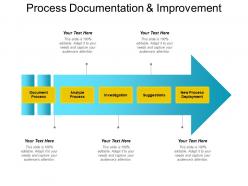
Measure the efficiency of what you have planned to do with our process documentation and improvement PowerPoint slides. This template of process documentation has been created by our team of professional team members to make sure the project is successful by making routine evaluations throughout its execution. With the help of this project evaluation checklist PPT template, you can outline your observations about future projects to understand what went wrong, what went right, and what needs to be improved. This workflow process PowerPoint presentation can be used to train employees because your documentation about the process will help new employees understand their job roles and familiarize themselves with the processes. This process workflow management system template assists in visualizing where you are and compare it with where you want to be, based on the assessment you have made. Use this business workflow PPT slides to create workflows that help to streamline the process so that managers can monitor the steps within workflows. Our Process Documentation And Improvement Powerpoint Slides give you a bagful of choices. You will enjoy a heap of alternatives.
People who downloaded this PowerPoint presentation also viewed the following :
Process documentation and improvement powerpoint slides with all 5 slides:
Continue to build on the initial advantage with our Process Documentation And Improvement Powerpoint Slides. You will inch ahead consistently.


FAQs for Process documentation and
Fundamental principles of process improvement include value stream mapping, waste elimination, continuous measurement, stakeholder engagement, and standardization of best practices. These methodologies enhance operational efficiency by identifying bottlenecks, reducing redundancies, and optimizing resource allocation, with many organizations finding that systematic implementation delivers faster cycle times, lower costs, and ultimately sustainable competitive advantage.
Lean methodology integrates into existing workflows through value stream mapping, waste identification, standardized processes, employee training, and continuous improvement cycles. Organizations across manufacturing, healthcare, and financial services streamline operations by eliminating non-value activities, reducing cycle times, and enhancing quality control, ultimately delivering improved efficiency and customer satisfaction while maintaining operational flexibility.
Data analysis plays a crucial role in process improvement by identifying bottlenecks, inefficiencies, and performance gaps through metrics tracking, trend analysis, and comparative benchmarking. Through advanced analytics tools, organizations streamline operations, reduce costs, and enhance productivity, with many manufacturing and financial services companies finding that data-driven insights deliver measurable improvements and competitive advantages.
Companies can measure process improvement success through key performance indicators like cycle time reduction, cost savings, error rates, customer satisfaction scores, and employee productivity metrics. By establishing baseline measurements before implementation, organizations can track quantifiable improvements across manufacturing, healthcare, and financial services operations, with many finding that combining multiple metrics delivers clearer insights into operational efficiency and competitive advantage.
Common pitfalls include inadequate stakeholder engagement, insufficient data collection, resistance to change management, unrealistic timelines, and lack of clear success metrics. These challenges can derail projects by creating implementation gaps, employee pushback, and unclear outcomes, with many organizations finding that early stakeholder involvement and comprehensive change management strategies ultimately deliver smoother transitions and sustainable improvements.
Employee feedback contributes to successful process improvements by identifying bottlenecks, revealing inefficiencies, suggesting practical solutions, and highlighting customer pain points that management might overlook. This frontline insight enables organizations to streamline operations more effectively, with many companies finding that employee-driven improvements deliver faster implementation, higher adoption rates, and sustainable operational efficiency gains.
Process improvement tracking tools include process mapping software like Visio, project management platforms such as Asana and Monday.com, statistical analysis tools like Minitab, and specialized solutions including Lean Six Sigma software and business intelligence dashboards. These technologies streamline progress monitoring by automating data collection, visualizing performance metrics, and generating real-time reports, with many organizations finding that integrated platforms deliver enhanced transparency and faster decision-making capabilities.
Process mapping enhances workflow understanding by visually documenting each step, identifying bottlenecks, redundancies, and inefficiencies within existing processes. Through detailed visualization, organizations can streamline operations, eliminate waste, and optimize resource allocation, with many manufacturing and healthcare institutions finding that mapped processes reduce cycle times significantly while improving quality outcomes.
Best practices for continuous improvement culture include establishing clear metrics and feedback loops, empowering employees at all levels to identify inefficiencies, implementing regular process audits, and creating cross-functional improvement teams. These approaches streamline operations by fostering innovation, reducing waste, and accelerating problem-solving capabilities, with many organizations finding that sustained improvement initiatives ultimately deliver enhanced productivity and competitive advantage.
Cross-functional teams collaborate effectively in process improvement by establishing clear communication channels, defining shared objectives, and implementing structured workflows that leverage diverse expertise. Through regular stakeholder meetings and collaborative platforms, organizations streamline decision-making, enhance transparency, and accelerate implementation timelines, with many finding that diverse perspectives ultimately deliver more comprehensive solutions and sustainable operational improvements.
Technology significantly enhances process efficiency by automating repetitive tasks, providing real-time data analytics, and enabling seamless integration across departments. Through AI-powered automation and cloud-based platforms, organizations in manufacturing, healthcare, and financial services streamline workflows, reduce operational costs, and deliver faster customer experiences, ultimately gaining competitive advantage in increasingly digital markets.
Organizations ensure stakeholder buy-in during process improvement implementations by communicating clear benefits early, involving key stakeholders in planning phases, and demonstrating quick wins that validate the approach. Through transparent progress updates, comprehensive training programs, and addressing concerns proactively, companies like manufacturing firms and healthcare systems build trust, minimize resistance, and ultimately achieve smoother transitions with higher adoption rates.
Six Sigma delivers measurable benefits including reduced defects, enhanced operational efficiency, cost savings, improved customer satisfaction, and data-driven decision making. Through systematic DMAIC methodology, organizations across manufacturing, healthcare, and financial services streamline workflows, minimize waste, and achieve significant quality improvements, with many companies reporting 10-25% cost reductions and enhanced competitive advantage.
Process improvement initiatives align with organizational goals through strategic mapping, stakeholder engagement, performance metrics integration, and resource prioritization that directly supports business outcomes. By establishing clear KPIs, conducting regular progress reviews, and ensuring cross-functional collaboration, organizations streamline operations while achieving measurable results like cost reduction, enhanced efficiency, and improved customer satisfaction, ultimately delivering sustainable competitive advantage.
Effective strategies include establishing continuous monitoring systems, embedding improvements into standard operating procedures, training staff regularly, conducting periodic audits, and maintaining leadership commitment. These approaches ensure sustainability by creating organizational habits, measuring performance consistently, and addressing deviations quickly, with many companies finding that regular reinforcement and employee engagement ultimately deliver lasting operational efficiency and competitive advantage.
-
Attractive design and informative presentation.
-
Perfect template with attractive color combination.