

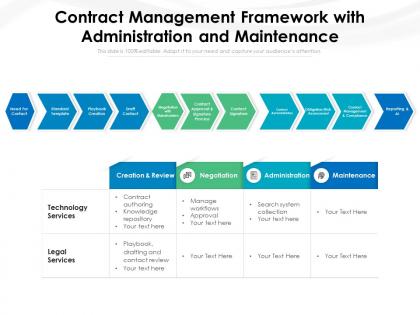
Contract management framework with administration and maintenance




Try Before you Buy Download Free Sample Product
 Impress Your
 Audience
 100%
100% Editable
 Save Hours
 of Time


Our Contract Management Framework With Administration And Maintenance are topically designed to provide an attractive backdrop to any subject. Use them to look like a presentation pro.
People who downloaded this PowerPoint presentation also viewed the following :
Contract management framework with administration and maintenance with all 2 slides:
Use our Contract Management Framework With Administration And Maintenance to effectively help you save your valuable time. They are readymade to fit into any presentation structure.

FAQs for Contract management framework with
You need standardized processes for creating contracts, approval workflows, centralized storage, and performance tracking. Define clear roles too. Storage is honestly where everyone screws up - contracts end up everywhere and nowhere at once. Set up automated alerts for renewals and expirations, trust me on this. Risk assessment protocols matter for big-ticket agreements. Oh, and regular compliance audits. My advice? Map your current process first. Find the biggest headaches and tackle those components initially. Don't try to fix everything at once or you'll go crazy.
Honestly, getting your contract process sorted out changes everything. No more frantically searching for documents or playing phone tag about signatures. Map out what you're doing now first - bet you'll spot the mess immediately. Clear steps for drafting, approvals, and renewals mean deals close faster and you're not scrambling when stuff expires. Compliance headaches basically disappear too. The renewal alerts alone are worth it (can't tell you how many times I've seen companies caught off guard by expirations). Less chaos, fewer bottlenecks. Your future self will thank you.
Honestly, you'll want to grab a cloud-based CLM platform first - those things handle everything from writing contracts to tracking renewals automatically. DocuSign is a no-brainer too (seriously, who has time for printing anymore?). The AI contract analytics are actually pretty solid now - they catch risky clauses and pull out important terms way quicker than doing it manually. Make sure whatever you pick plays nice with your CRM and ERP stuff. Oh, and get something with proper document storage so people aren't working off random outdated versions. I'd focus on finding a CLM that integrates well with what you're already using.
Honestly, I'd start by mapping out where things usually go wrong in your current setup - that'll show you exactly what needs fixing. Set up those standard approval workflows and get some automated compliance checks running. Templates with all your legal stuff already built in are a lifesaver, trust me on this one. Don't forget about tracking renewal dates and terminations because missed deadlines are the worst. Oh, and build in some way to monitor how contracts are actually performing so you can spot problems early. Way easier than dealing with bigger messes later.
Dude, automation is honestly a lifesaver for contract stuff. You can set up auto-reminders so you're not panicking when renewals sneak up on you. Templates help churn out new contracts way faster too. The workflow tracking is pretty solid - keeps everyone on the same page during approvals. Oh, and it'll catch sketchy clauses before you sign something terrible. Everything gets documented automatically which beats trying to remember what happened six months ago. I'd start with just the alerts and templates first. Those two things alone will save you like 5+ hours a week, no joke.
Honestly, build those KPIs right into your contract from day one - delivery times, quality benchmarks, cost goals, service levels. Monthly or quarterly check-ins work pretty well for tracking. The key thing is making your metrics actually measurable, not some vague stuff that looks impressive but means nothing. I usually just throw everything into dashboards or even basic spreadsheets to see trends over time. That way you'll catch problems early and have real data when it's time to renew or renegotiate. Way better than flying blind and hoping for the best.
Honestly, I can't stress this enough - figure out your bottom line before you even walk into the room. Research what they actually need too, because finding common ground is way easier than just battling over every little thing. Get your legal team involved early (trust me on this one). Document everything as you go. Building actual relationships matters more than people think - I've seen deals fall apart over personality clashes that could've been avoided. Oh, and don't let anyone rush you into signing. Draft up a simple checklist beforehand - it's a lifesaver.
Look, good communication basically prevents everything from going sideways. Map out who needs updates and when, then actually stick to it - that's honestly the hardest part. People cooperate way more when they're not left in the dark about timelines and what's expected of them. You'll catch problems early before they blow up your budget. Regular check-ins and feedback loops sound boring, but they work. When stakeholders get their roles and aren't surprised by deadlines, you get smoother renewals and way fewer headaches. Trust me, it's worth setting up those communication protocols from day one.
Ugh, the worst part is definitely getting people to actually adopt the thing - everyone's so set in their ways. Legacy contracts are a total mess too, like they're buried everywhere across different departments. Contract templates? Completely inconsistent. Processes? What processes lol. You won't be able to see what's working and what isn't. Oh and good luck with system integration - that's always fun. Honestly though, just pick one department to start with. Get some wins there first, then you can show off those results to convince everyone else it's worth it.
Honestly, it's a game-changer for the whole "where's the latest version?" nightmare we all deal with. Everyone gets access through one searchable spot instead of digging through emails and random drives. You can control who sees what with permissions, track changes, and actually find stuff when you need it. The transparency part is huge - you'll see exactly where contracts are in approval workflows, renewal dates, all that. Oh, and visibility into status updates too. Start with your most important contracts first. Trust me, once you get those uploaded, your team will wonder how they ever survived without it.
You'll definitely want to hit both the tech stuff and process training. Cover basic navigation, permissions, document storage, workflows - all that. But honestly? The process side is where people really struggle. Teach them the contract stages, review protocols, compliance stuff. I've watched teams nail the software but completely whiff on understanding why they're doing each step. Everyone needs to know their role and when they jump in. Oh, and phase the rollout - don't dump everything at once. Pick some super-users early who can help troubleshoot the random daily headaches.
Dude, you really can't underestimate how much culture affects international deals. Some places want to build relationships for months before even talking business - others just want the contract done yesterday. Communication styles are wild too. Like, Americans are super direct but that can totally backfire in places where being indirect is the norm. Decision-making timelines? Forget everything you think you know. Oh and hierarchy matters way more in some cultures than others. Honestly, get local legal help who actually gets the cultural stuff, not just the law. Worth every penny.
Oh man, yeah - bad contract management will definitely screw you over legally. Breach of contract suits are the obvious one, but you'll also get hit with penalty fees when deadlines slip by. Vague contract language becomes a nightmare when disputes pop up later. Companies I know have lost ridiculous amounts of money on this stuff. Plus there's compliance headaches if you're not staying on top of regulatory requirements. Honestly, the whole mess just gets worse over time if you ignore it. Even throwing together a basic spreadsheet to track dates and deliverables is way better than winging it completely.
So basically you can track stuff like delivery times, cost overruns, and how well your vendors are actually performing - all in real-time which is nice. The dashboards take a minute to figure out but they're not bad once you get the hang of it. You'll start seeing patterns pretty quickly, like which contracts are total duds or where you're literally just throwing money away. Plus it compares your deals to similar ones so you know if you're getting screwed on terms. Oh and it'll flag when renewals are coming up or if something sketchy is brewing. Honestly just pick 3 or 4 metrics you actually care about first and go from there.
Honestly, start with weekly 30-minute check-ins where teams can share updates and catch problems before they blow up. Get some shared dashboards going so everyone knows what's happening - I can't stress enough how much transparency helps. You'll need standardized processes too, otherwise teams just do their own thing and nothing works together. Cross-training is clutch here. When procurement gets why legal does what they do (and vice versa), everything flows better. Oh, and figure out escalation paths now for when people inevitably disagree. Trust me on this one - you don't want to be making up conflict resolution on the fly.
-
Much better than the original! Thanks for the quick turnaround.
-
Excellent design and quick turnaround.
-
Best way of representation of the topic.