


Corporate social responsibility ppt summary format ideas




Try Before you Buy Download Free Sample Product
 Impress Your
 Audience
 100%
100% Editable
 Save Hours
 of Time


Ensure fears don't get a chance to build with our Corporate Social Responsibility Ppt Summary Format Ideas. Identify attempts at intimidation.
People who downloaded this PowerPoint presentation also viewed the following :
Content of this Powerpoint Presentation
Description:
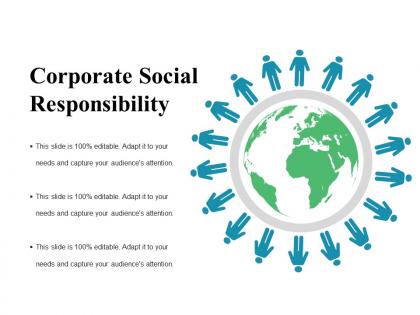
This image presents a PowerPoint slide that is themed around the concept of Corporate Social Responsibility (CSR). The main title "Corporate Social Responsibility" clearly indicates the central theme of the presentation. This could mean altering the text, changing the graphics, or modifying the overall layout to suit the particular priorities of the organization's CSR initiatives.
The graphic in the center portrays a stylized Earth surrounded by a circle of human figures with arrows pointing towards the globe, symbolizing a commitment to positive global impact and the role of human activity in CSR.
Use Cases:
The industries that may find this slide relevant commonly engage in CSR initiatives and could use the template to convey their efforts and strategies in this area:
1. Manufacturing:
Use: Discussing sustainable production and ethical labor practices
Presenter: CSR Manager
Audience: Company shareholders and employees
2. Finance:
Use: Presenting investment in green technologies or community development programs
Presenter: Head of Corporate Affairs
Audience: Investors and regulators
3. Technology:
Use: Showcasing initiatives to bridge the digital divide or create inclusive technology
Presenter: Chief Sustainability Officer
Audience: Tech community and nonprofit partners
4. Retail:
Use: Explaining fair trade partnerships and environmentally-friendly packaging ventures
Presenter: Marketing Director
Audience: Consumers and advocacy groups
5. Energy:
Use: Highlighting renewable energy projects and carbon footprint reduction measures
Presenter: Environmental Compliance Officer
Audience: Environmental associations and policy makers
6. Pharmaceutical:
Use: Sharing drug donation programs and healthcare access expansion in developing regions
Presenter: Head of Public Relations
Audience: Healthcare providers and NGO representatives
7. Food & Beverage:
Use: Illustrating efforts in sustainable sourcing and reducing food waste
Presenter: Brand Manager
Audience: Customers and sustainability analysts
Corporate social responsibility ppt summary format ideas with all 5 slides:
Leave the design to us and get back to the more important things. Our compelling Corporate Social Responsibility Ppt Summary Format Ideas design do the hard work for you.



FAQs for Corporate social responsibility ppt
CSR is basically balancing making money with not screwing over people or the planet. Actually, it goes beyond that - you want your business contributing something positive too. Look, it's not just about feeling good (though honestly, that part's nice). Smart companies use CSR to build customer trust and attract better employees. Plus it often cuts costs through sustainable practices and keeps regulators off your back. My advice? Start small with something your team genuinely gives a damn about. Don't just check boxes - that's obvious and customers see right through it.
Don't treat CSR like some box to check later - build it right into how you make decisions from the start. Pick issues that actually connect to what your business does, not just random charity stuff that looks good on paper. Way too many companies do that and it's so obvious. Tie these goals to your KPIs and how you pay people. Make your leadership team accountable by putting CSR metrics in their performance reviews. Focus on your supply chain too - that's where real change happens. The whole thing falls apart if it doesn't feel authentic, so choose causes that genuinely make sense for your company.
Tech and finance companies are crushing it with CSR right now. Microsoft and Google are going hard on carbon neutrality. Banks are pushing ESG investing like crazy. Retail brands are also big players - honestly, they kinda had to step up after all that backlash over labor issues and environmental stuff. Energy companies are throwing money at renewable projects too, though that feels more like PR cleanup to me. Fashion industry's doing similar moves. If you want to see what's working, just peek at what the big players in your space are doing and find ways to stand out from their approach.
Honestly, people really do care about this stuff now - especially younger customers. They'll literally choose brands that match their values and pay extra for them too. But here's the thing: everyone can smell fake CSR from a mile away. Like, companies that just slap a green logo on everything while still being terrible? People see right through that garbage. Trust me, if you're gonna do CSR, you better mean it. Customers will absolutely roast you online if they catch you being performative. When it's genuine though, it actually builds real loyalty. Studies back this up - socially responsible brands get more trust and sales. Just don't promise what you can't deliver.
CSR makes customers think you're not just another greedy company, which is huge for your reputation. People trust brands that support causes or go green - it shows you have actual values. Plus the media loves covering this stuff, so free publicity. Your employees get to brag about working somewhere meaningful too, which honestly might matter more than you think. Just don't pick random causes that have nothing to do with your business. Customers smell BS corporate charity from miles away and it'll backfire on you.
So for tracking CSR stuff, I'd focus on employee engagement scores and volunteer participation rates first. Customer sentiment surveys are actually really telling - people genuinely care about this now more than ever. Environmental metrics like carbon footprint reduction work well too, plus community investment ROI if you're doing local programs. Honestly though, don't go crazy trying to measure everything at once. Pick maybe 3-4 things that match what you're actually trying to achieve with your CSR goals. Media coverage sentiment is worth tracking too. Start small and you can always add more metrics later once you've got the basics down.
Honestly, just pick one thing that matches what you care about and go from there. Partner with a local nonprofit or let your employees volunteer during work hours - that stuff doesn't cost much. Going paperless actually saves you money while being green, which is pretty cool. You could also buy from other local businesses instead of big chains. The best approach? Look at what you're already doing and just be more intentional about it. Some of my favorite examples come from companies that started super simple. You can always add more later once you see what works.
Honestly, transparency makes or breaks your CSR efforts. Without it, everything just screams greenwashing. You've got to share real data - your goals, where you're actually at, and yeah, the stuff that didn't work out. Customers and investors can smell BS from a mile away. Those glossy tree-planting photos are fine, but back them up with actual numbers. Regular CSR reports help, and here's the thing - admitting you're still figuring some things out actually builds more trust than pretending you're perfect. People respect honesty way more than corporate speak.
Look, regulatory stuff varies wildly by region and it's honestly pretty messy right now. Europe's all about mandatory ESG reporting - they don't mess around with environmental standards, so companies there have to stay on top of things. Meanwhile the US keeps it mostly voluntary, which gives flexibility but creates inconsistencies. Asia's weird though - some countries are racing to catch up with new rules while others stick to the honor system. You'll need to map out requirements for each market you're in because what flies in one place might totally bomb somewhere else. It's a lot but that's just how it works.
Oh totally! CSR stuff really does help with keeping people around. Your employees feel way more connected when they're proud of where they work. Millennials and Gen Z especially - they won't stick around if your company doesn't stand for anything meaningful. The volunteering events are great too because people actually bond doing that stuff together. Honestly, I'd just ask your team what causes they care about first. Then build programs around whatever they say. Way better than guessing what'll motivate them, you know?
Honestly, the biggest thing is your reputation getting trashed on social media - and that stuff spreads like wildfire. You'll start bleeding customers too, especially younger ones who actually care about this stuff. Finding good employees becomes way harder since people want to work somewhere that doesn't suck for the world, you know? Plus there's all the regulatory headaches coming down the pipeline. Oh, and you lose that competitive edge when everyone else is doing the right thing. My advice? Pick a few things that actually matter to your customers and do those well first.
Honestly, tech can make your CSR stuff way more impactful. Data analytics will track your sustainability numbers better, and AI optimizes energy use pretty well. Blockchain's great for supply chain transparency - though I know that sounds buzzword-y. Employee volunteer programs get crazy engagement when you use apps that gamify everything. IoT sensors monitor environmental impact in real-time, which is actually super helpful. Social media works for showcasing what you're doing too. My advice? Don't go overboard initially. Pick one CSR area you're already working on and see how tech could make it more measurable or efficient. Way easier than overhauling everything at once.
Check out Patagonia's 1% for the Planet - they've dumped over $100M into environmental stuff that actually moves the needle. Starbucks does this cool thing with community stores in rough areas, creating jobs and keeping profits local. Microsoft's TEALS program gets computer science into low-income schools (which is honestly brilliant). Ben & Jerry's lets employees own pieces of local franchises through their PartnerShop deal. The secret sauce? These aren't just donation drives. They build real partnerships that stick around and solve actual problems. Find one that matches what your company's good at and basically copy their homework.
Honestly, climate change is forcing companies to completely overhaul their CSR approach. Gone are the days of just planting trees for good PR. Investors and customers want real action now - like actual carbon reduction plans and sustainable supply chains. The risk is too big to ignore anymore. Smart companies are baking these goals right into their business strategy instead of leaving it to some separate CSR team. My advice? Start by looking at how climate risks could mess with your specific industry. Some sectors are way more vulnerable than others.
Honestly, stakeholders have way more power than people realize. Customers can just stop buying from you or pick your competitors instead. Investors? They'll either pull their money or start demanding you hit certain ESG targets. Even your own employees won't stick around if your company's values suck - which is huge right now with how tight the job market is. Community groups and NGOs are ruthless too; they'll blast you on social media until your reputation's toast. Regulators set the rules obviously, but suppliers can also pressure you by requiring specific standards. Companies that blow off these concerns usually get hit hard financially.
-
Best way of representation of the topic.
-
Really like the color and design of the presentation.