


Corporate philosophy ppt presentation




Try Before you Buy Download Free Sample Product
 Impress Your
 Audience
 100%
100% Editable
 Save Hours
 of Time


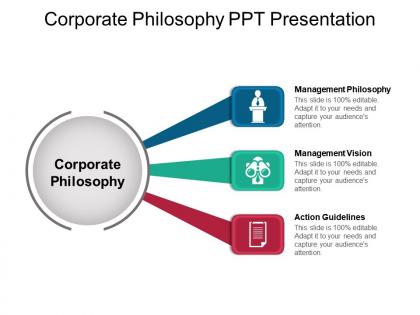
Download our corporate philosophy PPT template that has been designed to make corporate professionals understand the importance of the concept. A well-defined corporate philosophy helps your target market and potential customers understand the objective, goal and intention of your company which helps to build faith and brand loyalty. You can use our presentation slide to make your colleagues understand what the corporate philosophy is all about and how important it is to be in sync with your business values and vision. This PowerPoint sample shows three aspects of the corporate philosophy that you can communicate with your audience such as management philosophy, management vision and action guidelines. Today all leading corporate look to set a strong corporate philosophy to engage the consumer with their brand. The PPT layout is completely editable. Download and use it appropriately. Convince folks in advance about important issues with our Corporate Philosophy Ppt Presentation. Avoid having to jam it down.
People who downloaded this PowerPoint presentation also viewed the following :
Corporate philosophy ppt presentation with all 5 slides:
Figure out how to handle individual differences with our Corporate Philosophy Ppt Presentation. Identify the cause of dichotomy.

FAQs for Corporate
So corporate values are basically the big principles that drive how a company actually works - stuff like integrity, innovation, teamwork, customer focus. They're supposed to be your moral compass for everything from who you hire to what products you build. Honestly, some companies go way overboard with fancy names (startups love their "radical transparency" nonsense), but the good ones keep it simple and memorable. Here's the thing though - make sure they're not just pretty words on the wall. If the values don't match what you're seeing day-to-day, that tells you everything.
Your company's philosophy is like the foundation everything else builds on. People can tell instantly when values are just wall decoration versus actually driving decisions. Honestly, I've seen so many places where leadership talks a big game but then acts completely different day-to-day. When your core beliefs actually show up in how you operate, employees connect with the mission way deeper. They get why their work matters. Short version - authentic values create engaged teams because people want to be part of something real, not just collect paychecks.
Honestly, having solid values makes customers actually care about your brand beyond just what you're selling. When they see you stand for stuff they believe in - sustainability, whatever - it feels like they're part of something bigger. Pretty cool how that works. They'll defend you against competitors even when someone else has better prices. But here's the thing: you can't just slap it on your website and call it a day. Your philosophy has to show up in real decisions and how you actually run things. Otherwise people see right through the BS and you lose them completely.
Honestly, just stop treating your company values like some sacred document nobody reads. Bring them up in actual meetings when you're making decisions - like "hey, this aligns with our thing about innovation" or whatever. New employees should hear about it during onboarding, not discover it buried on page 47 of the company website. Leadership needs to connect the dots between big announcements and your core philosophy. People respond way better to real examples than fluffy mission statements anyway. Oh, and put it in newsletters or team updates regularly. The whole point is making it feel relevant to what people actually do every day, not just wall decoration.
Your company's philosophy is basically like having a compass for big decisions. When you're stuck between options, just ask "does this fit who we are?" It actually works if leadership doesn't just slap it on the wall and forget about it. Use it for hiring, strategy changes, crisis situations - whatever comes up. The trick is bringing it into real meetings and conversations. I've seen companies where it's just decorative nonsense, but when it's actually part of how people think? Pretty game-changing for keeping everyone aligned on tough calls.
Look, when shit hits the fan, you need something solid to fall back on - that's where your corporate philosophy comes in. No time to reinvent the wheel during a crisis, right? Your team already knows what you stand for, so decisions get made faster and everyone stays on the same page. I mean, think about it - stakeholders can tell when you're just scrambling versus actually sticking to your principles. The smart move? Figure out your non-negotiables now, before you're drowning in the next emergency. Trust me, future you will thank present you.
Look, most companies totally screw this up by setting their values once and never touching them again. Bad move. You've got to bake regular check-ins into your routine - quarterly reviews work great. Have leadership actually question whether your core stuff still makes sense with what's happening in the market. Get feedback from stakeholders, see how employees are really interpreting your philosophy daily. Customer surveys help too, honestly. Stay aware of industry shifts through competitive analysis. Make it part of your normal operations instead of waiting for everything to fall apart. Oh, and put "philosophy review" on your next board meeting agenda.
Look, the data's pretty clear on this - diverse teams bring in 19% more revenue because you're getting way more perspectives on problems. Your people actually want to show up when they can be themselves at work, which means better ideas and less turnover. Plus you'll pull from a way bigger talent pool instead of the same old networks everyone else uses. Oh, and customers notice when companies actually reflect their demographics. Honestly, I'd start by digging into whatever philosophy docs you have now. See where you can bake inclusion right into your core values - not just tack it on as an afterthought.
Look at Patagonia's "Don't buy this jacket" campaign - they literally told people not to buy their stuff for environmental reasons. Southwest built everything around making employees happy first. Google had that whole "Don't be evil" thing back in the day (though that's... questionable now). The thing is, these weren't just clever marketing stunts. They actually hired and made decisions based on these values. Your philosophy has to be real, not just nice words you slap on your website. Pick something you genuinely believe in and can stick to when things get tough. Otherwise you'll just sound like every other company spouting generic corporate BS.
Think of your corporate philosophy like a GPS for CSR - it shows you which causes matter and how much to actually spend. When companies really believe in something (like going green), you'll see serious sustainability programs, not just some random tree-planting photo op. Half the time though, businesses just slap on CSR stuff without any real connection to what they stand for. Employees and customers spot that fake vibe instantly - honestly, it's pretty cringe when companies do this. The whole thing only works if your values and CSR efforts actually match up.
Honestly, the worst part is watching your company values turn into meaningless wall art. Middle management doesn't get the vision, departments do their own thing, and employees think it's all corporate BS. When quarterly numbers are due? Forget about it - everyone takes shortcuts that go against what you supposedly stand for. I've watched this happen so many times it's painful. You need actual systems that reward people for living those values, not just hitting revenue targets. Otherwise you're just fooling yourself.
Honestly, tech makes you question everything you thought you believed about your company. All that data you're suddenly collecting? It shows how work really happens - and it might not match what you preach about transparency or employee empowerment. Then there's AI forcing you to figure out where human judgment actually matters (which is trickier than it sounds). Your whole philosophy needs to bend more now too. You can't just carve values in stone anymore - digital moves too fast for that. I'd check regularly how your tech choices line up with what you claim to stand for. That gap usually shows where your thinking needs an update.
Honestly, a solid company philosophy makes a huge difference for keeping people around. Employees need to feel like their work actually matters, you know? When your values match what they care about, they'll stick with you through the rough patches. Think of it like any good relationship - shared beliefs are everything. During stressful times, people get why certain decisions are made because they understand the bigger picture. That builds real trust. But here's the thing - your philosophy can't just be some poster in the break room. It has to show up in how you actually run things daily. I'd start by asking if your team even knows what your company stands for.
Honestly, just talk to your actual customers first. Survey them, stalk their Facebook groups, whatever - figure out what they genuinely care about instead of guessing. Then build your brand philosophy around that, but only if you can actually deliver on it. Don't go trying to please everyone because that's a recipe for disaster. I'd test it out in some marketing campaigns to see how people react. The biggest thing though? It has to feel authentic to you too, because people can spot BS corporate messaging from space.
Look, you need both hard numbers and the squishy stuff to really know what's working. Employee surveys and retention rates are obvious starting points. Customer satisfaction too. But honestly? The real gold comes from actually talking to people - focus groups, exit interviews, casual check-ins with your team. Track how decisions get made against your stated values. Are people actually walking the walk or just nodding along? I'd probably set up some kind of regular rhythm for measuring this stuff - quarterly maybe? - so you can catch patterns instead of just random good or bad days.
-
Unique and attractive product design.
-
Content of slide is easy to understand and edit.
-
Illustrative design with editable content. Exceptional value for money. Highly pleased with the product.
-
Excellent template with unique design.