


Branches of philosophy example of ppt




Try Before you Buy Download Free Sample Product
 Impress Your
 Audience
 100%
100% Editable
 Save Hours
 of Time


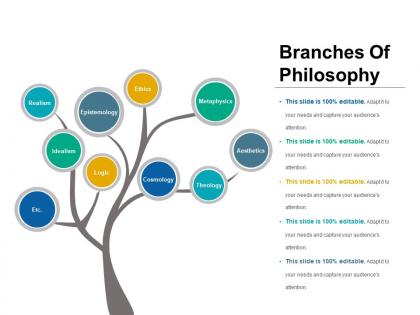
Performances get better by the day with our branches of philosophy example of PPT. Use the example if a PowerPoint design to show the fundamental laws that underlie the development and operation of a business enterprise. Following PPT design contains a high contrast image of a tree with each of its branches containing a segment of business philosophy topic. Subjects included here are, realism, idealism, epistemology, ethics, cosmology, metaphysics, theology, aesthetics, etc. Personalize the PPT format to show the nature and purpose of a corporation, and the moral responsibilities that concern to it. Comprising of engaging colors and text segments make this slide an eye catcher, text boxes enable you to develop on the topic in concern. Get your customers to see the best of you through our branches of philosophy example of PPT and see your company evolve brightly. Implement your ideas before anyone else with our Branches Of Philosophy Example Of Ppt. Be able to jockey for advantage.
People who downloaded this PowerPoint presentation also viewed the following :
Branches of philosophy example of ppt with all 5 slides:
Your recent experiment has proved successful. Our Branches Of Philosophy Example Of Ppt willhelp demonstrate the process.


FAQs for Branches of philosophy
Philosophy breaks down into five main areas. Metaphysics deals with what actually exists, while epistemology is all about how we know stuff in the first place. Ethics covers right and wrong - super practical for everyday choices. Logic is your toolkit for solid arguments (honestly saved me in so many debates). Then there's aesthetics, which explores beauty and art. Each branch tackles different questions but they overlap constantly. Metaphysics asks "what's real?" Epistemology goes "how do you even know that?" Ethics is like "should I actually do this?" Start with ethics if you want something you'll use immediately - it's way more relevant than you'd think.
So metaphysics is basically philosophers asking "what's actually real?" - like, are your thoughts as real as your coffee mug? They dive into whether abstract stuff like numbers or consciousness truly exist the same way physical objects do. Time, space, identity - it's all fair game. Are you even the same person from five years ago? Honestly, some of this stuff does keep you up at night if you think about it too much. Try questioning what you consider "real" in your everyday life and you'll get what they're after.
So epistemology is basically questioning how you know what you know. Like, can you actually trust your senses? What about stuff other people tell you? It gets into whether your beliefs are justified or if you're just guessing. The whole field examines what counts as real knowledge versus just opinions. Honestly, it's pretty trippy once you start going down that rabbit hole. Philosophers debate how certain you need to be before claiming you actually "know" something. There's also the skepticism angle - maybe we don't know as much as we think we do.
So there are basically three ways philosophers think about right and wrong. Consequentialism is all about results - did your choice lead to good stuff happening? Deontological ethics is more black and white, like some things are just wrong no matter what (lying, stealing, whatever). Virtue ethics asks what would a genuinely good person do here. Most of us actually use all three without thinking about it, which is kinda funny. But yeah, when you're stuck on something tough, try running through each angle. Way better than just winging it and hoping for the best.
So political philosophy basically takes huge concepts like justice and rights and asks "what do these actually mean?" Justice could be equal treatment, fair outcomes, or people getting what they deserve - philosophers argue about this stuff constantly. Rights are tricky too. Are they natural or does society give them to us? And government's role is probably the biggest debate (super relevant lately tbh). You've got Hobbes saying we need strong authority, then libertarians wanting barely any state involvement. What's crazy is this isn't just theoretical - it literally shapes the laws and policies we deal with every day.
So aesthetics is just philosophy's take on beauty and art questions. What makes things beautiful? Is beauty universal or totally personal? Why does certain art hit different? Honestly, it's way more interesting than it sounds because you're already doing it - like when you wonder why that one song gives you chills or why you hate modern art (guilty). Philosophers study everything from universal beauty principles to cultural differences in taste. Next time you're really drawn to something visually, ask yourself why. That's literally aesthetic philosophy happening in real time.
So existentialists like Sartre are basically saying "you're totally free, deal with it" - it's all about creating your own meaning in a world that doesn't hand you any. Phenomenology is different though. Husserl and those guys want to figure out how your brain actually processes experience itself. One's about the anxiety of making authentic choices, the other's more like... the nuts and bolts of consciousness? Honestly, if you're trying to study this stuff, just grab their main texts and read them together. The contrast makes both way clearer.
Honestly, logic is like the foundation for all philosophical thinking. You need it to build solid arguments and catch when someone's reasoning falls apart. Philosophy without logic? Just people arguing opinions back and forth - which happens enough already lol. It helps you spot fallacies, organize your ideas properly, and make sure your conclusions actually make sense. That's what separates real philosophical work from random debates. Oh, and definitely learn the basics first before jumping into heavy topics. Trust me, it'll save you so much confusion later.
Philosophy of science is where philosophers dig into how science actually works - the methods, assumptions, all that stuff behind scientific research. What makes something "scientific"? When are theories actually valid? What can't science tell us? It's like analyzing science itself. Popper came up with falsifiability, Kuhn did paradigm shifts - both pretty huge for how scientists view their work. Honestly, if you're interested, grab Popper's "The Logic of Scientific Discovery." Bit dense but it'll totally shift how you think about scientific claims. Changed my perspective on a lot of things, actually.
So basically, big historical moments created the philosophy we know today. Descartes and the Scientific Revolution got everyone obsessing over "how do we actually know anything?" The Enlightenment gave us political philosophy - Locke and Rousseau figuring out government stuff. Greeks obviously started ethics and metaphysics way back. Darwin totally flipped our view of human nature, and honestly, the world wars forced philosophers to deal with some really dark existential questions. If you're trying to understand modern debates, just trace them back to these moments. Makes everything click way better.
So basically each area of philosophy looks at free will totally differently. Metaphysics is like "does this even exist or is everything just destined to happen?" Ethics gets into whether you can actually blame people if they don't have real choices. Then epistemology questions how we'd even know if our decisions are genuinely free - which honestly makes my head hurt sometimes. Political philosophy ties it to your rights and how society should work. The cool thing is seeing all these angles together gives you a way better picture of how human choice and responsibility actually work.
Dude, AI ethics is a rabbit hole of crazy philosophical stuff. Like, can machines actually be conscious? The trolley problem becomes real when self-driving cars have to decide who dies in a crash - honestly pretty terrifying when you think about it. Free will gets messy too since algorithms are making choices for us constantly. What even counts as "intelligence" anyway? Then there's all the bias issues and whether we can blame AI for screwing up. Pick something you use daily - your phone's recommendations or whatever - and think through the ethics. Makes it way less abstract.
So hermeneutics is basically about recognizing that context, history, and your own biases all influence how you read texts or situations. Pragmatism goes a step further - it cares less about finding some "perfect" meaning and more about what actually works in practice. Both are clutch when you're trying to decode whether your boss's email was passive-aggressive or just rushed (honestly, probably both lol). The main thing is that meaning isn't just sitting there waiting for you to find it. You're actively creating it through interpretation, so it helps to be aware of what lens you're using.
So philosophers have been wrestling with this "who am I really" thing forever. There's psychological continuity - basically you're you because of your memories and personality staying connected over time. Physical continuity says it's all about your body/brain. But here's where it gets trippy: bundle theory claims there's no solid "self" at all, just a stream of changing experiences. Honestly, I think about this stuff way too much sometimes. But it actually helps with real questions like - am I responsible for dumb things I did years ago? These theories aren't just academic nonsense. Next time you're wondering about identity stuff, see which one clicks with how you actually experience being you.
Oh man, postmodernism is a total headache to work with. The whole thing basically says objective truth doesn't exist, so how do you even argue about anything? Knowledge gets split up across different fields, and postmodernists love tearing apart traditional philosophy methods. Plus they write stuff that's deliberately confusing to interpret - which honestly feels a bit pretentious sometimes. The discipline fragmentation makes everything messier too. My advice? Start with the main guys like Derrida and Foucault first. Don't jump into secondary sources until you've wrestled with their actual texts.
-
Wonderful templates design to use in business meetings.
-
Nice and innovative design.
-
Illustrative design with editable content. Exceptional value for money. Highly pleased with the product.
-
Great designs, Easily Editable.