


Philosophy in teaching ppt sample file




Try Before you Buy Download Free Sample Product
 Impress Your
 Audience
 100%
100% Editable
 Save Hours
 of Time


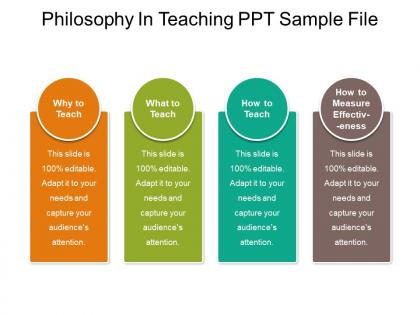
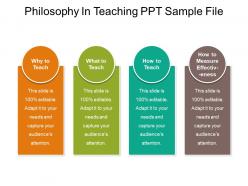
Download our philosophy in teaching PPT sample design that has been designed beautifully to communicate the information about the concept in a professional manner. You can use this presentation template to share details about the teaching philosophy which is an explanation of your values and beliefs as they relate to teaching. It is an amalgamation of approaches that you studied in school or colleges or any during your work experience. Our PowerPoint diagram shows four aspects of the teaching which is why to teach, what to teach, how to teach and how to measure effectiveness. Every institute or an individual has different styles and approach of teaching and have different philosophies to impart education. Using this presentation layout, you can present details about the methods that you adopt to teach. You can make students aware of the teaching philosophy and make them understand the purpose behind it. You may also think how you have put your ideas about education into act, and what values are established by your work. Access it now. Folks break out in a jig with our Philosophy In Teaching Ppt Sample File. They begin to dance with elation.
People who downloaded this PowerPoint presentation also viewed the following :
Philosophy in teaching ppt sample file with all 5 slides:
Finish off fast with our Philosophy In Teaching Ppt Sample File. Get the chance to go to bed early.

FAQs for Philosophy in teaching
Honestly, critical thinking is pretty much the backbone of how we teach now. Gone are the days of just cramming facts - though my old high school history teacher would probably disagree lol. Most schools focus on getting kids to actually analyze and question stuff independently. You see it everywhere: inquiry-based learning, constructivist approaches, even those standardized tests emphasize "21st-century skills." The whole point? If students can think critically, they'll handle whatever gets thrown at them later. When you're planning lessons, try sneaking in moments where they have to challenge assumptions or back up their arguments. Makes a huge difference.
Your teaching philosophy totally changes how you run your classroom. Progressive teachers go for project-based stuff and group work. Traditional ones? Straight-up direct instruction and teacher-led lessons. Constructivists are big on hands-on discovery - letting kids figure things out themselves. Behaviorists stick to rewards and super structured routines (which honestly can feel a bit rigid sometimes). Most teachers I know mix different approaches though. They don't just pick one and call it a day. When you're watching a classroom, try spotting which elements they're using. It'll make their teaching choices make way more sense.
Honestly, it's wild when you start digging into who actually gets decent education and why. Look at how standardized tests basically favor kids from wealthier families - that's not an accident. The whole thing makes you question whose voices we're hearing in textbooks and curricula. Are we just propping up the same old power structures? I'd start by examining your own assumptions about education (we all have them). Think about whether schools are actually helping everyone or just the kids who were already set up to succeed. The classroom dynamics alone tell you so much about who gets heard and who doesn't.
So constructivism is basically the opposite of traditional teaching - students aren't just sitting there absorbing info. They're actively building their own understanding from what they already know and experience. Pretty cool shift, right? Instead of being the person who delivers all the knowledge, you become more like a guide. The old way assumes there's one correct understanding and you just tell them. But this approach recognizes everyone constructs meaning differently. Try letting students figure things out themselves first - maybe through experiments or problems - instead of explaining everything upfront. Way more engaging honestly.
So existentialism basically flips the script - puts kids in charge of their own learning instead of just cramming info into them. They get to make real choices about their education and actually think about who they want to become. Pretty cool, right? It's all about building critical thinking and giving them permission to question stuff that adults usually just expect them to accept. Students develop their own values rather than blindly following rules. Honestly, I'd try more open-ended projects where they can dive into whatever interests them. Way more authentic than traditional assignments.
Honestly, it's totally doable. Start with your non-negotiables - the core facts and skills kids absolutely need to know. Then get creative with delivery. Instead of just lecturing about the Revolutionary War (random example but you get it), have them run mock trials or create podcasts. Real-world projects work great for this. You're still hitting those accountability standards administrators love, but students are actually engaged instead of zoned out. Short version: keep the "what" strict, make the "how" fun and hands-on. Critical thinking develops naturally when they're solving actual problems rather than just memorizing stuff.
Oh totally, culture shapes everything about education! Japan's group discipline thing? That's just their broader values playing out in schools. Western systems push individual creativity hard, while Eastern approaches usually make you master the basics first. Your local economy and social stuff determines whether schools focus on getting kids jobs or teaching them to think outside the box. Even the whole individual achievement vs. working together thing depends on where you are. It's wild how different it all is. When you're picking teaching methods, just think about what cultural baggage you're bringing along - we all have it.
So basically, whatever you believe about learning totally changes how you grade kids. Constructivists love portfolios and projects - all that messy, real-world stuff. Behaviorists? They're all about those clean rubrics and standardized tests (which honestly feels kinda soulless to me, but whatever works). Traditional teachers usually wait till the end to assess everything at once. Progressive types give feedback constantly throughout the process. Oh, and here's the thing - you gotta make sure your testing actually matches what you think learning should look like. Otherwise you're just being fake.
Your teaching philosophy seriously impacts how you treat kids - it's not just abstract theory. Behaviorist approaches can make students feel like lab rats responding to treats, which honestly seems pretty dehumanizing. But then progressive methods sometimes swing too far the other way. They prioritize student choice over actual learning, leaving kids who desperately need structure kind of hanging. You're constantly deciding what knowledge matters and how much freedom students should get. Those are huge value calls. I'd suggest looking at what you actually do in class versus what you say you believe - might catch some contradictions you hadn't noticed.
Your teaching philosophy totally shapes which tech you'll click with. Constructivists love collaborative stuff - think project platforms where kids build knowledge together. Behaviorists go crazy for adaptive learning software with tracking features. Progressive teachers? They're all about maker spaces and creative tools (seriously, their classrooms look amazing). Critical pedagogy people use tech differently - digital storytelling, analyzing power structures, that kind of thing. I'd honestly just focus on tools that match how you think kids actually learn. Don't grab random gadgets just because they look cool.
Yeah, so much of what happens in classrooms today actually comes from these old philosophical ideas. Dewey's progressive stuff gave us hands-on learning and project work. Montessori is why we're all obsessed with student choice now. Nature-based learning? That's Rousseau - he thought kids were naturally good, which honestly makes sense. Even boring lectures trace back to medieval times, which is kinda crazy when you think about it. The cool thing is once you know where these methods come from, you can pick what actually works instead of just doing whatever's trendy.
Your whole view of learning comes down to your educational philosophy, tbh. Some people think knowledge is this fixed thing you collect in school, then boom - you're done. Others (the smart ones imo) see it more like pragmatism or constructivism - where you're constantly adapting and picking up new stuff. It's wild how much this affects your approach to work training or just... life growth in general. Like, do you really think your brain just stops at graduation? Check what you actually believe about learning - bet it's shaping way more of your decisions than you think.
Skip the abstract stuff and give them real problems they'll actually deal with - budgeting for events, fixing local environmental issues, that kind of thing. Let them mess up and try again instead of memorizing the "right" answer. Way more fun than lecturing at them for an hour. Teach them to think "does this actually work?" when they're problem-solving. Oh, and don't try to overhaul everything at once - just pick one unit next semester and build it around something happening in your community. Trust me, they'll be way more invested.
Oh totally - emotions are huge in education now. Like, we finally get that stressed-out kids literally can't learn properly (something about how anxiety messes with memory processing). Dewey was onto this forever ago, but whatever. The thing is, you can't just dump information on students anymore. Their emotional state directly affects whether anything actually sticks. Safe classroom environment? That's not touchy-feely stuff - that's practical learning strategy. When designing anything educational, I always think: would a student feel comfortable enough here to ask a "dumb" question or mess up? Because that's where real learning happens.
Honestly, interdisciplinary stuff is a game-changer because you're not boxing yourself into one way of thinking. Psychology shows you how kids actually process information. Sociology explains why classroom culture matters so much. Then there's neuroscience for the brain mechanics - that field is exploding right now with cool findings. Economics helps with policy analysis too. It's way better than just philosophizing in a vacuum, you know? You'll develop way more realistic educational theories when you're pulling from multiple fields. Definitely start reading outside philosophy journals. The education research from other disciplines will blow your mind.
-
Use of different colors is good. It's simple and attractive.
-
Awesome presentation, really professional and easy to edit.
-
Very unique, user-friendly presentation interface.
-
Easily Understandable slides.