

Critical thinking skills ppt samples download




Try Before you Buy Download Free Sample Product
 Impress Your
 Audience
 100%
100% Editable
 Save Hours
 of Time


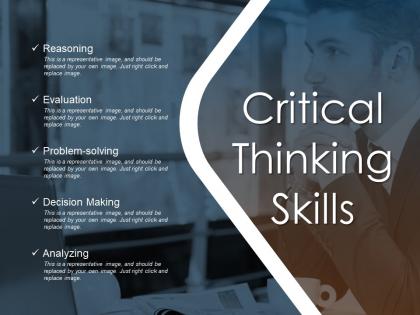
Crafting a presentation on the ability to analyze information objectively as well as make a reasoned judgment have easy when you go for our critical thinking skill PPT slide. A user can illustrate that the critical thinking PowerPoint template incorporates evaluation of sources like data, facts, observable phenomenon, research findings, etc. The good critical thinking presentation slide design is suitable for demonstrating that people who have good critical thinking can easily draw reasonable conclusions from set of information and they can also discriminate between useful and not so useful details to solve a problem or even to make a decision. The analytical thinking slide is suitable for employers as they want job candidates who are capable of evaluating a situation by using logical thought and they come up with appropriate solution. You can share facts with viewers that a person who has critical thinking skills is trustworthy to make decisions on his or her own and he does not need constant hand holding using the problem solving skill presentation slide. The creative thinking skill template is ideal for describing that circumstances demands critical thinking and it vary from industry to industry. Face it head on with our Critical Thinking Skills Ppt Samples Download. Counter difficulties with all your force.
People who downloaded this PowerPoint presentation also viewed the following :
Critical thinking skills ppt samples download with all 5 slides:
Ever wondered why your colleague seems to be getting all the praise on their presentation? Well that is because they have discovered the advantages of using professional Critical Thinking Skills Ppt Samples Download to create presentations.

FAQs for Critical thinking skills
Ok so there's like 5 main things: analysis, evaluation, inference, interpretation, and explanation. Break stuff down objectively, check if sources are actually credible, draw conclusions that make sense. Then communicate why you think that way. The self-regulation part is honestly the hardest - catching your own biases before they mess with your thinking. We're all guilty of it though. Stay curious instead of just hunting for stuff that proves you're right. Oh, and try this - pick one random assumption you make every day and ask yourself "wait, what actual evidence do I have for this?" You'll be shocked how often the answer is basically nothing.
Dude, critical thinking is basically just hitting pause before you do something stupid. Instead of going with whatever feels right or listening to whoever's yelling loudest, you actually stop and think it through. Ask yourself what you're assuming, what proof you actually have, and what could blow up in your face. I've avoided so many bad choices this way - like that time I almost quit my job without having another one lined up lol. You start noticing when people (including yourself) are being biased about stuff. Game changer honestly.
Honestly, biases are just mental shortcuts your brain takes to save time, but they can totally mess up your judgment. We all do it - like when you only pay attention to info that backs up what you already believe (confirmation bias is the worst for this). Your brain thinks it's being helpful, but really it's making you skip over important stuff. I always try to catch myself by asking "wait, what am I assuming here?" It's annoying but worth it. Also look for evidence that contradicts your gut reaction - even when you don't want to find it.
Stop just telling kids to "think critically" - that's useless. Give them messy problems instead, stuff without clear answers. Current events work great for this, especially the controversial ones (parents might complain but whatever). I'm constantly asking "how do you know that?" and "why?" during class discussions. The Socratic method is perfect - just keep pushing until they question their own assumptions. Oh, and don't pretend you have all the answers. I'll literally say "I'm not sure about this" and walk through my thinking process out loud. They need to see how actual thinking works.
Honestly, critical thinking just stops you from making dumb decisions you'll regret later. You know how we sometimes jump on the first solution that sounds decent? This makes you pause and actually think it through first. Look at problems from different sides, question what you think you know, check if your evidence actually makes sense. My sister's terrible at this and constantly gets burned by obvious scams lol. Anyway, try asking yourself "what could go wrong here?" or "am I missing something?" when you're stuck. Gets you in the habit of spotting consequences before they bite you.
Honestly, when you think before you speak, you just communicate so much better. I used to just blurt out whatever came to mind - total disaster sometimes. Now I actually consider what the other person needs to hear and structure my thoughts first. You'll start spotting your own assumptions too, which is huge. Plus you get way better at asking the right questions instead of just reacting to everything. Oh, and reading between the lines when people talk? Game changer. Try this: pause for like 5 seconds before responding in your next meeting. Sounds weird but it works.
Honestly, the worst culprit is just being rushed all the time. You end up making gut calls instead of actually thinking things through. We're also terrible at confirmation bias - like I'll totally seek out info that backs up what I already decided, you know? Groupthink kills good decisions too. Nobody wants to be the one disagreeing with their boss or going against what everyone else thinks sounds great. My trick is setting little checkpoints where I force myself to ask "okay but what am I not seeing?" Works way better than you'd think.
Try setting up interactive scenarios where people can dig into data and work through messy problems in real-time. Gaming works really well for this - honestly better than I expected. Simulation tools let them practice without screwing anything up in the real world. VR's pretty cool too if you can swing it, drops people right into situations where they have to think fast and evaluate evidence on the spot. The trick is picking tools that actually make their brains work harder, not just spoon-feed them info. I'd start small with one interactive thing and see how it goes.
Honestly, creativity and critical thinking aren't enemies - they actually make a pretty good team. You need both when you're solving problems. Like, creativity throws out all these wild ideas and possibilities, then critical thinking comes in to figure out which ones might actually work. I used to think you had to pick one or the other, but that's not really how it goes. The best solutions happen when both are firing at once. Try switching back and forth between brainstorming mode and analysis mode - sounds weird but it works way better than you'd expect.
Honestly, skip the traditional tests for this one. Case studies are your best bet - throw messy real-world problems at them and watch how they work through it. Socratic seminars are amazing too (students arguing reveals SO much about their logic). Portfolio stuff works great for tracking their thought process over time. Don't put all your eggs in one basket though - you'll want multiple ways to see what's going on in their heads. Maybe start with just case studies? I always found those told me the most about who could actually think versus who just memorized well.
Honestly, start by questioning everything - like when someone makes a claim, ask "how do you know that?" Look for the actual reasoning behind arguments and watch out for logical fallacies. I read stuff from different viewpoints, even fiction weirdly helps with reasoning. Try arguing the opposite side of things just for practice. Oh and check your own biases too - we all have them. The trick is doing this regularly, not just once in a while. Maybe grab a news article today and just tear apart its claims? You'll get the hang of it.
Honestly, emotional intelligence is like a superpower for thinking clearly. It helps you catch yourself when feelings are messing with your logic - you know that moment when you're too angry to see straight? Being aware of your emotional state lets you pause and go "wait, am I actually thinking this through or just reacting?" Plus you get better at reading other people's emotions, so you don't automatically write off their points just because they're getting heated. I do this thing now where I check in with myself emotionally before making big decisions. Game changer.
Honestly, critical thinking is a game-changer for teams. Instead of just going with whoever's loudest (which, let's be real, happens way too often), you're actually evaluating ideas on merit. People start asking better questions and challenging assumptions without being jerks about it. Plus it kills that groupthink thing where everyone nods along to avoid drama. Your team catches problems early instead of scrambling later. The decision-making gets so much better when people actually think things through. Try asking "what aren't we seeing here?" in your next meeting - I bet the whole conversation shifts.
Honestly, critical thinking shows up everywhere once you start noticing it. News articles, social media drama, even picking where to eat dinner - I'm always asking "who's saying this?" and "does this actually make sense?" Shopping's a big one too. Instead of buying whatever's trending, I'll check reviews and think about whether I really need it or just want it because everyone else has it. Work stuff obviously benefits from this approach. The trick is catching yourself before you automatically accept things. Maybe start small - question one random assumption you make today and see where it leads you.
Okay so once you notice it, critical thinking is literally everywhere. Doctors rule out different diagnoses one by one. Journalists double-check their sources before hitting publish. You comparing Amazon reviews before buying something? That counts too. Engineers figure out why stuff broke by testing different theories. Honestly, it's just pausing to question what you're assuming instead of jumping straight to conclusions. Next time you're stuck on something at work, ask yourself "wait, what am I taking for granted here?" - you'd be surprised how often that shifts everything.
-
Great product with effective design. Helped a lot in our corporate presentations. Easy to edit and stunning visuals.
-
Illustrative design with editable content. Exceptional value for money. Highly pleased with the product.