


0314 questions of general knowledge




Try Before you Buy Download Free Sample Product
 Impress Your
 Audience
 100%
100% Editable
 Save Hours
 of Time


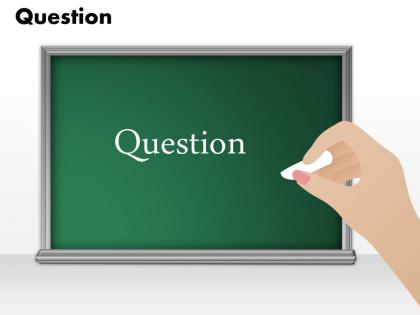
Take questions of general knowledge PowerPoint design to clear the doubts related to both professional as well as personal life. At the present time, every individual has some sort of questions related to their career and development which needs to be answered at the right time. This presentation visual helps you to clear all the doubts that are creating concerns in the minds of the business professionals. Not only this, the PPT template also helpful for the education firms as they can ask the students to get solution for the question related to their subject. With the use of this presentation slide, the questions can be answered in the best possible way. Whenever you end any training session, it is essential that you answer the people queries about the topic that you discussed. The PowerPoint template is ideal for the business communication experts and education instructors. Download and make use of the presentation design to answer the audience queries. Get applauded with our 0314 Questions Of General Knowledge. They will congratulate you on your ideas.
People who downloaded this PowerPoint presentation also viewed the following :
0314 questions of general knowledge with all 5 slides:
Your thoughts have put you on the brink of success. Our 0314 Questions Of General Knowledge will get you across.
FAQs for 0314 questions
Russia's the biggest by far - like 17 million square kilometers, which is just insane. Canada comes second but it's still way smaller. Then you've got the US in third place, followed by China and Brazil. Australia barely misses the top five at sixth, which always catches people off guard for some reason. Honestly, just remember "Russia, Canada, US, China, Brazil" and you'll crush any geography trivia question. Works every time!
Oh dude, it's actually Canberra! I know, weird right? Everyone thinks Sydney because it's got all the famous stuff - Opera House, that massive bridge, plus it's huge and where most tourists fly into. But yeah, back in 1908 Sydney and Melbourne were basically having a pissing contest over who got to be capital, so they just said screw it and built Canberra as a compromise. Kind of like how NYC isn't our capital even though it's way more well-known than DC. Pretty random bit of trivia to impress people with!
So Constantinople falling in 1453 is what most people say started the Renaissance, but it's more like the cherry on top honestly. Greek scholars basically ran for their lives to Italy when the Ottomans took over, and they brought all these ancient texts with them. Italy was already getting rich from trade, so you've got this perfect mix of money and classical knowledge. Short sentences work better here. Some historians think it actually started way earlier though - like around 1350 when the Black Death finally ended. Don't get too hung up on exact dates since it was really multiple things happening at once.
RGB stands for red, green, and blue - those are the three colors your phone and computer screen use to make literally every other color you see. Pretty crazy that just mixing different amounts of those three can create millions of shades, right? It's totally different from art class where they taught us red, yellow, blue. Oh and here's the weird part - if you crank all three RGB colors to maximum, you get white light instead of some muddy brown mess like you'd expect from mixing paints. Digital stuff is backwards like that.
Yeah, Neil Armstrong was first on July 20, 1969. Got out of the lunar module at 10:56 PM EDT. You know that famous "one small step" quote? There's actually some debate about whether he said "a man" or just "man" - honestly the audio quality was pretty rough back then. Buzz came out like 20 minutes after him. They hung out on the moon for about 21 hours total, which seems both forever and not nearly long enough if you think about it. But yeah, definitely remember this one for trivia night!
So the Great Wall was basically China's huge defense system against northern invaders - Mongols, Manchurians, you know. Built over like 2,000 years though, not all at once which is wild. It worked as an early warning thing and forced attackers to bunch up at certain spots, making them easier to fight off. Course, it wasn't foolproof - Mongols eventually broke through anyway lol. But honestly? Pretty genius combo of geography and engineering for its time. Great example if you're looking at ancient military stuff.
Oh you're definitely thinking of Mozart! Dude was an absolute prodigy - lived from 1756 to 1791 and somehow cranked out over 600 pieces in just 35 years. His symphonies are legendary, especially No. 40 and the "Jupiter" Symphony (No. 41). Classical period stuff alongside Haydn and Beethoven. Start with Symphony No. 40 if you want to dive in - that opening melody is ridiculously catchy and you'll recognize it immediately. Still can't believe he died so young with that much talent.
So the seven ancient wonders were scattered around the Mediterranean and Middle East - Great Pyramid of Giza, Hanging Gardens of Babylon, Temple of Artemis in Turkey, Statue of Zeus at Olympia, Mausoleum at Halicarnassus, Colossus of Rhodes, and the Lighthouse of Alexandria. Makes total sense they're all clustered there since that's where everything was happening back then. Crazy thing is only the pyramid survived - like, everything else just... gone. You can still check out some of the old sites if you're ever traveling around there though. Egypt's obviously the big one to hit.
Gold's symbol is Au - comes from some Latin word, aurum or whatever. Electronics companies use tons of it since it won't corrode and conducts electricity really well. Your phone, laptop, all that stuff has gold in the circuit boards. Jewelry's obviously huge too, plus they use it for dental work and aerospace stuff. Medical devices are starting to use more of it. Actually, electronics is now the biggest industrial user, which is kind of crazy. Makes me feel guilty about all the old phones I've just thrown away honestly.
So China figured out paper around 105 AD during the Han Dynasty - literally centuries before anyone else. Before that, people had to use crazy expensive stuff like papyrus or animal skins just to write. Paper changed everything though. Suddenly way more people could afford books and letters, which meant literacy actually spread. I mean, think about it - newspapers, official documents, even random notes wouldn't exist without this invention. It's wild that we're still using basically the same tech from 2,000 years ago.
So Newton's first law is all about **inertia** - objects hate changing what they're doing. A ball sitting there? It'll stay put. Something rolling? Keeps going straight forever unless you mess with it. That's why you get thrown forward when someone slams the brakes - your body wants to keep moving at the same speed. Hockey pucks are perfect for this since they just glide and glide on ice. The weird part is realizing that staying in motion is actually the default. You don't need force to keep things moving, just to change them.
Yeah so Darwin dropped "The Origin of Species" in 1859 and it was wild for the time. His whole thing was that animals aren't just stuck being what they are - they actually change based on what helps them survive and have babies. Natural selection, you know? He had all this evidence from sailing around on the Beagle. Religious folks were NOT happy about it lol. Honestly the original book is kind of a slog to read, so maybe start with like a modern breakdown first. But it's crazy how much that one book changed everything we thought about life.
So the Sumerians basically invented writing around 3200 BCE in Mesopotamia - that's Iraq now. Started as little pictures they'd scratch into clay tablets, but cuneiform got way more complex over time with all these wedge shapes. Wild how that led to us sending cat videos, right? They used it first for boring stuff like trade records, then eventually stories and laws. Oh and if you're ever at the British Museum, they've got tons of these tablets. Pretty cool to see in person actually.
So the Industrial Revolution totally changed how society worked. Factory owners became the new power players instead of old-school aristocrats with land. People flooded into cities for factory jobs - which honestly looked awful back then. Families stopped working together on farms and started doing separate factory shifts instead. The wealth gap got crazy wide, but at least you could actually climb the social ladder through business now, not just being born lucky. Oh and focus on how all the economic stuff caused everything else to shift when you're studying this. That's like the main thread connecting it all.
So basically the Fibonacci sequence is where each number equals the two before it added together - 1, 1, 2, 3, 5, 8, you get it. Nature's obsessed with this pattern for some reason. Flower petals, pinecone spirals, nautilus shells all follow it. Even our body proportions do! It ties into the golden ratio (1.618) that artists love using. Oh and it pops up in computer algorithms and finance stuff too. Honestly blew my mind when I learned this. Next time you see a sunflower, count the spirals - bet it's a Fibonacci number.
-
Unique and attractive product design.
-
Much better than the original! Thanks for the quick turnaround.