


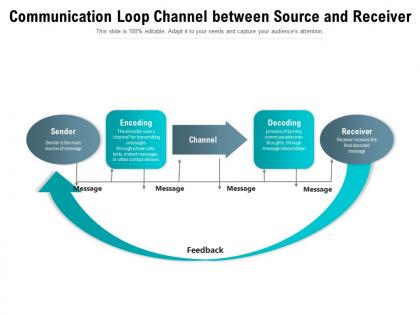
Communication loop channel between source and receiver




Try Before you Buy Download Free Sample Product
 Impress Your
 Audience
 100%
100% Editable
 Save Hours
 of Time


Our Communication Loop Channel Between Source And Receiver are topically designed to provide an attractive backdrop to any subject. Use them to look like a presentation pro.
People who downloaded this PowerPoint presentation also viewed the following :
Communication loop channel between source and receiver with all 2 slides:
Use our Communication Loop Channel Between Source And Receiver to effectively help you save your valuable time. They are readymade to fit into any presentation structure.
FAQs for Communication loop channel between
**INPUT**: What are the most effective communication channels for remote teams? **OUTPUT**: Effective communication channels for remote teams include video conferencing platforms, instant messaging apps, project management tools, shared document systems, and asynchronous communication platforms. These technologies streamline collaboration by enabling real-time discussions, facilitating file sharing, and maintaining project visibility, with many organizations finding that strategic channel combinations ultimately deliver enhanced productivity and stronger team cohesion.
Different age groups demonstrate distinct communication preferences, with Baby Boomers favoring phone calls and face-to-face meetings, Gen X preferring email and structured discussions, Millennials embracing instant messaging and video calls, and Gen Z gravitating toward collaborative platforms and brief digital exchanges. Organizations increasingly find that offering multiple communication channels enhances productivity across all generations, ultimately delivering better team collaboration and more inclusive workplace environments.
Social media serves as a primary communication channel for brand awareness, customer engagement, real-time feedback collection, targeted advertising, and community building. These platforms enable organizations to reach diverse audiences instantly, monitor brand sentiment effectively, and create personalized customer experiences, with many businesses finding that strategic social media integration significantly enhances their competitive positioning and market responsiveness.
Businesses can leverage email marketing by segmenting audiences, personalizing content, automating campaigns, tracking engagement metrics, and integrating with CRM systems. Through targeted messaging and analytics, companies in retail, financial services, and healthcare enhance customer relationships, drive conversions, and reduce acquisition costs, while delivering measurable ROI and sustained competitive advantage.
When choosing communication channels for client interactions, consider urgency requirements, message complexity, client preferences, security needs, and documentation requirements. Different scenarios demand strategic channel selection, with email serving formal documentation needs, phone calls handling urgent matters, and video conferencing facilitating complex discussions, ultimately enhancing client satisfaction while streamlining operational efficiency across diverse business relationships.
Cultural differences significantly influence communication channel preferences through varying formality expectations, technology adoption rates, hierarchical communication norms, and relationship-building approaches. While Western cultures often favor direct digital channels like email and instant messaging, many Asian and Latin American cultures prefer face-to-face interactions or formal written communication, with organizations increasingly adapting multicultural strategies to enhance global collaboration and customer experiences.
Video conferencing offers enhanced collaboration, reduced travel costs, global connectivity, real-time interaction, and improved work-life balance through flexible scheduling. While it delivers significant operational efficiency and enables organizations to maintain seamless communication across distributed teams, many businesses find that technical challenges and screen fatigue present considerations, ultimately requiring strategic balance with other communication methods for optimal effectiveness.
Internal communication channels enhance employee engagement by fostering transparency, enabling two-way feedback, and creating opportunities for collaboration and recognition. Through digital platforms, town halls, and interactive forums, organizations streamline information flow, reduce isolation, and empower employees to contribute meaningfully, ultimately delivering higher job satisfaction and stronger organizational culture with improved retention rates.
**INPUT**: What tools can be integrated into communication channels for better collaboration? **OUTPUT**: Communication channels can integrate project management platforms, file sharing systems, video conferencing tools, real-time editing software, and workflow automation applications. These integrations streamline collaboration by centralizing communications, eliminating context switching, and enabling seamless information flow, with many organizations finding that unified platforms significantly enhance team productivity and reduce project completion times.
Communication channel choice significantly affects message retention through sensory engagement, cognitive processing, and interaction levels. Visual channels like presentations and infographics enhance retention through dual coding, while interactive channels such as workshops and digital platforms enable active participation and reinforcement, with many organizations finding that multi-channel approaches deliver higher retention rates and improved knowledge transfer outcomes.
Emerging communication channel trends include AI-powered chatbots, voice-activated interfaces, omnichannel integration, video-first messaging platforms, and augmented reality interactions. These technologies streamline customer engagement by personalizing experiences, reducing response times, and enabling seamless cross-platform connectivity, with many organizations finding that strategic channel diversification ultimately delivers competitive advantage and enhanced customer satisfaction.
Organizations can measure communication channel effectiveness through engagement metrics, response rates, message reach, feedback quality, and conversion tracking across different platforms. Analytics tools enable companies to assess email open rates, intranet usage, meeting participation, and survey responses, while many businesses find that combining quantitative data with qualitative feedback delivers comprehensive insights for optimizing their communication strategies.
Companies face integration complexities, employee resistance to change, data security concerns, technology infrastructure gaps, and maintaining personal connection quality during digital transitions. While these challenges require strategic planning and training investments, organizations increasingly find that phased implementation approaches, comprehensive staff development, and robust cybersecurity measures enable smoother transitions, ultimately delivering enhanced operational efficiency and competitive advantage.
Visual communication enhances traditional methods by simplifying complex information, increasing message retention, and accelerating comprehension across diverse audiences. Through infographics, presentations, and interactive displays, organizations streamline training processes, improve customer engagement, and bridge language barriers, with many companies finding that visual elements reduce miscommunication while delivering faster decision-making and enhanced operational efficiency.
Best practices for multi-channel communication include establishing consistent messaging across platforms, implementing centralized content management systems, personalizing interactions based on channel preferences, maintaining unified customer data, and regularly analyzing performance metrics. These strategies streamline operations by reducing redundancies, enhancing customer experiences, and enabling faster response times, with many organizations finding that integrated approaches deliver improved engagement rates and operational efficiency.
-
Unique design & color.
-
Great product with effective design. Helped a lot in our corporate presentations. Easy to edit and stunning visuals.
-
Appreciate the research and its presentable format.
-
Graphics are very appealing to eyes.