ESG Framework For Sustainable Business Development

Rating:
90%
ESG Framework For Sustainable Business Development
Slide 1 of 6
Favourites Favourites

Try Before you Buy Download Free Sample Product

Audience Impress Your
Audience
Editable 100%
Editable
Time Save Hours
of Time
The Biggest Sale is ending soon in
0
0
:
0
0
:
0
0
Rating:
90%
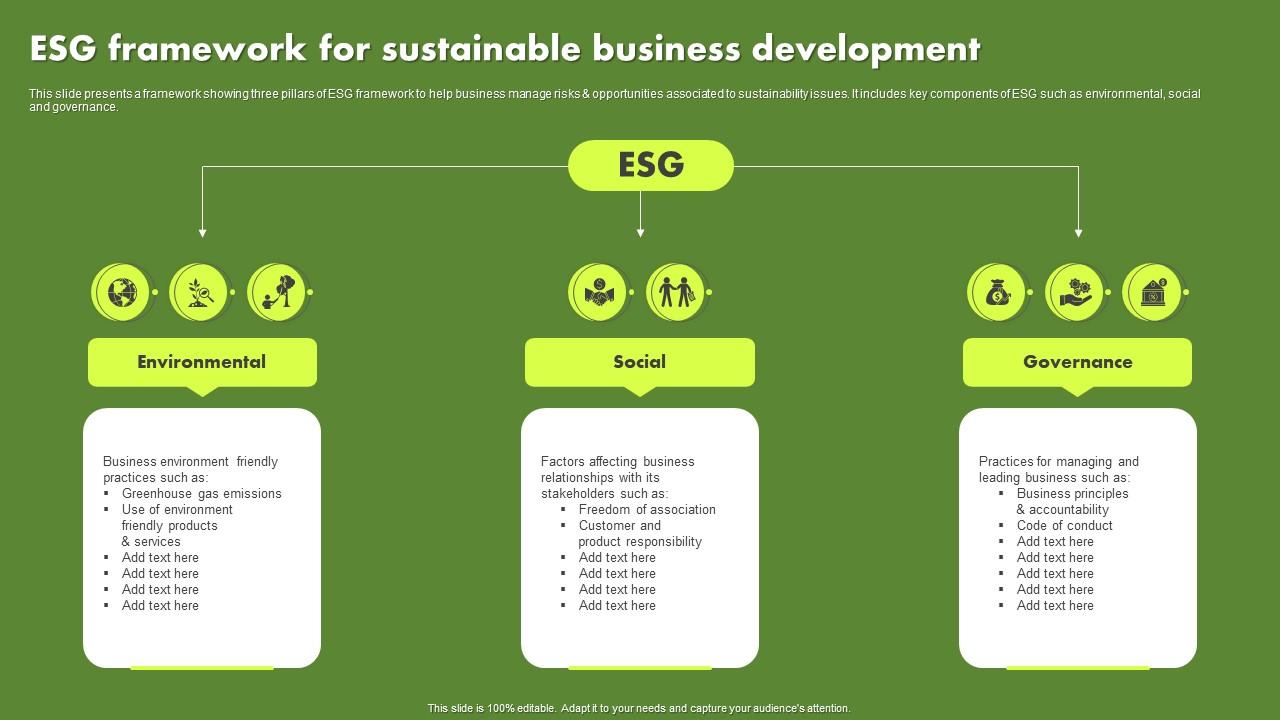
This slide presents a framework showing three pillars of ESG framework to help business manage risks and opportunities associated to sustainability issues. It includes key components of ESG such as environmental, social and governance. Introducing our premium set of slides with name ESG Framework For Sustainable Business Development. Ellicudate the three stages and present information using this PPT slide. This is a completely adaptable PowerPoint template design that can be used to interpret topics like Business Environment, Business Relationships, Leading Business. So download instantly and tailor it with your information.

FAQs for ESG Framework For

ESG frameworks encompass environmental factors, social responsibility, and governance principles, including carbon emissions, labor standards, and ethical leadership. These components streamline operations by fostering transparency, enhancing stakeholder engagement, and minimizing risk, with many financial institutions finding that robust ESG practices deliver improved long-term value and attract responsible investment.

ESG principles can be integrated by embedding environmental, social, and governance considerations into core business functions, including risk management, innovation, and stakeholder engagement. While initially requiring investment in data collection and reporting, it also unlocks opportunities for enhanced brand reputation, streamlined operations, and access to sustainable financing. With many institutions finding that proactive ESG integration delivers long-term value and competitive advantage, ultimately enhancing investor confidence and fostering resilience in an increasingly regulated landscape.

ESG performance is commonly measured through environmental metrics like carbon emissions and water usage, social factors such as employee satisfaction and diversity, and governance aspects including board independence and ethical conduct. These measurements enable organizations to benchmark progress, attract investment, and enhance stakeholder transparency, ultimately delivering improved risk management and long-term value creation.

ESG frameworks increasingly influence investment decisions by evaluating companies based on environmental, social, and governance factors, alongside financial performance. While traditionally focused on returns, investors now assess risks and opportunities related to sustainability, ethical practices, and long-term value creation, with many institutions finding that ESG integration delivers enhanced risk-adjusted returns and fosters responsible corporate behavior.

Stakeholders—including investors, employees, customers, and regulators—significantly shape ESG policies by demanding transparency, ethical sourcing, and demonstrable impact. While companies initiate these frameworks, consistent stakeholder engagement presents both challenges and opportunities, influencing resource allocation and strategic decision-making. With many institutions finding that proactive stakeholder inclusion enhances reputation, ultimately delivering long-term value and competitive advantage.

ESG communication requires transparency, consistency, and quantifiable data, including emissions reductions, diversity metrics, and ethical sourcing initiatives. While showcasing progress is crucial, it also demands acknowledging areas for improvement, building trust with stakeholders through detailed reporting. With many investors prioritizing sustainability, effectively communicating ESG efforts enhances brand reputation, attracts capital, and ultimately delivers long-term value and competitive advantage.

Implementing an ESG framework presents both challenges and opportunities, including data collection complexities, evolving regulatory landscapes, and stakeholder expectation alignment. While organizations strive for transparency, they also navigate inconsistent reporting standards, requiring significant resource allocation for accurate measurement. With many institutions finding that robust frameworks deliver enhanced investor confidence, streamlined operations, and ultimately, a strengthened competitive advantage in an increasingly conscious market.

ESG strategies are increasingly shaped by regulatory requirements spanning carbon emissions reporting, supply chain due diligence, and diversity disclosures. While compliance presents both challenges and opportunities, these mandates drive transparency and accountability, particularly within financial services and manufacturing. These technologies streamline data collection by automating reporting, enhancing risk management, and ultimately delivering competitive advantage and improved stakeholder trust.

ESG ratings are increasingly significant, evaluating organizations based on environmental impact, social responsibility, and governance structures, presenting both challenges and opportunities. These assessments are determined by agencies like MSCI and Sustainalytics through publicly available data, company disclosures, and independent research, ultimately delivering transparency and informing investment decisions. With many institutional investors finding that strong ESG performance correlates with reduced risk and enhanced long-term value, these ratings streamline resource allocation and enhance competitive advantage.

ESG adoption for SMEs can begin with assessing current practices, prioritizing key areas like energy efficiency, ethical sourcing, and employee wellbeing, and then setting measurable goals. While larger firms dedicate extensive resources, SMEs can leverage readily available frameworks and partnerships, enhancing brand reputation and attracting investors. These technologies streamline reporting by focusing on material impacts, ultimately delivering cost savings and a competitive advantage in an increasingly conscious marketplace.

Technology enhances ESG reporting and compliance by automating data collection, streamlining analysis, and improving transparency through blockchain and AI-powered analytics. While manual processes present challenges and opportunities, these digital tools enable organizations to track key metrics, manage risks, and demonstrate accountability, with many financial services institutions finding that automated reporting significantly reduces costs and enhances stakeholder trust, ultimately delivering improved ESG ratings and attracting responsible investment.

ESG frameworks are demonstrably successful at Unilever, Patagonia, and Microsoft, integrating environmental, social, and governance factors into core operations. These organizations enhance brand reputation, attract investors, and minimize risk by prioritizing sustainability, ethical sourcing, and inclusive practices, ultimately delivering improved financial performance and long-term value.

Cultural differences impact ESG implementation globally by necessitating nuanced approaches to stakeholder engagement, reporting standards, and materiality assessments. While universal ESG goals exist, varying societal values—such as collectivism versus individualism—present both challenges and opportunities, with many multinational corporations finding that localized strategies enhance acceptance and drive impactful change. These adaptations streamline resource allocation, improve transparency, and ultimately deliver competitive advantage and enhanced brand reputation in an increasingly interconnected landscape.

ESG frameworks are increasingly incorporating standardized reporting, enhanced data analytics, and a growing focus on social justice issues, alongside traditional environmental concerns. These technologies streamline compliance by automating data collection, enhancing transparency, and enabling proactive risk management, with many financial services and manufacturing firms finding that robust ESG practices deliver competitive advantage and attract investment.

Organizations can balance profitability with ESG commitments by integrating sustainable practices into core business strategies, streamlining operations, and enhancing brand reputation. While initial investments in ESG initiatives can present both challenges and opportunities, these technologies ultimately deliver long-term cost savings, attract investors, and foster customer loyalty, with many financial services firms finding that responsible investing yields competitive advantages.

Ratings and Reviews

90% of 100
Review Form
Write a review
Most Relevant Reviews
  1. 100%

    by George Miller

    SlideTeam is my go-to resource for professional PPT templates. They have an exhaustive library, giving you the option to download the best slide!
  2. 80%

    by Richard Scott

    Wonderful ideas and visuals. I'm really pleased with the templates, which are unique and up to date.

2 Item(s)

per page: