


Creating Value With Machine Learning Improve Customer Journey Mapping Through AI




Try Before you Buy Download Free Sample Product
 Impress Your
 Audience
 100%
100% Editable
 Save Hours
 of Time


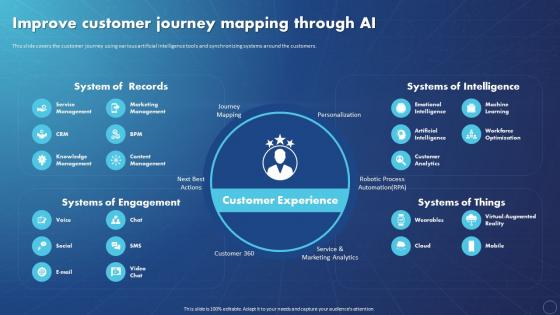
This slide covers the customer journey using various artificial intelligence tools and synchronizing systems around the customers.
People who downloaded this PowerPoint presentation also viewed the following :
Creating Value With Machine Learning Improve Customer Journey Mapping Through AI with all 6 slides:
Use our Creating Value With Machine Learning Improve Customer Journey Mapping Through AI to effectively help you save your valuable time. They are readymade to fit into any presentation structure.





FAQs for Creating Value With Machine Learning Improve Customer Journey
Supervised learning uses labeled data to predict outcomes, unsupervised learning finds patterns in unlabeled data, and reinforcement learning learns through trial-and-error interactions with environments. These approaches enable organizations to tackle different challenges, with banks using supervised learning for fraud detection, retailers applying unsupervised learning for customer segmentation, and manufacturing companies leveraging reinforcement learning for process optimization, ultimately delivering enhanced decision-making and operational efficiency.
Bias in training data significantly compromises machine learning model performance by creating skewed predictions, reduced accuracy across different groups, and unfair outcomes in real-world applications. This particularly impacts sectors like financial services, healthcare, and hiring, where biased models can perpetuate discrimination, ultimately undermining trust and regulatory compliance while limiting business scalability.
Common feature selection and dimensionality reduction techniques include principal component analysis, recursive feature elimination, LASSO regularization, mutual information scoring, and variance thresholding. These methods streamline model performance by eliminating irrelevant data, reducing computational costs, and preventing overfitting, with many organizations finding that strategic feature selection ultimately delivers faster processing and more accurate predictive outcomes.
Overfitting occurs when machine learning models memorize training data rather than learning generalizable patterns, resulting from excessive complexity, insufficient data, or prolonged training cycles. Strategies include cross-validation, regularization techniques, early stopping, and data augmentation, with many organizations finding that ensemble methods and dropout layers ultimately deliver more robust predictive accuracy and reliable business insights.
Data preprocessing serves as the foundation of machine learning pipelines, involving data cleaning, normalization, feature selection, handling missing values, and outlier detection. This critical stage enables algorithms to perform optimally by ensuring data quality and consistency, with organizations in healthcare, finance, and retail finding that thorough preprocessing significantly improves model accuracy and reduces training time.
Hyperparameter tuning significantly enhances model performance by optimizing parameters like learning rate, batch size, regularization strength, and network architecture before training begins. Through systematic approaches such as grid search, random search, and Bayesian optimization, data scientists achieve higher accuracy, reduce overfitting, and improve generalization, ultimately delivering more reliable predictions and competitive advantage.
Ethical considerations include algorithmic bias, data privacy violations, transparency deficits, accountability gaps, and potential job displacement impacts. These challenges present both risks and opportunities for organizations, with many companies finding that proactive ethical frameworks, diverse development teams, and transparent AI governance ultimately deliver stronger stakeholder trust and sustainable competitive advantage.
Transfer learning leverages pre-trained models on similar tasks, enabling organizations to achieve higher accuracy with minimal data by adapting existing knowledge rather than training from scratch. Through this approach, companies in healthcare, finance, and retail can deploy effective machine learning solutions faster, reduce computational costs, and overcome data scarcity challenges while maintaining competitive performance standards.
Machine learning deployment challenges include data drift, model performance degradation, scalability issues, integration complexity, and monitoring difficulties. While these obstacles can impact operational efficiency, organizations in healthcare, finance, and retail are addressing them through robust MLOps frameworks, automated monitoring systems, and continuous retraining processes, ultimately delivering more reliable AI-driven services and competitive advantage.
Model interpretability is crucial for building trust, ensuring regulatory compliance, detecting bias, and enabling stakeholders to understand AI decision-making processes in critical applications like healthcare and finance. It can be achieved through techniques like LIME, SHAP, feature importance analysis, and decision trees, with many organizations finding that transparent models enhance user adoption, reduce liability risks, and deliver better business outcomes in regulated industries.
Algorithm efficiency varies significantly with dataset scale, with linear models like logistic regression delivering faster processing than complex ensemble methods or deep neural networks. While simpler algorithms excel in speed and resource management, sophisticated approaches like random forests or gradient boosting often provide superior accuracy for complex patterns, with many organizations finding that strategic algorithm selection balances computational costs against predictive performance requirements.
GPU advancements have revolutionized machine learning through parallel processing capabilities, enabling faster neural network training, real-time inference, and complex deep learning architectures. These hardware developments have accelerated breakthroughs in computer vision, natural language processing, and autonomous systems, with organizations across healthcare, finance, and manufacturing finding significantly reduced model training times and enhanced AI deployment capabilities.
Natural language processing integrates into machine learning through deep learning algorithms, neural networks, transformer models, and feature extraction techniques that enable computers to understand human language patterns. These technologies streamline customer service through chatbots, automate document analysis in legal and financial sectors, and enhance sentiment analysis for marketing, with many organizations finding that NLP-powered systems significantly reduce processing times while improving accuracy.
Machine learning model evaluation relies on metrics like accuracy, precision, recall, F1-score, ROC-AUC, and mean squared error, depending on the problem type and business objectives. These metrics enable organizations across healthcare, finance, and retail to assess model reliability, optimize performance, and ensure deployment readiness, ultimately delivering better predictions and more confident decision-making processes.
Machine learning revolutionizes healthcare and finance by enabling predictive diagnostics, personalized treatments, algorithmic trading, and fraud detection systems. Through pattern recognition and data analysis, hospitals streamline patient care while reducing costs, banks accelerate loan approvals and minimize risks, ultimately delivering enhanced operational efficiency and competitive advantage across industries.
-
The PPT layout is great and it has an effective design that helps in presenting corporate presentations. It's easy to edit and the stunning visuals make it an absolute steal!
-
I downloaded some of the presentations for work. They were simple to modify and saved me a lot of time and effort.