

Cross Functional Team Collaboration Need Of Cross Functional Collaboration





Try Before you Buy Download Free Sample Product
 Impress Your
Audience
 100%
Editable
 Save Hours
of Time


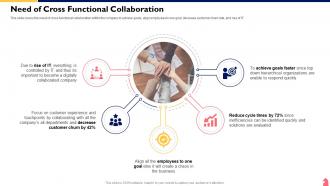
This slide covers the need of cross functional collaboration within the company to achieve goals, align employees to one goal, decrease customer churn rate, and rise of IT.
People who downloaded this PowerPoint presentation also viewed the following :
Cross Functional Team Collaboration Need Of Cross Functional Collaboration with all 6 slides:
Use our Cross Functional Team Collaboration Need Of Cross Functional Collaboration to effectively help you save your valuable time. They are readymade to fit into any presentation structure.





FAQs for Cross Functional Team Collaboration Need Of
Honestly, cross-functional teams are a game changer. You'll catch problems way earlier because different people spot different issues. Creative solutions just happen naturally when you mix perspectives - way better than what any single department comes up with alone. Everyone actually knows what they're working toward instead of doing their own thing in separate bubbles. Builds real relationships too, which makes everything smoother down the road. Oh, and you save tons of time not having to fix miscommunications later. Start with something small first though - test it out on one project before you go all in.
Honestly, start by getting everyone on the same page about what you're actually trying to accomplish. I'd grab all the department heads and literally map out how their work connects to the big picture - it's wild how often people don't see those connections. Cross-functional metrics are huge too, like making teams share KPIs so they can't just optimize for themselves anymore. Oh, and those regular check-ins aren't optional. The trick is making collaboration feel natural, not like some annoying extra task. Maybe try one pilot project first? See how joint goals work before rolling it out everywhere.
Okay so cross-functional stuff - you basically need three things. Communication tool like Slack or Teams, project management (I'd go with Asana or Monday.com), and something for real-time collab like Miro or Google Workspace. But here's the thing - getting everyone OFF email threads is honestly the hardest part. Pick tools that actually talk to each other, otherwise you'll be tab-switching all day which is super annoying. Start simple though. One chat app, one project tracker. You can always add the fancy stuff once people stop complaining about change.
Oh man, cultural stuff is huge for cross-functional teams. Some people are brutally direct, others drop subtle hints when things go wrong. Meeting styles alone can trip you up - like Germans want every detail planned out while other cultures need to chat and build trust first. Decision-making is all over the place too. Asian teams often want everyone on board before moving forward, but other places are way more top-down. Honestly, the time zone thing is probably the easiest part to figure out! Set team norms early that work for everyone and make it safe for people to speak up about their cultural perspective.
Start with psychological safety - nobody's gonna share stuff if they think they'll get blamed later. Regular check-ins between teams help, not just those panic meetings when everything's on fire. We've all been there, right? Build info sharing into your actual processes too. Like, make each team give quick updates during planning sessions. When you see people collaborating well, call it out publicly. The whole point is making cross-team talk feel totally normal instead of this extra thing people try to dodge.
Honestly, you need both the hard data and the touchy-feely stuff to know if it's actually working. Track delivery times and quality scores, sure, but employee surveys are where you'll get the real tea - people will tell you straight up if they feel heard. Watch for organic collaboration too, like when teams start their own Slack channels or just naturally solve problems together. I always check in with team leads regularly because they see the day-to-day friction we miss from up here. Numbers don't lie, but they also don't tell you when Sarah from marketing finally stopped rolling her eyes in cross-team meetings, you know?
Look, without trust your team's basically screwed from day one. People won't give real feedback or admit they're lost on something. Everyone just protects their own department instead of actually working together - I've watched teams completely implode over this stuff. But when trust is there? You move way faster because nobody's constantly checking up on each other or assuming the worst. Honestly, politics kills more projects than bad ideas do. My advice: start small and actually do what you say you'll do. Sounds obvious but most people suck at follow-through.
Honestly, you can't just ignore this and hope it goes away. Get everyone together - Zoom works fine - and actually talk through what's causing the mess. Nine times out of ten it's not personal beef, just teams stepping on each other's toes or nobody knowing who owns what. Have each side explain what they're dealing with and why they need certain things. I've watched so many "conflicts" turn out to be simple miscommunication. Look for fixes that help the whole company, not just one team getting their way. Then check back in a few weeks because these things have a sneaky way of popping back up.
Honestly, it usually comes down to teams having totally different goals and just not talking to each other. Finance people and engineers basically speak different languages - it's wild how disconnected they can be. Departments get super territorial too, which doesn't help. Start by getting everyone on the same page about what you're actually trying to accomplish together. Set up regular check-ins, not just crisis meetings. But here's the thing - you really need people to actually know each other first. Try coffee chats or having team members shadow other departments for a day. Sounds cheesy, but it works.
Honestly, your leaders just need to back off and trust people more. Set the goals and boundaries, then let teams actually decide how to get there. Don't make someone ask permission for a $50 tool - that's just demoralizing. I've watched this transform entire departments when managers finally stop hovering. Be around for questions, sure, but resist the urge to check in constantly. Maybe try it with one project first? Pick something small where you can practice the hands-off thing and see what your team's actually capable of when they're not being micromanaged every step of the way.
Honestly, the biggest thing is sending a clear agenda ahead of time - people hate showing up confused about what they're supposed to discuss. Keep it small too, like 6-8 people tops. Any bigger and it turns into chaos. You definitely want actual decision-makers there, not someone who has to "run it by their boss" for everything. Oh, and assign someone to take real notes with action items. I can't tell you how many meetings I've sat through that accomplished literally nothing because no one followed up. Always end by confirming who's doing what by when, then send a recap the next day.
Honestly, mixing different teams is where the best ideas come from. Marketing spots customer problems that engineers totally miss. Finance suggests something that flips your whole product approach. Those department walls just trap good thinking, you know? When diverse people actually work together instead of staying in their lanes, that's when cool stuff happens. I'd pick one project and grab someone from a completely random department - maybe accounting or whatever. The creative tension between different perspectives is what sparks innovation. Try it once and see what weird solutions pop up.
Communication's huge - you gotta break down your work for people who have zero clue about your stuff. Listening matters too since you'll discover how other teams actually function (spoiler: it's usually messier than you think). Adaptability's key because these projects always go sideways somehow. Plus you need emotional intelligence to deal with everyone's different work styles and what they think is urgent. Problem-solving gets trickier when you're juggling multiple viewpoints. Oh, and asking good clarifying questions in cross-team meetings? Game changer.
Set up checkpoints where teams actually talk at major milestones. Quick cross-team reviews after big deliverables work great. Shared dashboards help too - everyone sees progress and can flag problems early. Most feedback dies because it's way too late in the game, which is honestly super frustrating. Don't create separate processes though. Just embed quick feedback into stuff you're already doing. Slack channels for real-time input are clutch. The whole thing should feel natural, not like another painful meeting. Start small with one touchpoint and build from there.
Spotify's squad model is probably the best example - they get marketing, engineering, and product people working in these small autonomous teams. That's why their new features always roll out so smoothly. Apple did something similar when developing the iPhone, breaking down all the walls between hardware, software, and design (though good luck getting details on that - they're ridiculously secretive). Amazon makes teams collaborate upfront by writing press releases together before they build anything. Honestly, the pattern here is pretty clear: successful companies create actual systems for collaboration instead of just throwing people together and hoping it works out.
-
I came across many PowerPoint presentations with excellent creatives and I believe they would be beneficial to my work.
-
You can rely on SlideTeam whenever you run out of designs for your presentation. Thank you so much SlideTeam!