

Data Lake Formation With Hadoop Cluster Powerpoint Presentation Slides





Try Before you Buy Download Free Sample Product
 Impress Your
Audience
 100%
Editable
 Save Hours
of Time


This PowerPoint presentation gives a brief idea about a data lake, its essentials, foundational elements, architecture, need for data lake, and risks involved in data lake implementation. In this Data Lake Formation with Hadoop Cluster PowerPoint Presentation, we have covered the overview of the data lake by showcasing its main features, key concepts, primary components, and working. In addition, this Data Lake Architecture and The Future of Log Analytics PPT contains four data lake formations on different architectures such as AWS, Hadoop, and Azure, along with a cloud data lake. Moreover, this Data Lake Formation with AWS Cloud PPT contains the data lake implementation methods such as on-premise and cloud and the data lake implementation process. Lastly, this Data Lake Formation with Azure Cloud Platform deck comprises data lake vendors and tools, use cases and applications, and a comparison of the data lake with other storage systems. It incorporates slides showcasing a 30-60-90 days plan, a roadmap, and a dashboard for data lake reporting. Download our 100 percent editable and customizable template, which is also compatible with Google Slides.
People who downloaded this PowerPoint presentation also viewed the following :
Content of this Powerpoint Presentation
Slide 1: This slide introduces Data Lake Formation with Hadoop Cluster. State your company name and begin.
Slide 2: This slide states Agenda of the presentation.
Slide 3: This slide presents Table of Content for the presentation.
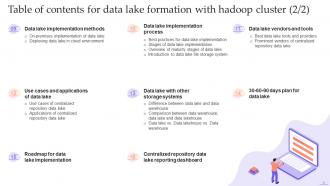
Slide 4: This is another slide continuing Table of Content for the presentation.
Slide 5: This slide highlights title for topics that are to be covered next in the template.
Slide 6: This slide represents the overview of data lake and how it stores machine learning analytics.
Slide 7: This slide showcases Main Features of Data Lake for Customer.
Slide 8: This slide shows Key Concepts of Data Lake Architecture.
Slide 9: This is another slide continuing Key Concepts of Data Lake Architecture.
Slide 10: This slide presents Primary Components of Data Lake Architecture.
Slide 11: This slide displays Essential Elements of Data Lake and Analytics Solution.
Slide 12: This slide represents the working of the data lakes, including how different types of data are stored.
Slide 13: This slide highlights title for topics that are to be covered next in the template.
Slide 14: This slide showcases Foundational Elements of Centralized Repository Data Lake.
Slide 15: This slide shows Process of Building Centralized Repository Data Lake.
Slide 16: This slide represents the building data lake team and their roles and responsibilities.
Slide 17: This slide highlights title for topics that are to be covered next in the template.
Slide 18: This slide displays why organizations should use data lakes based on their features.
Slide 19: This slide describes the value of a data lake including improved customer interactions, improved research and development innovation choices.
Slide 20: This slide depicts the purpose of the data lake in the business.
Slide 21: This slide showcases benefits of the data lake including low-cost scalability and flexibility.
Slide 22: This slide depicts the key pointers to help to understand organizations if they need to maintain a data lake for critical business information.
Slide 23: This slide highlights title for topics that are to be covered next in the template.
Slide 24: This slide presents Architecture of Centralized Repository Data Lake.
Slide 25: This slide displays Architecture Layers of Centralized Repository Data Lake.
Slide 26: This slide highlights title for topics that are to be covered next in the template.
Slide 27: This slide depicts the data lakes on AWS architecture through the data lake console.
Slide 28: This slide represents How to Implement Data Lake in Hadoop Architecture.
Slide 29: This slide describes the data lakes on Azure architecture by covering details of data gathering.
Slide 30: This slide highlights title for topics that are to be covered next in the template.
Slide 31: This slide describes the cloud-based data lake, how these data lakes can eliminate on-premise data lake challenges.
Slide 32: This slide depicts the cloud data lake challenges such as data security, data swamp, on-premise data warehouse, etc.
Slide 33: This slide represents the working of the cloud data lake.
Slide 34: This slide highlights title for topics that are to be covered next in the template.
Slide 35: This slide shows Risks Associated with Data Lake Usage.
Slide 36: This slide presents Critical Challenges Related to Data Lake.
Slide 37: This slide displays How Data Lakehouse Solves Data Lake Challenges.
Slide 38: This slide highlights title for topics that are to be covered next in the template.
Slide 39: This slide represents Strategies to Avoid the Data Swamp in Data Lake.
Slide 40: This slide depicts how to avoid a data swamp in a data lake.
Slide 41: This slide highlights title for topics that are to be covered next in the template.
Slide 42: This slide presents On-Premises Implementation of Data Lake.
Slide 43: This slide represents the deploying data lakes in the cloud and the percentage of believers in cloud computing.
Slide 44: This slide highlights title for topics that are to be covered next in the template.
Slide 45: This slide showcases Best Practices for Data Lake Implementation.
Slide 46: This slide depicts the stages of data lake implementation such as the collection of raw data, environment for data science, etc.
Slide 47: This slide showcases Overview of Maturity Stages of Data Lake.
Slide 48: This slide shows Introduction to Data Lake File Storage System.
Slide 49: This slide highlights title for topics that are to be covered next in the template.
Slide 50: This slide represents the data lake tools and providers, and tools are categorized based on storage, data format, etc.
Slide 51: This slide shows Prominent Vendors of Centralized Repository Data Lake.
Slide 52: This slide highlights title for topics that are to be covered next in the template.
Slide 53: This slide presents Use Cases of Centralized Repository Data Lake.
Slide 54: This slide displays Applications of Centralized Repository Data Lake.
Slide 55: This slide highlights title for topics that are to be covered next in the template.
Slide 56: This slide represents Difference Between Data Lake and Data Warehouse.
Slide 57: This slide showcases Comparison Between Data Warehouse, Data Lake and Data Lakehouse.
Slide 58: This is another slide continuing Data Lakes vs. Data Lakehouses vs. Data Warehouses.
Slide 59: This slide highlights title for topics that are to be covered next in the template.
Slide 60: This slide describes the 30-60-90 days plan for the data lake.
Slide 61: This slide highlights title for topics that are to be covered next in the template.
Slide 62: This slide presents Roadmap for Data Lake Implementation.
Slide 63: This slide highlights title for topics that are to be covered next in the template.
Slide 64: This slide displays Centralized Repository Data Lake Reporting Dashboard.
Slide 65: This slide contains all the icons used in this presentation.
Slide 66: This slide is titled as Additional Slides for moving forward.
Slide 67: This slide displays Column chart with two products comparison.
Slide 68: This is Our Target slide. State your targets here.
Slide 69: This slide describes Line chart with two products comparison.
Slide 70: This slide depicts Venn diagram with text boxes.
Slide 71: This slide presents Roadmap with additional textboxes.
Slide 72: This slide contains Puzzle with related icons and text.
Slide 73: This is a Timeline slide. Show data related to time intervals here.
Slide 74: This slide shows Post It Notes. Post your important notes here.
Slide 75: This is a Thank You slide with address, contact numbers and email address.
Data Lake Formation With Hadoop Cluster Powerpoint Presentation Slides with all 80 slides:
Use our Data Lake Formation With Hadoop Cluster Powerpoint Presentation Slides to effectively help you save your valuable time. They are readymade to fit into any presentation structure.









FAQs for Data Lake Formation With Hadoop Cluster
Okay so you'll need four main things. Storage first - S3 or Azure Data Lake work great for dumping tons of raw data. Ingestion tools pull everything from your different sources. Processing engines like Spark clean up all that messy stuff and make it actually useful. And honestly? The metadata catalog might be the most important part because without it you're just creating a giant data swamp where nobody can find anything. Oh and obviously wrap security around the whole thing. I'd start with storage and the catalog - learned that one the hard way.
Okay so data lakes basically let you throw in whatever - raw logs, images, streaming stuff, you name it. No upfront structure needed. Warehouses are the opposite though, you've gotta transform and organize everything before loading it in. Makes queries way faster since it's already structured, but you're kinda locked into that schema from the start. Data lakes give you more flexibility since you figure out how to use the data later when you actually need it. Honestly feels way less restrictive. But yeah, if you're dealing with tons of different data sources and don't know what you'll do with them yet, I'd probably go the lake route first.
Day one is when you wanna nail down your partitioning strategy - don't wing this part. Use Parquet or Delta Lake for performance. Schema evolution handling is huge too. I can't tell you how many teams I've watched skip the groundwork and then scramble later when everything breaks. Validate your data quality right at ingestion, not after it's already downstream causing chaos. Set up monitoring for failed ingests and drift. Oh, and figure out if you need batch vs streaming early on since that'll totally change your whole setup. Trust me on the upfront work - it's worth it.
Okay so first thing - get data validation running at ingestion, plus automated quality checks throughout your whole pipeline. Schema validation, profiling, anomaly detection, all that stuff running 24/7. You'll want clear data lineage tracking too so when things break (and they will), you can actually trace it back. Set up governance with data stewards who get the business side, not just tech nerds. Oh and build monitoring dashboards that'll scream at you when metrics go sideways - honestly this part's crucial. Start with your most critical datasets first, then expand once you've got those locked down. Trust me on this one.
Dude, you absolutely need metadata and governance or your data lake becomes this nightmare swamp situation. Metadata is like your catalog - tells you what data you actually have, where it came from, how old it is. Governance gives you the rules for quality control, who can access what, lifecycle stuff. Honestly, I've seen companies skip this step and regret it hard. Tag everything going in from day one. Set up clear ownership roles too. Without it? You'll be drowning in useless data faster than you think.
Think of data lakes like throwing everything into one massive storage bin - no organizing required upfront. You've got your SQL tables mixed with JSON files, plus random stuff like videos and log files all sitting together. Pretty messy sounding, right? But here's the thing: you only worry about structure when you actually need to analyze something. That "schema-on-read" approach saves you from doing tedious data prep work beforehand. Just figure out what data types you're dealing with first, then set up some basic folders so you don't completely lose track of everything.
Ugh, data lake security is such a pain. The main problem? Everything's just dumped in there with zero organization - raw data from everywhere mixing together. Traditional databases have clear rules about who sees what, but data lakes? Total chaos. You can't tell what's sensitive anymore, and good luck managing who has access to what. Classification becomes a nightmare. Oh and don't get me started on compliance headaches. Honestly, you need governance rules from the start, plus some automated tools to sort through the mess. Otherwise you'll be drowning.
Three things to focus on: partition your data by whatever you query most (dates, regions, etc), switch from CSV to Parquet format, and set up proper indexing. Partitioning is seriously a game-changer - I can't stress this enough. Also cache your most-used datasets and pick the right query engine for your setup. Presto's solid, Spark too, depends what you're running. Oh and here's the thing - figure out your query patterns first before doing anything else. Look at your slowest queries and start optimizing those partitions. Way more effective than just guessing what needs work.
So you'll need cloud storage first - AWS S3, Azure Data Lake, or Google Cloud Storage work well. For getting data in, try Apache Kafka, AWS Kinesis, or Azure Event Hubs. Processing-wise, Apache Spark or Hadoop are solid choices. Oh and you definitely want cataloging tools like AWS Glue or Apache Atlas because trust me, things get messy fast without them. The whole ecosystem is honestly pretty overwhelming when you first look at it. I'd just pick one cloud provider and stick with their integrated stuff to start - way easier than mixing and matching everything.
So you can just plug ML services like SageMaker or Databricks right into your data lake storage. No moving huge datasets around - thank god because that's always a nightmare. Training and inference happen where the data already sits. Pretty neat setup actually. You'll get way richer models since structured and unstructured data can work together. Feature engineering pipelines become automated too. Just make sure your data lake has decent cataloging upfront, otherwise your ML folks will spend forever hunting for usable data. Oh and governance - don't skip that part.
Delta Lake and Apache Iceberg are your go-to options for data lake versioning - they both handle schema changes and time travel queries really well. Lineage tracking is trickier though. Apache Atlas, DataHub, or AWS Glue's lineage features work depending on what you're already using. Honestly? Getting versioning right is so much easier than nailing lineage across different data sources. Set up your versioning approach early because adding it later absolutely sucks. Go with Delta Lake if you're using Databricks, otherwise Iceberg's probably better since it works everywhere. Oh and lineage will take way longer to get working properly than you think.
Honestly, the biggest money is in turning that raw data into stuff that actually moves the needle - customer segmentation, predictive maintenance, demand forecasting. Once you've got insights, make them work for you through automated recommendations or dynamic pricing models. Some companies even sell their insights as data products to other businesses, which is pretty smart. Build self-service tools so your business teams aren't constantly bugging the data science folks for every little analysis. That's where I'd start anyway. The key is finding use cases that directly hit your revenue or cut costs.
Honestly, cloud platforms make data lakes way more powerful. Auto-scaling means you don't have to guess storage needs anymore. Security and governance tools are already built in - saves you tons of setup time. The crazy part? Spinning up Spark clusters or ML pipelines takes minutes now instead of weeks. I still can't get over how fast that is compared to the old days. You're only paying for what you use too, which beats maintaining expensive hardware. My advice? Pick one cloud service and test how it plays with your current setup first.
Honestly, the worst thing you can do is treat it like some massive digital trash can. No governance = data swamp nightmare. Set up metadata and cataloging right away - I learned this the hard way when we couldn't find anything months later. Access controls and quality checks need to happen upfront too, not as an afterthought. Oh, and don't try migrating everything at once like some hero. Start with your best datasets first. Really though, just plan your whole architecture before dumping stuff in there. Saves so much headache.
Start with RBAC - just map out who needs what based on their actual job. Hook it up to whatever identity system you're already using, then get granular with permissions for datasets, tables, columns, whatever. AWS Lake Formation handles this pretty well if that's your setup. Don't overthink it though - I've seen people create permission nightmares trying to be too precise upfront. Begin with basic role buckets, then tighten things up once you see how people actually use the data. Oh, and write this stuff down somewhere because you'll forget why you set things up a certain way six months from now.
-
SlideTeam is the best in the business. Their templates are engaging and customizable. You can rely on them.
-
I am glad to have come across Slideteam. I was searching for some unique presentations and templates for my business. There are a lot of alternatives available here.