


Hadoop it powerpoint presentation slides





Try Before you Buy Download Free Sample Product
 Impress Your
 Audience
 100%
100% Editable
 Save Hours
 of Time


Hadoop is a Java-based Apache open-source platform that enables distributed massive datasets among computer clusters using basic programming concepts. Here is a competently designed template on Hadoop IT that gives a brief idea about the companys current situation through a map and its need in the business. It incorporates templates that depict the importance, global market share, and advantages of Hadoop. In this presentation, we have covered the overview of Hadoop, its different components, Cluster, architecture, its working, and use cases in various sectors. In addition, this Apache PPT contains slides depicting Hadoop as a big data management platform that can be used to jot down the key takeaways. This presentation addresses features of the Apache flume tool for extensive data management in Hadoop. Furthermore, this presentation provides a framework for implementing Hadoop in the company and helps you conduct a comparative analysis between Hadoop 2. x and Hadoop 3. x. Lastly, the deck comprises a 30-60-90 days plan, a roadmap, and a dashboard for Hadoop implementation in the company. Get access now.
People who downloaded this PowerPoint presentation also viewed the following :
Content of this Powerpoint Presentation
Slide 1: This slide introduces Hadoop (IT). State Your Company Name and begin.
Slide 2: This is an Agenda slide. State your agendas here.
Slide 3: This slide shows Table of Content for the presentation.
Slide 4: This slide presents Table of Content for the presentation.
Slide 5: This slide displays title for topics that are to be covered next in the template.
Slide 6: This slide represents current situation of the company, including structured data, unstructured data, etc.
Slide 7: This slide showcases title for topics that are to be covered next in the template.
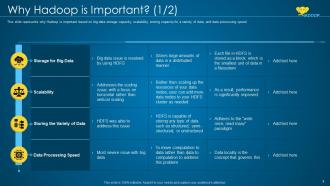
Slide 8: This slide shows why Hadoop is important based on big data storage capacity.
Slide 9: This slide presents importance of the Hadoop Platform, including open-source, Hadoop ecosystem, etc.
Slide 10: This slide displays global market share of Hadoop, including classification based on services.
Slide 11: This slide represents advantages of Hadoop on the basis of scalability, flexibility, cost, etc.
Slide 12: This slide showcases title for topics that are to be covered next in the template.
Slide 13: This slide shows Core Components of Hadoop Framework.
Slide 14: This slide presents Hadoop distributed file system architecture, including its components.
Slide 15: This slide displays Goals of Hadoop Distributed File System (HDFS).
Slide 16: This slide represents Hadoop MapReduce architecture and how it processes a huge amount of information.
Slide 17: This slide showcases Map and Reduce Function of MapReduce Task.
Slide 18: This slide shows map phase of the MapReduce task, including record reader, map, combiner, etc.
Slide 19: This slide presents reduce phase of the MapReduce task that includes the sort and shuffle.
Slide 20: This slide displays job execution flow of MapReduce, including input data stored on HDFS.
Slide 21: This slide represents Hadoop Yet Another Resource Negotiator (YARN) Architecture.
Slide 22: This slide showcases Components of Yet Another Resource Negotiator (YARN).
Slide 23: This slide shows title for topics that are to be covered next in the template.
Slide 24: This slide presents Hadoop cluster and how it helps to process queries on a massive amount of data.
Slide 25: This slide displays architecture of the Hadoop cluster’s component.
Slide 26: This slide represents functions of Name Node in master in Hadoop cluster architecture.
Slide 27: This slide showcases functions of Resource Manager in master in Hadoop cluster.
Slide 28: This slide shows slaves in Hadoop cluster architecture along with functions of its additional components.
Slide 29: This slide presents client node in Hadoop cluster architecture and its various functions.
Slide 30: This slide displays Communication Protocols used in Hadoop Cluster.
Slide 31: This slide represents Best Practices for Building Hadoop Cluster.
Slide 32: This slide showcases Features of Hadoop Cluster Management Tool.
Slide 33: This slide shows benefits of the Hadoop cluster, including scalable, cost-effective, robustness, etc.
Slide 34: This slide presents title for topics that are to be covered next in the template.
Slide 35: This slide displays architecture of Hadoop, including its various components and elements.
Slide 36: This slide represents internal working of Hadoop, including how it distributes data storage and processing.
Slide 37: This slide showcases Operation Modes of Hadoop Framework.
Slide 38: This slide shows title for topics that are to be covered next in the template.
Slide 39: This slide presents Hadoop as a big data management platform and how it stores data in the Hadoop data lakes.
Slide 40: This slide displays Apache HBase Tool for Big Data Management in Hadoop.
Slide 41: This slide represents Apache Flume Tool for Big Data Management in Hadoop.
Slide 42: This slide showcases Apache Hive Tool for Big Data Management in Hadoop.
Slide 43: This slide shows Apache Pig Tool for Big Data Management in Hadoop.
Slide 44: This slide presents title for topics that are to be covered next in the template.
Slide 45: This slide displays checklist to implement the Hadoop framework in the organization.
Slide 46: This slide represents Deployment of Hadoop Framework in Company.
Slide 47: This slide showcases Single Node Hadoop Cluster or Pseudo Distributed Mode.
Slide 48: This slide shows Multi Node Hadoop Cluster or Fully Distributed Mode.
Slide 49: This slide presents methods to get data into the Hadoop framework.
Slide 50: This slide displays challenges of the Hadoop platform, including slow processing speed, no caching, etc.
Slide 51: This slide represents solutions to Hadoop challenges such as Spark, Flink, Hadoop Archives, etc.
Slide 52: This slide showcases title for topics that are to be covered next in the template.
Slide 53: This slide shows Comparison between Hadoop 2.x and Hadoop 3.x.
Slide 54: This slide presents comparison between Hadoop and Spark based on factors such as performance, cost, etc.
Slide 55: This slide displays title for topics that are to be covered next in the template.
Slide 56: This slide represents impacts of Hadoop on businesses, including big data analysis and queries.
Slide 57: This slide showcases impacts of Hadoop on the business, including data-driven decisions, better data access, etc.
Slide 58: This slide shows title for topics that are to be covered next in the template.
Slide 59: This slide presents 30-60-90 Days Plan for Hadoop Implementation.
Slide 60: This slide displays title for topics that are to be covered next in the template.
Slide 61: This slide represents roadmap for Hadoop implementation by displaying the tasks to be performed.
Slide 62: This slide showcases title for topics that are to be covered next in the template.
Slide 63: This slide shows dashboard of Hadoop implementation in the business by covering details of HDFS.
Slide 64: This slide presents dashboard for Hadoop and covering the details of NameNode heap, HDFS disk usage, etc.
Slide 65: This slide is titled as Additional Slides for moving forward.
Slide 66: This slide represents title for topics that are to be covered next in the template.
Slide 67: This slide shows what Hadoop is, including its various components such as storage layer or HDFS, batch processing engine, etc.
Slide 68: This slide presents Hadoop ecosystem by including its core module and associated sub-modules.
Slide 69: This slide displays disadvantages of Hadoop on the basis of security, vulnerability by design, etc.
Slide 70: This slide represents use cases of Hadoop in different sectors, including healthcare, telecom, finance, etc.
Slide 71: This slide showcases Icons for Hadoop(IT).
Slide 72: This slide represents Stacked Column chart with two products comparison.
Slide 73: This slide showcases Magnifying Glass to highlight information, specifications etc
Slide 74: This is an Idea Generation slide to state a new idea or highlight information, specifications etc.
Slide 75: This slide depicts Venn diagram with text boxes.
Slide 76: This slide shows Circular Diagram with additional textboxes.
Slide 77: This slide contains Puzzle with related icons and text.
Slide 78: This slide displays Mind Map with related imagery.
Slide 79: This is a Thank You slide with address, contact numbers and email address.
Hadoop it powerpoint presentation slides with all 87 slides:
Use our Hadoop IT Powerpoint Presentation Slides to effectively help you save your valuable time. They are readymade to fit into any presentation structure.













FAQs for Hadoop it
So basically there's three main parts you need to know about. HDFS handles storage - it splits your data across different machines and keeps backup copies. Pretty smart actually. YARN is like the manager that decides which computers do what work. Then MapReduce does the heavy lifting with all the actual number crunching. Honestly, I'd start with understanding HDFS first since the other two depend on it. YARN grabs data from HDFS and tells MapReduce what to process. It's kind of like HDFS is your hard drive, YARN's the scheduler, and MapReduce is doing all the math work. They're designed to work together seamlessly.
So basically Hadoop spreads your data across a bunch of machines using HDFS - when you need more space or power, just throw more hardware at it. The cool part? It automatically makes 3 copies of everything and scatters them around different nodes. One machine dies? No big deal, there's backups running somewhere else. MapReduce is smart too - if a job crashes, it'll just restart on a working machine. I learned this the hard way, but you've gotta plan for stuff breaking instead of crossing your fingers it won't.
So HDFS is what makes Hadoop actually work - it takes your huge files and chops them into 128MB pieces, then scatters copies across different machines. Smart move because when a server crashes (and they will), your data's still safe somewhere else. Instead of hauling massive files around the network, it sends the processing jobs to wherever the data already sits. Way more efficient. Oh, and here's something most people mess up - you really want to match your block size to your typical file sizes or performance gets weird. It's honestly pretty clever how the whole thing coordinates itself.
Honestly, Hadoop's pretty solid for big data stuff. You can run it on cheap regular servers instead of those crazy expensive specialized machines. Scales like crazy too - just throw more hardware at it when your data explodes. Traditional databases would totally choke on the massive datasets Hadoop handles no problem. Works with any data type you've got, which is nice. The whole ecosystem around it is massive - Spark, Hive, all that good stuff makes analysis way smoother. If your current setup is drowning under all that data, maybe spin up a small Hadoop cluster first? Test it out before going all-in.
So MapReduce basically splits your data job into two parts - first you Map (distribute and process stuff across multiple machines), then Reduce (combine all the results back together). The cool thing is it scales like crazy - we're talking terabytes across hundreds of machines. If some nodes crash? No big deal, it just recovers automatically. You don't have to deal with all the messy distributed computing stuff either. Honestly, I'd just start with basic word count examples first. Once you get that pattern down, everything else clicks way faster. Way better than trying to wrap your head around the theory initially.
So the main thing with Hadoop 2.x is YARN replaced that old JobTracker/TaskTracker mess. Before, you were stuck with just MapReduce jobs. Now? You can run Spark, Storm, whatever on the same cluster since YARN manages resources way better. Honestly, the flexibility alone makes it worth upgrading. Plus you're not hitting that annoying 4,000 node wall anymore. Most new tools won't even work without YARN anyway - learned that the hard way when I tried running some newer stuff on 1.x last year. If you're still using the old version, you'll probably want to upgrade soon.
Start with Kerberos for authentication - yeah, it's annoying to set up but you'll thank yourself later. Encryption is huge too, both for data sitting around and moving between nodes. For permissions, Apache Ranger works really well (though honestly Sentry's fine if you're already using it). Don't put all your eggs in one basket though. Layer everything together - authentication + encryption + access controls + regular audits. I learned this the hard way on a project last year. Defense in depth is your friend here, especially when you're dealing with sensitive stuff in your cluster.
First thing - check your cluster metrics with Ambari or whatever monitoring tool you've got. Can't fix what you can't see, right? HDFS block placement is actually huge for performance, so keep your data close to processing nodes. Memory and CPU allocation for YARN containers needs to be dialed in too. Oh and compression - seriously, most people skip this but it cuts down I/O overhead like crazy. Tune your mappers and reducers based on data size. I spent way too much time learning this the hard way, but these basics will get you pretty far.
Hadoop works great as your data foundation while ML frameworks do the heavy lifting. Spark's probably your easiest win - runs right on your Hadoop cluster through YARN and honestly feels pretty natural once you've got it configured. TensorFlow's trickier since it wasn't really designed for Hadoop from the start, but you can pull data from HDFS or use something like TensorFlowOnSpark to make them play nice together. If you're already deep in the Hadoop world, I'd just start with Spark MLlib. Way less of a pain than trying to force other frameworks to cooperate.
Honestly, data migration is going to be your biggest headache - moving from regular databases to Hadoop's whole distributed thing is like learning a new language. Your team probably doesn't know MapReduce or HDFS yet, which means training costs you didn't budget for. Infrastructure gets expensive fast too. Plus integrating with your current systems? Total nightmare. Oh and the mindset shift is huge - you're basically rethinking how data works. I'd definitely start small with a pilot project first. Get your people trained early or you'll be scrambling later.
So Hadoop data ingestion is just moving your data from wherever it lives into HDFS or other Hadoop storage. Sqoop works great for pulling stuff from relational databases. For streaming data like logs, Flume is solid - I actually prefer it over some of the newer options. Kafka's your go-to for real-time streams, and NiFi has this nice visual interface if you're into that. Really comes down to whether you need batch processing or real-time. Oh, and figure out your data sources first - that'll basically tell you which tool to use.
So Hadoop's really good for companies drowning in massive amounts of data. Finance companies use it for fraud detection and risk stuff - honestly the algorithmic trading applications are pretty fascinating. Healthcare does patient analytics and drug discovery with it. Retail? Customer behavior analysis and those creepy-good product recommendations you see everywhere. The genomic research thing is actually mind-blowing when you think about it. Basically any industry processing petabytes of data from tons of different sources. Traditional databases just can't handle that scale. Worth checking out if you're dealing with that kind of data volume.
So cloud computing basically lets you ditch the whole "managing your own Hadoop clusters" nightmare. AWS EMR, Google Dataproc, Azure HDInsight - they handle all that infrastructure stuff so you don't have to. Spin up clusters when you need them, auto-scale, pay as you go. Pretty sweet deal honestly. Only real downsides are getting locked into one vendor and those data transfer fees can add up fast (learned that one the hard way). But yeah, for your next project I'd definitely check out the managed services first. Way less headache than maintaining your own setup.
Look, Hadoop data governance matters way more than you'd think. Without it, your data lake becomes this nightmare swamp where nothing's findable or trustworthy. Apache Atlas helps track where data comes from and goes - super useful for lineage stuff. Ranger's your go-to for controlling who accesses what. The boring part? Setting up data classification policies and automated quality checks upfront. But trust me, you'll be so glad when auditors show up asking questions. I learned this the hard way at my last job - we skipped the governance setup initially and spent months cleaning up the mess later.
Honestly, data modeling and cluster sizing will bite you if you don't plan HDFS structure upfront - retrofitting sucks. Debugging distributed systems across nodes is a nightmare, no joke. Most folks way overengineer at first when you could just start small and scale out later. Oh and the small files thing? Total performance killer if you've got thousands of tiny files everywhere. I'd say do a proof of concept first with smaller data. Get your pipeline patterns down solid, then scale up the infrastructure once you know what actually works.
-
Appreciate the research and its presentable format.