


Data Lake It Comparison Between Data Warehouse Data Lake And Data Lakehouse




Try Before you Buy Download Free Sample Product
 Impress Your
 Audience
 100%
100% Editable
 Save Hours
 of Time


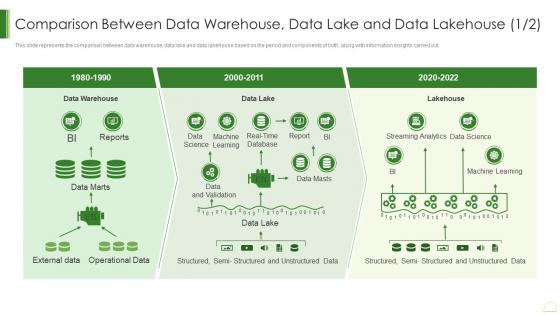
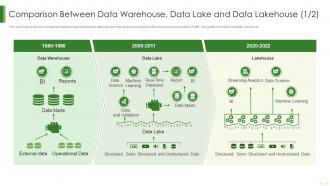
This slide represents the comparison between data warehouse, data lake and data lakehouse based on the period and components of both, along with information insights carried out.
People who downloaded this PowerPoint presentation also viewed the following :
Data Lake It Comparison Between Data Warehouse Data Lake And Data Lakehouse with all 6 slides:
Use our Data Lake It Comparison Between Data Warehouse Data Lake And Data Lakehouse to effectively help you save your valuable time. They are readymade to fit into any presentation structure.





FAQs for Data Lake It Comparison Between Data Warehouse Data Lake
Data lakes store raw, unstructured data in its native format until needed, while data warehouses require structured, processed data organized for specific business intelligence purposes. Data lakes offer greater flexibility and cost-effectiveness for diverse data types, though data warehouses provide faster query performance and easier analysis, with many organizations increasingly adopting hybrid approaches that combine both architectures for comprehensive data management strategies.
Data lake ingestion handles massive volumes of raw, unstructured data from diverse sources through batch and real-time streaming, while traditional databases require pre-processed, structured data with defined schemas. This flexibility enables organizations like Netflix and financial institutions to rapidly ingest social media feeds, IoT sensors, and multimedia content, ultimately delivering faster analytics and broader data accessibility.
Schema-on-read allows data lakes to store raw, unstructured data without predefined formats, enabling faster ingestion, greater flexibility, and reduced upfront modeling costs. This approach streamlines data collection from diverse sources like IoT sensors, social media, and transaction logs, while enabling organizations to adapt analytics as business requirements evolve, ultimately delivering competitive advantage through agile data exploration.
Data lakes excel at storing unstructured data like videos, documents, and social media content in their native formats, while structured data requires predefined schemas in traditional databases. This flexibility enables organizations to capture diverse data sources from customer interactions, IoT sensors, and multimedia content, ultimately delivering comprehensive analytics capabilities and faster insights across retail, healthcare, and financial services sectors.
Organizations with diverse data sources and high-volume operations benefit most from data lake architecture, including financial services, healthcare systems, retail chains, manufacturing companies, and telecommunications providers. These entities leverage data lakes to consolidate structured and unstructured information from multiple touchpoints, enabling advanced analytics, real-time insights, and scalable data processing that ultimately delivers competitive advantage and operational efficiency.
Data lake governance challenges include data quality inconsistencies, unclear data lineage tracking, inadequate access controls, metadata management complexities, and regulatory compliance difficulties. These issues often arise from the schema-on-read approach and diverse data sources, with many organizations finding that establishing clear data stewardship roles, automated quality monitoring, and comprehensive cataloging systems ultimately delivers better regulatory adherence and operational transparency.
Data lakes enhance analytics capabilities by storing vast amounts of structured and unstructured data in native formats, enabling advanced analytics, machine learning, and real-time processing across diverse data types. Financial institutions and healthcare organizations leverage this flexibility to perform complex pattern recognition, predictive modeling, and cross-departmental analysis, ultimately delivering faster insights and more comprehensive business intelligence than traditional data warehouses.
Scalability enables data lakes to accommodate growing data volumes, diverse formats, and increasing user demands without performance degradation, making them viable for enterprise-level operations. Through elastic storage and compute resources, organizations can seamlessly expand their analytics capabilities, support real-time processing, and deliver faster insights, ultimately providing competitive advantage in increasingly data-driven business environments.
Data lakes typically require lower initial setup costs due to their ability to store raw data in inexpensive object storage, while data warehouses demand significant upfront investment in structured storage, ETL processes, and specialized hardware. However, long-term operational costs can shift this balance, with data lakes requiring ongoing governance and processing resources, while data warehouses deliver predictable query performance and streamlined maintenance, ultimately making cost optimization dependent on specific organizational data volume and usage patterns.
Common data visualization and reporting tools for data lakes include Tableau, Power BI, Apache Superset, Looker, and Qlik Sense. These platforms streamline analytics by connecting directly to data lake storage, enabling real-time dashboards and self-service reporting, with many organizations finding that integrated visualization ultimately delivers faster insights and enhanced decision-making capabilities.
Data lakes typically implement perimeter-based security with authentication, authorization, and encryption at rest and in transit, while traditional databases rely on structured access controls, row-level security, and granular permissions. Through advanced governance frameworks, organizations in healthcare, finance, and retail enhance data protection with automated monitoring and compliance tracking, ultimately delivering comprehensive security while maintaining scalability for diverse data types.
Best practices for ensuring data quality within a data lake include implementing data validation rules, establishing clear data lineage tracking, creating automated quality monitoring systems, defining consistent data formats, and maintaining comprehensive metadata management. These approaches streamline data governance by detecting anomalies early, ensuring source transparency, and enabling faster analytics, with many organizations finding that proactive quality frameworks ultimately deliver more reliable insights and reduced data preparation costs.
Data lakes integrate with machine learning and AI applications by providing centralized raw data storage, enabling direct algorithm training, and supporting real-time model deployment through APIs and streaming frameworks. Through cloud-native architectures, organizations streamline data preprocessing, accelerate model development, and enhance predictive analytics capabilities, with financial services and healthcare institutions finding that integrated platforms ultimately deliver faster insights, reduced data silos, and competitive analytical advantages.
Data lake storage options include object storage systems, distributed file systems, cloud-based repositories, hybrid architectures, and columnar formats like Parquet and Delta Lake. These technologies streamline data management by enabling flexible ingestion, cost-effective scaling, and rapid query processing, with many organizations finding that strategic combinations deliver enhanced analytics capabilities and significantly faster insights across diverse data types.
Organizations ensure compliance with data privacy regulations in data lakes through robust encryption, access controls, data lineage tracking, automated governance policies, and comprehensive audit trails. These security frameworks enable banks, healthcare institutions, and retail companies to manage sensitive information while meeting GDPR, HIPAA, and other regulatory requirements, ultimately delivering regulatory confidence and operational transparency.
-
Awesome use of colors and designs in product templates.
-
The content is very helpful from business point of view.