

Department Wise Future Plan For Business Start Up




Try Before you Buy Download Free Sample Product
 Impress Your
 Audience
 100%
100% Editable
 Save Hours
 of Time


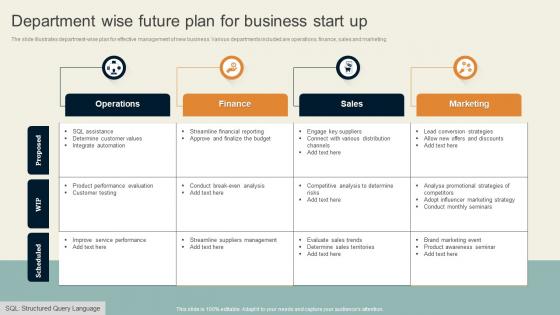
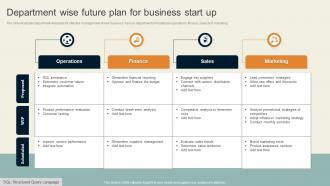
The slide illustrates department wise plan for effective management of new business. Various departments included are operations, finance, sales and marketing.
People who downloaded this PowerPoint presentation also viewed the following :
Department Wise Future Plan For Business Start Up with all 6 slides:
Use our Department Wise Future Plan For Business Start Up to effectively help you save your valuable time. They are readymade to fit into any presentation structure.





FAQs for Department Wise Future Plan For
Honestly, just go talk to people first - like 20-30 potential customers minimum. Don't pitch your idea yet though, that's the mistake everyone makes. Just ask about their problems and how they're dealing with stuff now. Listen to what they actually say. After that, throw together some basic mockups or a simple version to see if anyone would pay. Oh and definitely check out your competition (there's probably some, which is usually good tbh). The real test? Try getting people to pre-order or join a waitlist. If nobody cares enough to sign up before you've built anything, well... there's your answer.
Look, market research is basically your startup's GPS - shows you who actually wants what you're building and what they'll pay for it. You'll uncover problems you never thought about and honestly might realize your whole idea needs a major pivot. Better to find that out now than after burning through your cash, right? Start with surveys and just talking to potential customers. Their feedback shapes everything - pricing, messaging, positioning. Oh and you'll figure out who you're really competing against too. Sometimes the competition isn't who you think it is.
Look, your business model is literally the foundation for every big decision you make. It shows how you create value and actually make money - which then determines if you're chasing growth, profits, or market share. Take subscription businesses - they're all about keeping customers happy long-term. Marketplaces? They live and die by network effects. Honestly, without knowing your exact revenue model, you're just throwing strategies at the wall. Figure out how you'll make money first, then build your strategy around that. Everything else flows from there.
Honestly, just start by stalking their websites and social media - you'd be shocked what people post publicly. I use SEMrush to peek at their keywords and traffic sources, though it's kinda pricey if you're bootstrapping. Sometimes I'll even sign up for competitor newsletters just to see their messaging (feels sneaky but whatever). Make a basic spreadsheet tracking their pricing, features, who they target - the usual stuff. Oh and don't just do this once and forget about it. Things change crazy fast, so I try to check in monthly or you'll miss when they pivot their whole strategy.
First things first - watch your cash flow, burn rate, and runway religiously. That's literally your survival timer. CAC and LTV matter too, but honestly you're mostly guessing on the LTV part early on anyway. If you're doing subscriptions, track MRR. Gross margins help you figure out if your unit economics actually work. Don't waste time obsessing over vanity stuff like total users - I see founders do this constantly and it's pointless. Revenue per customer and churn rate are way more telling. Just throw it all in a Google Sheet and update weekly. You don't need anything fancy.
Honestly, start by checking what your competitors charge - that's like your baseline right there. Calculate your actual costs plus whatever profit margin makes sense. Are you gonna be the fancy expensive option or the cheap alternative? Both work, just pick a lane. Survey potential customers about pricing, but take it with a grain of salt since people always say they want cheaper than they'll actually pay. Run some test pricing if you can swing it. The whole thing's kinda trial and error anyway - just start somewhere that isn't totally crazy and adjust when real customers tell you what's up.
First figure out what you actually stand for and what makes you different from everyone else. The visual stuff - logo, colors, fonts - honestly that's the easy part. What's harder is nailing how you talk to people. Your voice needs to be the same whether it's on Instagram, in emails, or on your packaging. Don't try being everything to everyone, that never works. Stay authentic and consistent instead. Test your messaging with real customers early - they'll tell you if you sound weird or fake. Oh and make sure people can actually remember you exist, which is trickier than it sounds.
Honestly, just pick one or two platforms where your people actually are - don't spread yourself thin everywhere. Post stuff that actually helps people instead of just pushing your product constantly (I see way too many businesses doing this and getting crickets). Behind-the-scenes content works great, or like quick tips about your industry. User-generated content is gold since it's free marketing. Actually talk to people when they comment - sounds obvious but so many don't bother. Oh and consistency matters more than perfection. Try posting regularly for a month and see what hits. You don't need a huge budget, just patience.
Honestly, just build the bare minimum that proves your idea works. Don't blow all your money on features before you know if people even want it. I've watched so many founders disappear for months building this "perfect" product, then crickets when they launch. Your MVP can be super basic - maybe just a landing page or prototype held together with duct tape behind the scenes. That's totally fine! The whole point is getting feedback from real users fast. You'll learn way more from 10 actual customers than from endless brainstorming sessions. Then you can fix what's broken and build what they actually ask for.
Honestly? Hire for attitude first, skills second. You can teach someone to code but you can't teach them to actually give a damn about what you're building. Look for scrappy people who won't freak out when everything's on fire - which it will be, constantly. Your first 10 hires basically become your DNA, so don't rush it. Fire quickly when someone's not working though. I learned that one the hard way. Find people who fill gaps in what you suck at, not clones of yourself. Oh, and write down your values super early - sounds cheesy but it's your best hiring filter.
Honestly, I'd start with whatever feels least scary first. Your own savings gives you total control but obviously that's risky. Friends and family is usually the easiest ask - they already believe in you. If you've got some early traction, angels and seed VCs become an option. Kickstarter's solid for physical products, though man, the marketing grind is intense. Oh and definitely look into grants if you're doing anything tech or social good related - free money is free money. My take? Build up from small wins. Each round makes the next one easier to pitch.
Look, your strategy can't be this rigid thing you never touch. Check your numbers constantly and actually talk to customers - surveys, quick calls, whatever works. Monthly reviews are huge for catching what's broken early. I've watched so many founders get obsessed with their first plan and totally miss obvious red flags. Small tests beat massive changes every time. When something's clearly not working, pivot fast but don't go crazy with it. The whole "falling in love with your idea" thing is real and honestly pretty dangerous if you're not careful.
Honestly, most people just skip the boring market research part and assume everyone will want their thing. Big mistake. Costs always end up way higher than you think too. Don't get stuck trying to make everything perfect before launching - I've seen so many people do that and never actually ship anything. Figure out who you're really building for, otherwise you're just throwing stuff at the wall. Oh, and actually talk to potential customers first! Sounds obvious but you'd be surprised how many skip this step. Their honest feedback will save you from wasting months on something nobody wants.
Oh totally! Start with just 2-3 tools that fix your biggest headaches first. CRM software is clutch for tracking customers, and cloud stuff makes team collaboration way easier. Social media obviously helps with marketing reach. Analytics tools are honestly where the magic happens though - the customer insights you get are insane. I'd also look into automation for boring repetitive tasks so you can actually focus on the fun strategic stuff. Don't go crazy buying every tool out there right away (I learned that the hard way). Just pick what's killing you most and build from there.
Honestly, it comes down to three big things: money, talent, and customers. San Francisco will bankrupt you on rent alone - like seriously, you'll pay $8k for what costs $2k in Austin. But if all your customers are in the Bay Area, might be worth it. Think about where you can actually hire good people too. Some cities have way better talent pools for certain skills. Tax breaks are nice if you can get them, but don't let that be your main deciding factor. Oh and you're gonna be living there basically 24/7 for the next few years, so pick somewhere you won't hate. Make a list of what matters most to you and rank each city against it.
-
Best way of representation of the topic.
-
Excellent products for quick understanding.